
Gleason Insurance Brokers

General Liability · Workers' Comp · Commercial Auto · Pollution Insurance · Surety Bonds Start a Business Insurance Quote Today

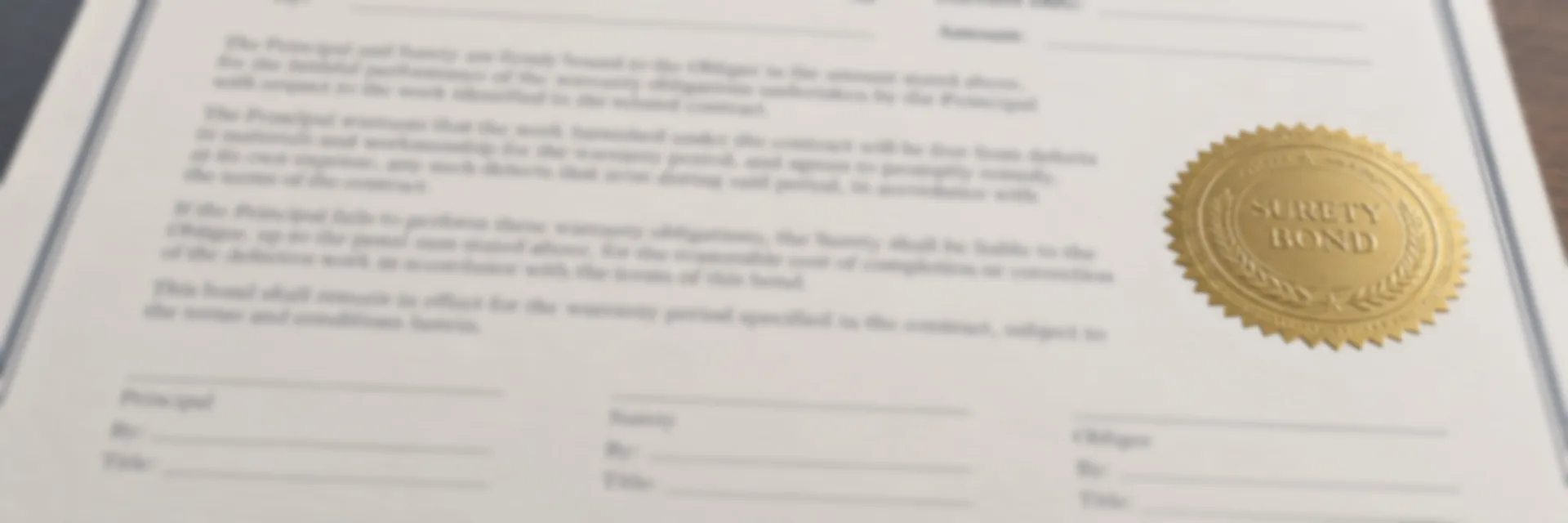
A warranty bond form on a leather desk pad with a gold surety seal, a newly built residential street behind it — warranty and maintenance bonds for completed construction work

California commercial insurance

Warranty & Maintenance Bond CA

Next Level Experience. Bonds Done Right.

844-97-USAVE

A warranty bond guarantees that a contractor will come back and correct defects that surface after the work is complete and accepted. It is a different obligation from the performance bond, it commonly starts at the moment that one ends, and the contract sets how long it runs.

  • Warranty & Maintenance Bonds
  • Post-Acceptance Defects
  • Capacity Release

Reviewed by David Gleason, Principal — October 11, 2026

CaliforniaGeneral information only, not legal advice — illustrative scenarios and coverage, subject to change without notice. Content may be out of date or contain errors, and requirements vary by city, county, state, agency, project, contract, carrier and policy, among other factors; verifying what applies to your own situation is your responsibility. Full disclaimer

Verified Google reviews

What contractors say about us

5.0 / 5from 7 Google reviews

Reviews reflect individual client experiences and are not a guarantee of coverage, pricing or results.

91 Enterprise LLC

91 Enterprise LLC

March 24, 2026

We are using Gleason insurance for our commercial auto policy and GL policy. David is the best insurance broker I've worked with — very honest, responsive, and knowledgeable. Highly recommend.

Fito Plumbers

Fito Plumbers

February 20, 2026

We have been working with David at Gleason Insurance Brokers for 8+ years. David always goes above and beyond to make sure we have the appropriate coverages. He explains everything in detail and makes sure we feel confident and understand all of our policies. He is always available and responds right away!

Barry Stay

Barry Stay

February 17, 2026

David provides great service and I highly recommend him for your insurance needs.

The bond that starts when the project is finished

A warranty bond guarantees that a contractor will come back and correct defects in workmanship or materials that surface after the work is complete and accepted.

Read more

The same instrument is called a maintenance bond or a guarantee bond depending on who drafted the contract — different names, one thing. It is distinct from a performance bond, which stands behind the construction itself and ends when the work is accepted.

That handover is the part worth understanding. Acceptance is commonly the event that releases the performance obligation and starts the warranty one, so a contractor who treats acceptance as the finish line can find a second bond required at exactly the moment the job is closing out. The duration is set by the contract; one to two years is the usual range and one year after acceptance is the most common term, though work with a public-safety dimension sometimes carries longer.

What the bond actually responds to is narrower than people expect. It covers defective workmanship and defective materials within the warranty period — not ordinary wear, not damage caused by someone else, and not a design the contractor built exactly as drawn. Where the line falls is a question of the contract documents and the specification, which is why reading the warranty clause matters more than assuming a standard.

Warranty, maintenance and guarantee bonds are three names for the same instrument
Begins at completion and acceptance — commonly the same event that releases the performance bond
One to two years is the usual range, with one year after acceptance the most common term
Responds to defective workmanship and materials, not to ordinary wear or another party's damage
Scope and duration come from the contract documents, not from a statewide standard

Who asks for one, and when it shows up

Three situations account for most warranty bond requirements.

Read more

Public agencies commonly require one on completed public works, sized as a percentage of the contract and running for a defined period after acceptance. Subdivision improvement agreements commonly require one on the improvements a developer builds and dedicates — the streets, the drainage, the utilities — starting when the jurisdiction accepts them. And private owners on larger commercial projects sometimes require one by contract, particularly where a building system carries a manufacturer warranty the owner wants backed.

In all three the requirement is written into a document that already exists before the work starts. It is rarely a surprise in the contract; it is frequently a surprise in the cash flow, because it lands when a contractor is demobilizing and moving capital to the next job.

A related trap is assuming the warranty bond and the contractor's own workmanship warranty are the same promise. The warranty in the contract is the contractor's obligation. The bond is a third party guaranteeing that obligation. The contractor still owes the work either way, and if the surety pays, the contractor repays the surety.

Public agencies, commonly on completed public works, sized by the contract
Subdivision improvement agreements, on the improvements accepted by the jurisdiction
Private owners on larger commercial projects, commonly by contract rather than by statute
The warranty is the contractor's obligation; the bond is a third party guaranteeing it

How a surety looks at it, and why it usually prices differently

A warranty bond commonly presents less risk to a surety than the performance bond that preceded it, for a straightforward reason: the hard part is over.

Read more

Labor and material availability, weather, subcontractor quality and estimating error have all already happened by the time the warranty period begins, and the work has been inspected and accepted. What remains is whether the completed work holds up.

That does not make it free of consequence. A warranty claim is still a paid claim on the contractor's surety record, and it affects later underwriting and bonding capacity the same way any other claim does. Sureties also look at the same fundamentals — financial statements, working capital, and the quality-control history that suggests whether callbacks are likely.

Where a warranty bond is issued alongside the performance and payment bonds at the start of a job, it is commonly handled as part of the same bond program rather than as a separate transaction later. Availability, amount and terms are subject to the surety's underwriting, and nothing here should be read as a commitment that a bond will be offered.

Commonly lower risk to the surety than the performance bond, because construction risk has already passed
A warranty claim is still a paid claim and affects later underwriting and capacity
Financial statements, working capital and quality-control history all carry weight
Often arranged with the performance and payment bonds rather than separately afterwards

Where contractors and developers get caught

The most common one is arithmetic: budgeting for the performance bond and not for the warranty bond that follows it.

Read more

The second is reading the duration as standard when the contract sets it — assuming one year where the document says two, or missing that a particular system carries a longer period than the rest of the work.

The third is a capacity problem rather than a cost one. A warranty bond that stays open after acceptance continues to occupy bonding capacity on a project that looks finished by every other measure. For a contractor or developer running consecutive phases, warranty obligations from earlier work can sit against the capacity needed to bond the next one, and the release rarely happens automatically — it usually has to be asked for once the warranty period has run.

The fourth is confusing the bond with insurance. A warranty bond does not pay the contractor to fix the work. It pays the owner if the contractor does not, and then the surety recovers from the contractor under the indemnity agreement. Coverage for damage a contractor's completed work causes to something else is a general liability question, and it is a different question with different answers.

Budgeting the performance bond and forgetting the warranty bond that follows it
Assuming a standard one-year term where the contract sets something else
Leaving capacity tied up because release was assumed rather than requested
Treating the bond as insurance — it pays the owner, and the surety recovers from the contractor

What to have ready

The fastest route to a warranty bond is usually the contract clause itself: the required amount, the period, what the warranty covers, and the date acceptance is expected.

Read more

Those four answers determine almost everything else.

Beyond that, a surety is working from the same file it uses for the rest of a bond program — current financial statements, a work-in-progress schedule, the contractor's license standing and the history of completed work. A contractor already bonded through an active program is commonly adding a bond rather than starting a relationship, which is faster.

Bond availability, amount and terms are subject to the surety's underwriting. The legal effect of a warranty clause — what it obliges, for how long, and how it interacts with statutory rights — is a matter for legal counsel rather than for a broker.

The contract's warranty clause: amount, period, scope and the expected acceptance date
Current financial statements and a work-in-progress schedule
License standing and the record of completed work
Adding a bond to an existing program is commonly faster than starting one

Release: when the bond comes off, and what to do when it does not

A warranty bond is written for a defined period, but it does not always come off the books the day that period ends.

Read more

Exoneration is generally an act of the obligee, not of the calendar: the agency, the owner or the jurisdiction has to acknowledge that the warranty term has run and that nothing is outstanding. Until the surety has something in writing, the bond commonly stays open on the contractor's record, and open bonds occupy bonding capacity that the next job needs.

The pattern we see most often is not a dispute. It is an inbox. On public works, the final acceptance and the warranty release are frequently handled by different people in different departments, and nobody downstream is tracking a date that matters only to the contractor. On a subdivision improvement agreement the release commonly waits on a council or board item, which is scheduled rather than automatic. Both are routine once somebody asks; neither tends to happen on its own.

Where there is a real dispute, it is usually about whether an item is a warranty item at all — a settlement crack, a pavement failure, a pump that was maintained differently than the specification assumed. That argument is between the contractor and the obligee first. A surety that pays before it is resolved will generally look to the indemnity agreement afterward, which is why getting the technical question answered early tends to matter more than the bond wording does.

Calendar the warranty expiry when the bond is issued, not when the project closes — the two dates are rarely the same
Ask for written exoneration rather than waiting for it; on a public job it is commonly an agenda item somebody has to raise
Keep the punch list sign-off, the acceptance notice and the maintenance records together — they are what answer a late warranty call
Tell the surety when a warranty claim is raised, early, even where you expect to resolve it directly with the owner
Open bonds that should have been released still count against capacity, which is usually discovered while quoting the next job

Frequently asked questions

10 questions — start typing to filter

Is a warranty bond the same as a maintenance bond?

Yes. Warranty bond, maintenance bond and guarantee bond are three names for the same instrument, and which one appears depends on who drafted the contract. All three cover defects in workmanship or materials that surface after the work is complete and accepted, for a period the contract defines.

How long does a warranty bond stay in place?

The contract sets it. One to two years is the usual range and one year after acceptance is the most common term, though work with a public-safety dimension sometimes carries longer. Because the period is set by the contract rather than by a statewide standard, it is worth reading rather than assuming.

Does the performance bond not already cover this?

No, and the two are deliberately separated. A performance bond stands behind the construction itself and commonly ends when the work is accepted. The warranty bond starts at that point and covers what happens to the completed work afterwards. Acceptance is frequently the single event that releases one and triggers the other.

What does a warranty bond actually pay for?

It responds to defective workmanship and defective materials within the warranty period. It is not a maintenance contract, so ordinary wear is generally outside it, and damage caused by another party or by a design the contractor built as drawn is usually a different question. Where the line falls is set by the contract documents and the specification.

We are a developer, not a contractor. Does this apply to us?

Commonly yes. Subdivision improvement agreements frequently require a warranty bond on the improvements a developer builds and dedicates — streets, drainage, utilities — beginning when the jurisdiction formally accepts them. That is the same event that releases the improvement bond, so the two obligations meet at one moment. See subdivision and development bonds.

Does a warranty bond tie up our bonding capacity?

It can. A bond that stays open after acceptance continues to occupy capacity on a project that appears finished by every other measure, and release is rarely automatic — it usually has to be requested once the period has run. For anyone bonding consecutive phases, tracking what is genuinely released protects the capacity needed for the next one.

Is this the same as construction defect insurance?

No. A bond pays the owner if the contractor does not correct the defect, and the surety then recovers from the contractor under the indemnity agreement — the contractor carries the cost either way. Insurance for damage that completed work causes to other property is a general liability question, with its own terms, conditions and exclusions. They are different instruments answering different questions.

When should we arrange it?

Ideally with the performance and payment bonds at the start of the job rather than as a separate transaction near closeout, because it is commonly handled as part of the same bond program and because it is easier to price when the whole job is in front of the surety. Leaving it to the week of acceptance is what turns it into a cash-flow problem.

What do you need from us to start?

The contract's warranty clause — amount, period, scope and the expected acceptance date — plus current financial statements, a work-in-progress schedule and license standing. A contractor already bonded through an active program is usually adding a bond rather than starting a relationship. You can start a quote or call 844-978-7283.

Can insurance and bonding be handled in the same place?

Yes. They are separate instruments placed with separate markets, but both can be handled with one agency, which usually matters most when a contract requires the bond, specific liability limits and certificates on the same timeline.

Official resources

Verify current licensing, regulatory and program requirements directly with the responsible agency — this is general information, not legal advice, requirements change without notice, and what is summarized here may be out of date or contain errors. Confirming what applies to your own city, project, contract and policy is your responsibility.

Updated October 11, 2026