Gleason Insurance Brokers

General Liability · Workers' Comp · Commercial Auto · Pollution Insurance · Surety Bonds Start a Business Insurance Quote Today

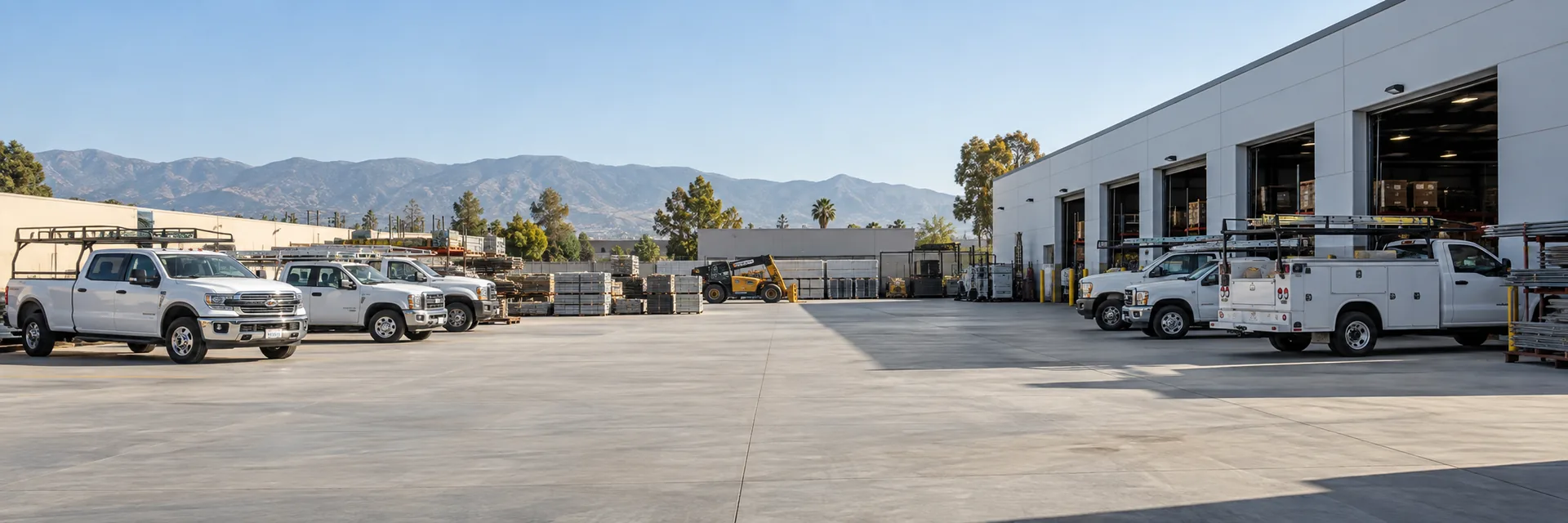
A contractor’s yard and shop with work trucks and stored materials — California contractor insurance — general liability, workers comp, commercial auto and bonds

California commercial insurance

Contractors Insurance California

844-97-USAVE

Every California contractor's insurance program is really several decisions stacked together — liability, workers compensation, bonding, vehicles, and whatever a specific contract requires on top of the baseline. Gleason Insurance Brokers builds that stack around the actual work you do, not a generic "contractor" label. Gleason Insurance Brokers is a local, independent California broker — not a single-carrier agent — built for fast, affordable quotes on real construction projects.

  • General Liability
  • Workers Compensation
  • Commercial Auto

Reviewed by David Gleason, Principal — October 12, 2026

Next Level Experience. Insurance Done Right.

CaliforniaGeneral information only, not legal advice — illustrative scenarios and coverage, subject to change without notice. Content may be out of date or contain errors, and requirements vary by city, county, state, agency, project, contract, carrier and policy, among other factors; verifying what applies to your own situation is your responsibility. Full disclaimer

Interactive coverage guide

Build a coverage stack around how the business actually operates.

Start with the preselected industry or trade, then adjust the operational questions. The commonly considered stack updates live. Keep the coverages you want GIB to evaluate, remove ones you do not want included in your quote request, and add other available lines before continuing.

Common Starting Coverages

General LiabilityThird-party injury and property damage

What it is

General Liability commonly addresses covered third-party bodily injury, property damage and certain personal or advertising injury claims, subject to the policy.

Why businesses like yours commonly carry it

Businesses commonly use it as a starting liability policy and to satisfy customer, landlord or contract requirements.

Possible coverage gap

General Liability is not intended to replace policies for employee injuries, business vehicles, owned property, cyber events or professional errors.

Learn more about General Liability

Commonly Added Based on Operations

Contractor Equipment / Inland MarineMobile tools, equipment and property away from premises

What it is

Inland Marine is commonly used for tools, equipment and certain mobile property that moves between locations or jobsites.

Why businesses like yours commonly carry it

Contractors frequently move tools, testing equipment and mobile machinery among jobsites.

Possible coverage gap

General Liability should not be assumed to insure the business's own tools and equipment against theft or physical damage.

Learn more about Contractor Equipment / Inland Marine
Cyber Liability & Data BreachCyber events, data and system interruption

What it is

Cyber insurance may address certain first-party and third-party losses from covered data breaches, cyberattacks, ransomware and system interruption, depending on the policy.

Why businesses like yours commonly carry it

Contractors commonly use email, electronic banking, project platforms, payroll systems and cloud document storage.

Possible coverage gap

General Liability generally should not be assumed to address data breach response, ransomware or network interruption.

Learn more about cyber insurance for contractors

Exposure-Dependent Coverages

Installation FloaterMaterials awaiting or undergoing installation

What it is

An Installation Floater may cover certain materials and equipment in transit, temporary storage and during installation, subject to the policy.

Why businesses like yours commonly carry it

Businesses responsible for materials before final installation commonly consider this coverage.

Possible coverage gap

A basic liability policy generally should not be assumed to cover the insured's materials against physical loss before installation is complete.

Learn more about Installation Floater
Builder's RiskProject property during construction

What it is

Builder's Risk may insure covered buildings, materials and certain project property while construction is underway.

Why businesses like yours commonly carry it

Owners, developers and contractors commonly consider it when a structure or major renovation is exposed during construction.

Possible coverage gap

Commercial Property and General Liability are not automatic substitutes for course-of-construction property coverage.

Learn more about Builder's Risk
Contractors Pollution LiabilityPollution conditions and cleanup liability

What it is

Pollution Liability may address covered cleanup costs and third-party injury or property damage arising from pollution conditions.

Why businesses like yours commonly carry it

Businesses working with fuels, chemicals, soil, water, demolition or environmental conditions may have pollution exposures.

Possible coverage gap

Standard General Liability commonly contains pollution exclusions or limitations.

Learn more about Contractors Pollution Liability
Umbrella / Excess LiabilityAdditional limits above scheduled liability policies

What it is

Umbrella or Excess Liability may provide additional limits above identified underlying liability policies, subject to its own terms and exclusions.

Why businesses like yours commonly carry it

Businesses with larger contracts, vehicles, public exposure or higher severity potential commonly consider additional limits.

Possible coverage gap

An umbrella does not automatically broaden every exclusion or sit over every policy unless the issued terms say it does.

Learn more about Umbrella / Excess Liability

Loading quote and requirements options…

Educational guidance only. Results are not a coverage recommendation, quote, binder, policy interpretation, or guarantee of coverage. Actual needs, availability, forms, limits, exclusions and requirements vary. A licensed insurance professional should review the complete risk and issued policy terms.

Verified Google reviews

What contractors say about us

5.0 / 5from 7 Google reviews

Reviews reflect individual client experiences and are not a guarantee of coverage, pricing or results.

91 Enterprise LLC

91 Enterprise LLC

March 24, 2026

We are using Gleason insurance for our commercial auto policy and GL policy. David is the best insurance broker I've worked with — very honest, responsive, and knowledgeable. Highly recommend.

Fito Plumbers

Fito Plumbers

February 20, 2026

We have been working with David at Gleason Insurance Brokers for 8+ years. David always goes above and beyond to make sure we have the appropriate coverages. He explains everything in detail and makes sure we feel confident and understand all of our policies. He is always available and responds right away!

Barry Stay

Barry Stay

February 17, 2026

David provides great service and I highly recommend him for your insurance needs.

Why "contractor insurance" isn't one policy

A CSLB license covers dozens of classifications, and the insurance program that fits a solo electrician looks nothing like the one a 40-person general contractor with a public works backlog needs.

Read more

Trade, revenue, payroll, subcontractor usage, project size, and claims history all push the right program in different directions before a single quote is requested.

The starting point isn't "what policy do I need" — it's "what am I actually exposed to." A framing crew and a solar installer both carry general liability, but the exclusions, classifications and completed-operations language that actually matter to each are different.

California's own small-job line is worth knowing before anyone leans on it. Under Business and Professions Code section 7048, as amended effective January 1, 2026, work falls outside contractor licensing only where the aggregate contract price for labor, materials and everything else comes to less than $1,000 and the job is casual, minor or inconsequential — and the exemption is gone the moment the work needs a building permit. It also does not apply where the job is part of a larger operation, where a bigger job is split into sub-$1,000 contracts, where the person advertises as a contractor, or where they employ anyone to do or help with the work. In practice almost any commercial job clears that line, so CSLB licensing, and the insurance that sits alongside it, is the starting point rather than the exception.

Classification-specific underwriting, not a one-size policy
Coverage sized to actual revenue, payroll and project size
Subcontractor usage factored into the program from the start
Built around the work performed, not the license category alone
CSLB exemption stops at $1,000 — and does not apply to permitted work

The core lines most CA contractors carry

General liability is the foundation for almost every contractor — third-party bodily injury and property damage arising from the work.

Read more

Workers compensation follows once there's a single employee, and for certain CSLB classifications, it's required even without one. A CSLB license bond is required to hold an active license, separate from either.

Beyond that baseline, commercial auto (for anything driven for work), builders risk (for ground-up or major renovation work), and umbrella liability (for higher project-size exposure) round out what most established contractors carry — not every business needs every line, but most need more than one.

For a closer look at how these lines actually stack, and in what order most contractors add them as the business grows, see our guide to the six coverage lines most California contractors carry.

General liability — where a third-party claim is answered first
Workers compensation — required once there's an employee
CSLB license bond — required to hold an active license
As operations grow: commercial auto, builders risk and umbrella

What actually drives your premium

Classification and payroll drive workers compensation pricing more than almost anything else — a misclassified employee can distort premium significantly in either direction.

Read more

For general liability, revenue and subcontractor cost are the typical rating basis, with residential versus commercial work and new construction versus repair changing eligibility on some programs entirely.

Loss history matters, but so does how it's presented — a well-documented explanation of a prior claim, including what changed afterward, gives an underwriter something to work with instead of just a number on a loss run.

Classification accuracy affects workers comp pricing directly
Revenue and subcontractor cost drive GL rating
Residential vs. commercial work can change eligibility
Documented loss history beats a bare loss-run number

Contracts drive requirements more than the policy alone

Most California contractors don't set their own insurance requirements — the general contractor, project owner, lender or public agency does, through the contract.

Read more

Additional insured status, waiver of subrogation, primary and noncontributory wording, and specific limits are all things a contract can require that a standard policy doesn't automatically include.

Reading the actual insurance requirements section of a contract — not just the certificate request — before binding a policy is what keeps a certificate from being rejected mid-project, which is one of the more common and avoidable delays contractors run into.

Additional insured status is contract-driven, not automatic
Waiver of subrogation and primary/noncontributory are separate endorsements
Read the contract's insurance section, not just the certificate request
Confirm requirements before binding, not after a certificate is rejected

A realistic scenario: one project, four coverage lines

A framing subcontractor is midway through a two-story residential build when a worker falls from scaffolding and is injured, a delivery truck backs into a neighbor's fence while unloading lumber, and the GC's insurance requirement letter arrives asking for a $2M umbrella the contractor doesn't currently carry.

Read more

None of these are hypothetical edge cases — they're the ordinary mix of exposure a mid-size CA contractor carries on a single active job.

Workers compensation responds to the injury, general liability responds to the fence, commercial auto responds to the delivery vehicle, and the umbrella — if it's in place before the GC's deadline — extends the liability limit high enough to satisfy the contract. A program built one policy at a time, reactively, is how a contractor discovers a gap during the one week it actually matters.

Illustrative only — this describes a typical pattern, not an actual claim or a guaranteed outcome. Coverage determinations depend on the specific policy and facts involved; for a real, case-specific question, consult a licensed attorney or the appropriate authority having jurisdiction.

One active project can trigger three or four coverage lines at once
Reactive, one-policy-at-a-time buying is how gaps get discovered mid-claim
Contract-driven requirements (like a GC's umbrella ask) often arrive with a hard deadline
A coordinated program is planned before the letter arrives, not after

How the core lines actually work together

General liability and workers compensation cover two different categories of harm — third-party claims versus your own employees — and neither substitutes for the other, even though both can trigger on the same incident.

Read more

Commercial auto and builders risk are project- and vehicle-specific, layered on top of the baseline rather than replacing it.

The umbrella policy is what ties the stack together at higher limits once a contract demands more than any single underlying policy provides on its own — it's not a standalone product, it only works in coordination with what's underneath it. Reviewing all of these together, once a year and any time operations change materially, is what keeps the stack from developing a silent gap between policies.

GL and workers comp cover different categories of harm, not interchangeable
Auto and builders risk are project/vehicle-specific layers on the baseline
Umbrella only works in coordination with the policies underneath it
Review the full stack annually and whenever operations change

Working with Gleason Insurance Brokers

We're construction and transportation focused — that's where our deepest market relationships and underwriting experience are, across general and specialty trades throughout California and into Arizona, Nevada, Texas and Utah.

Read more

The same disciplined process also supports developers, restaurants and breweries.

A submission that explains the actual operations, the contract or lender requirement driving the request, and the real deadline moves faster through underwriting than one that just names a product. That's the conversation we'd rather start with.

Construction and transportation focused, five-state licensed
Direct broker access, not a call center
Contract and endorsement review before binding
Start with the operations and deadline, not just a product name
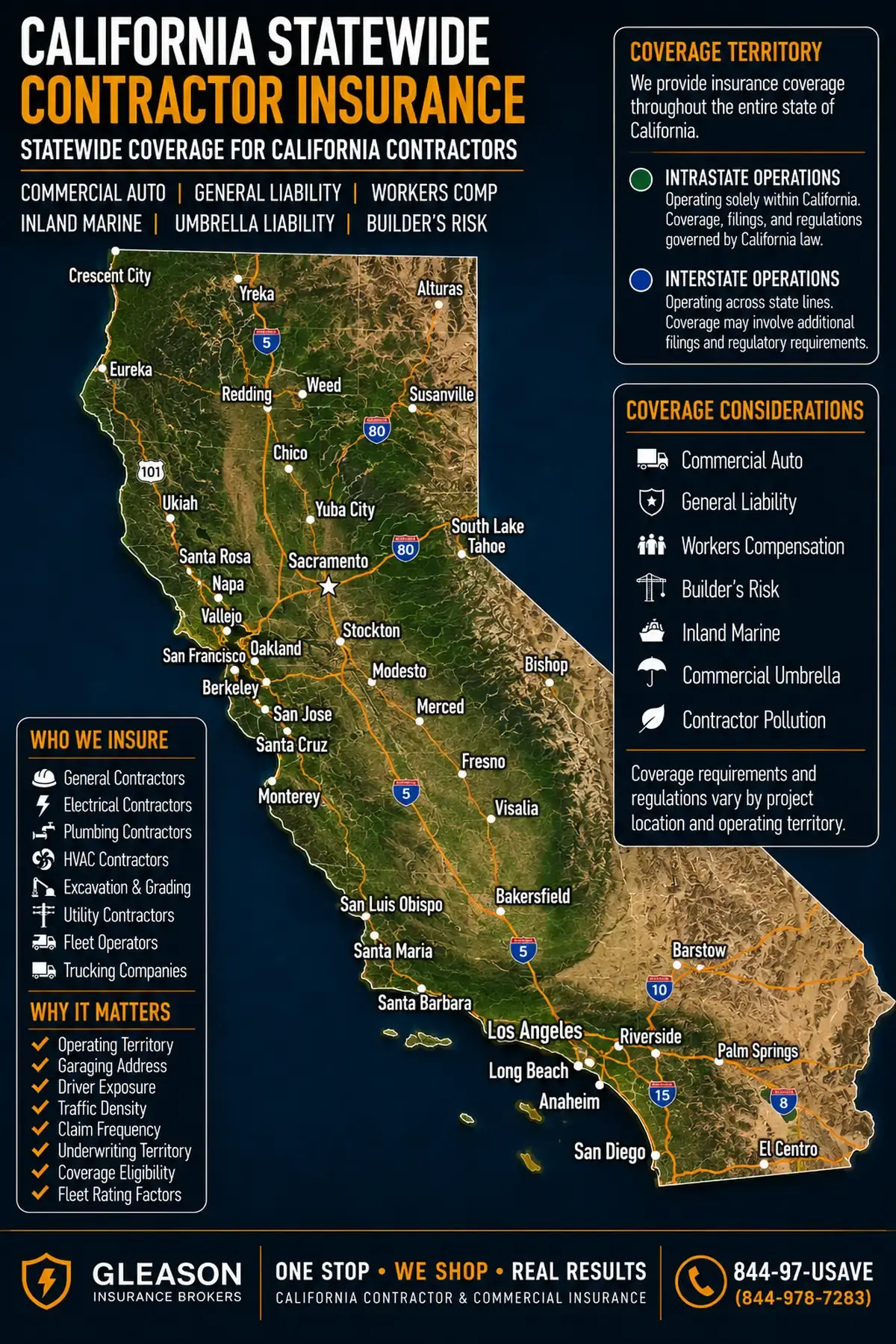
California statewide contractor insurance coverage map showing intrastate and interstate operations from Sacramento to San Diego — Gleason Insurance Brokers

One Stop · We Shop · Real Results

844-978-7283
  • General contractors
  • Electrical contractors
  • Plumbing contractors
  • HVAC contractors
  • Excavation and grading
  • Utility contractors
  • Fleet operators
  • Trucking companies
  • Operating territory
  • Garaging address
  • Driver exposure
  • Traffic density
  • Claim frequency
  • Underwriting territory
  • Coverage eligibility
  • Fleet rating factors
  • Commercial auto
  • General liability
  • Workers compensation
  • Builders risk
  • Inland marine
  • Commercial umbrella
  • Contractor pollution

Radius, territory, vehicle use, jobsite locations and garaging ZIP code can all influence commercial insurance pricing and underwriting eligibility. The zones shown describe how far this agency places coverage; they are not a statement of what any policy covers.

Built around the trades we work with every day

"Contractor insurance" means something different depending on who's asking.

Read more

A developer or subdivider buying land and managing a build-out needs an owner's program, not a trade contractor's policy. A commercial general contractor running multiple crews needs limits and endorsements that satisfy GC-level contracts and public works insurance requirements. A contractor who subcontracts 100% of the work needs a program built around managing sub compliance, not field crews. A residential contractor needs coverage sized to smaller jobs without paying for exposures they don't have. And paving and grading contractors carry underground and completed-operations exposure that a generic policy often prices wrong in both directions.

We built this site around those distinctions instead of a one-size-fits-all page because the coverage actually is different. A sand-and-gravel operation running a dump truck fleet has more in common, insurance-wise, with a transportation company than with a framing crew — see our dedicated dump truck insurance coverage. Getting matched to the right program from the start avoids both the overpriced generic policy and the underinsured one that looks cheap until a claim or an audit finds the gap.

A work truck registered to the business personally isn't automatically covered for business use under a personal auto policy — see why a work truck usually needs both reviewed rather than assumed.

Developers and subdividers — owner-side programs, not trade contractor policies
Commercial GCs and 100%-subcontracting GCs — sub compliance and limits built in
Paving, grading and excavation — underground and completed-operations exposure priced correctly
Sand and gravel dump truck fleets — coverage that matches a transportation-style risk profile
Roofing (C-39) and HVAC/mechanical/refrigeration (C-20) carry their own dedicated coverage guides — see Roofing Contractor Insurance California and HVAC / Mechanical / Refrigeration Contractor Insurance California

Programs that scale as the business grows

The insurance program that works for a five-truck, single-crew operation isn't the same one that should still be in place once that same contractor is running a fleet past five trucks and pushing toward $3 million or more in annual revenue.

Read more

Growth changes the underwriting picture — more payroll and vehicle exposure to manage, tighter GC and public agency contract requirements, and a bonding program that needs bonding capacity to keep pace with larger bids, not just a bond that was adequate for smaller jobs.

This is where a lot of established, growing contractors get stuck with a program they've outgrown without realizing it — because nothing broke yet. Our underwriting readiness guide walks through exactly what changes as a contractor scales, and our pre-project checklist is built for confirming a program still fits before it's tested by a claim or a contract review.

If that's where you are, our dedicated page for growing California contractors walks through exactly what changes in the program at that stage.

Fleet growth past 5 trucks changes commercial auto and umbrella exposure calculations
Revenue growth toward $3M+ typically requires a bonding capacity review, not just a renewal
GC and public agency contracts tighten as project size grows — limits need to keep pace
A program that fit at a smaller scale can silently become inadequate without a formal review

Public works, highway and government-project coverage across new and existing construction

California public works work spans new construction and renovation of existing public facilities alike, and each carries a different coverage emphasis.

Read more

New construction public works — a new school, a new municipal building, a new highway segment — centers on builders risk, general liability with the correct additional insured endorsement, and bonding sized to the contract amount. Renovation or retrofit work on an existing public facility adds occupied-building liability exposure and, on older buildings, real hazardous materials considerations (asbestos, lead) that a ground-up project wouldn't encounter.

Highway work specifically — Caltrans and large regional transportation agency contracts — layers traffic-adjacent liability severity and elevated umbrella/excess requirements on top of standard public works compliance (DIR registration, prevailing wage, certified payroll). Confirm which category a specific project actually falls into before assuming standard commercial coverage terms apply.

Confirming which category a specific project falls into means looking past the awarding agency alone — project size and your specific trade both shape the actual requirement. The only reliable way to know what a given public works project requires is to read the insurance and bonding pages from the actual contract documents or bid proposal, not to assume based on the procurement process looking familiar.

New construction public works: builders risk, GL with the correct AI endorsement, contract-sized bonding
Renovation/retrofit of existing public facilities: occupied-building liability plus possible hazmat exposure
Highway/Caltrans work: elevated umbrella/excess requirements on top of standard public works compliance
Confirm the project category before assuming standard commercial coverage terms apply

Insurance agency, agent, or broker: what the difference actually means for a contractor

These terms get used interchangeably in everyday search and conversation, but they describe genuinely different relationships, and the difference affects whose interest is actually being represented.

Read more

An insurance agent typically represents one insurance company (or a small, fixed set of them) and sells that company's own policies. A California contractors insurance broker, by contrast, represents the client — shopping coverage across multiple carriers to find the fit and pricing that actually matches the contractor's specific trade, project mix and risk profile, rather than being limited to one company's underwriting appetite and product lineup.

Gleason Insurance Brokers operates as an independent California contractors insurance broker, not a captive agent tied to a single carrier — licensed in California, Arizona, Nevada, Texas and Utah (CA Lic. 0K70385). "Insurance agency" is often used as a general umbrella term for any business that places insurance, whether structured as a broker or an agent relationship — worth confirming which one you're actually working with, since it affects whether the firm is shopping the market on your behalf or representing one insurer's interests.

What this means practically for a contractor comparing options: a broker relationship generally means more carrier options considered for your specific trade and project types, rather than being fit into whatever one company happens to offer. Ask directly whether a prospective firm is a broker or a captive agent before assuming either — it's a fair, reasonable question, and the answer should be given plainly.

That's the practical reason the broker relationship matters: we work to bring each contractor competitive options from the carriers available to us for their trade, and a program structure built around their actual exposures — drawing on multiple carrier relationships rather than one company's fixed product line.

Insurance agent: typically represents one carrier and sells that carrier's own policies
Insurance broker: represents the client, shopping coverage across multiple carriers
"Insurance agency" is often used as a general umbrella term for either relationship — confirm which one applies
Gleason Insurance Brokers is an independent California contractors insurance broker, not a captive agent

Why how your risk is presented to underwriters matters

The same business can get very different underwriting results depending on how it's submitted.

Read more

A submission that's a few ACORD forms, a raw loss run, and a one-line description — "general contractor, $8M in sales" — leaves an underwriter to guess at your subcontractor controls, driver management, safety program, project mix, maximum job size, and why a prior loss isn't likely to repeat. Underwriters price uncertainty, and an incomplete submission is where that uncertainty comes from.

We build the fuller picture before it goes to a carrier — the actual operations, subcontractor and safety controls, claims history with context on what changed afterward, and the specific reason coverage is needed now — so each market gets a complete risk story instead of an application dump. That's also why we're built around serious, established operations rather than open-ended coverage shopping: the fastest and most accurate results come from a real submission with a real deadline.

For coverage that spans beyond construction specifically, see our Business Insurance for California Companies and Cyber Liability for Construction Businesses pages, and for a plain-language rundown of what most California contractors actually carry, see The Six Coverage Lines CA Contractors Carry. Contractors in specific LA-area communities can also find pages built for their own local exposures, including Compton Contractors Insurance, Palmdale Contractors Insurance, West Covina Contractors Insurance and Whittier Contractors Insurance. To see every metro and submarket we cover in one place, browse the California Contractor Insurance Coverage Map. For a quick, no-obligation read on how insurance-ready a specific business actually is, try the Underwriting Readiness Tool.

The lines above are the ones most contractors deal with first. They are not the whole list — every commercial line this brokerage places is indexed in one place, including the specialty and management liability coverage that tends to come up later.

An incomplete submission reads as uncertainty to an underwriter, not a data gap
Operations, controls, claims context and project mix all belong in the submission
A documented explanation of a prior loss outperforms a bare loss-run number
Built around real operations and real deadlines, not open-ended shopping

Frequently asked questions

16 questions — start typing to filter

Are all insurance carriers basically the same?

No — insurance companies differ substantially in contractor appetite, acceptable trades, revenue limitations, project-size limitations, residential versus commercial construction, new construction appetite, claims tolerance, fleet appetite, coverage forms, exclusions, endorsements, financial ratings, pricing, approval processes and turnaround times.

Why does time in business matter to an insurance carrier?

Established businesses can provide underwriters with historical information such as revenue, payroll, claims, completed projects, insurance history and management experience. New businesses can still obtain coverage, but the owners' prior industry experience becomes especially important.

Why does my revenue matter to an insurance company?

Revenue can help indicate the size and scope of the operation — higher revenue can mean larger projects, more work, more employees or subcontractors and potentially greater exposure. Revenue is only one underwriting factor, though.

Why do insurance carriers ask so many questions about my operations?

The underwriter needs to understand what is actually being insured — two companies that both call themselves "general contractors" may perform completely different work. Accurate information helps match the contractor with insurance programs designed for the actual exposure.

Why should I start looking for insurance before my renewal or project deadline?

More time generally creates more opportunity to gather complete underwriting information, obtain current loss runs, approach appropriate insurance companies, review competing options, address coverage concerns, negotiate where possible, obtain required endorsements, and meet project deadlines. Complex risks, high-hazard operations, large-revenue contractors, previous claims and project-specific placements can require significantly more time than a straightforward small-business policy.

Aren't all $1 million/$2 million general liability policies basically the same?

No — the limit is only one number on the page. Two GL policies with identical $1M/$2M limits can differ substantially in what's actually excluded, from residential construction and roofing restrictions to how completed operations and additional insured coverage are handled. See the General Liability Insurance page for the full breakdown of what actually varies between policies.

Are we always the cheapest option for commercial insurance?

Absolutely not — and we do not believe the lowest price should be the only factor when choosing commercial insurance. Our goal is to provide professional advice, responsive service and access to insurance options that fit the actual needs of your business; coverage, exclusions, endorsements, carrier quality, claims handling, financial strength, contract requirements and long-term service can all be just as important as premium. We believe in honesty, integrity and respecting both your time and ours, and we work best with business owners who value professional service, clear communication and an insurance relationship built around getting the coverage structured properly — not simply finding the cheapest policy available. We do our best, work hard and work tirelessly with carrier underwriters to obtain competitive premiums from the carriers available to us. While we cannot guarantee that we will always be the lowest-priced option, we are committed to being competitive and providing meaningful value through our experience, market access, professional service and straightforward communication. Our priority is helping clients understand what they are purchasing and making sure price is considered alongside the coverage and protection their business actually needs.

What insurance does a California developer or subdivider need that a typical general contractor doesn't?

A developer or subdivider is usually buying coverage as the project owner rather than as a trade contractor, which typically means an owner-controlled program, subdivision and improvement bonds tied to the local jurisdiction's agreement, and builders risk structured around a multi-lot or phased timeline — different in structure from a GC's own trade coverage, even on the same project. See our dedicated developer and subdivider coverage for the specifics.

Do sand and gravel or dump truck operations need different insurance than other contractors?

Generally yes — a dump truck or sand-and-gravel operation carries a fleet and transportation-style exposure profile that looks more like a trucking company's insurance needs than a typical trade contractor's, particularly around commercial auto, physical damage scheduling and driver classification for workers compensation. This becomes more pronounced as the fleet grows past a handful of trucks.

How do I get an affordable, fast contractors insurance quote from a local broker in California?

Gleason Insurance Brokers is a California-licensed broker, not a single-carrier agent, so contractors insurance in California can be shopped across multiple markets rather than one company's terms. Actual turnaround and pricing depend on submission completeness, the scope of your construction projects, and carrier appetite — share your timeline and budget when requesting a quote so a local broker can prioritize accordingly.

What's the difference between a contractors insurance agent, agency and broker?

An insurance agent typically represents one insurance company and sells that company's own policies. An insurance broker represents the client, shopping coverage across multiple carriers to find the best fit for the contractor's specific trade and risk profile. "Insurance agency" is often used as a general umbrella term for either relationship — ask directly which one a prospective firm actually is before assuming.

How do I choose a California contractors insurance broker for my trade?

Look for a broker (not a captive agent limited to one carrier) with real experience placing coverage for your specific trade, direct relationships with multiple carriers who actually write that trade, and someone willing to explain exclusions and requirements plainly rather than just quoting a price. Start today by describing your actual trade, project types and current coverage to compare real options.

Is Gleason Insurance Brokers a construction insurance agency, agent or broker?

Gleason Insurance Brokers is an independent broker, not a captive agent tied to a single insurance company — we shop coverage across multiple carriers on your behalf rather than being limited to one company's underwriting appetite. Licensed in California, Arizona, Nevada, Texas and Utah.

What makes a submission move faster through underwriting?

A submission that explains actual operations, subcontractor and safety controls, the real deadline, and context behind any prior claim moves faster and prices more accurately than one that only lists a product and a revenue number. That's the information we gather before a risk goes to a carrier.

How do I get a general contractor insurance quote in California?

Share your actual operations — trade, project mix, payroll, and any specific contract requirements — and we'll put together a quote built around real exposure rather than a generic template. Most California general contractors need general liability, workers compensation and bonding at minimum, with commercial auto and builders risk added as the work requires them.

Is there contractor insurance near me if I'm outside a major metro area?

Yes — we place coverage for California contractors statewide, not just in the largest metro areas. If your city doesn't have its own dedicated page yet, that's a gap in our page coverage, not our actual coverage area; call 844-978-7283 or request a quote and we'll confirm your specific location.

Official resources

Verify current licensing, regulatory and program requirements directly with the responsible agency — this is general information, not legal advice, requirements change without notice, and what is summarized here may be out of date or contain errors. Confirming what applies to your own city, project, contract and policy is your responsibility.

Explore Related Coverage and Contractor Resources

Related coverage
Guides, trades and resources

Updated October 12, 2026