

What this resource center covers
Each guide below covers a distinct stage or category: getting your first submission together, surviving public works compliance, technical and regulatory reference material, and running operations in a way that keeps claims — and premium — down. None of it replaces the actual policy or a conversation with a broker; it's the background that makes that conversation faster.
If you already know what you need, the fastest path is usually the specific coverage page for that line, not this hub. Come here when the question is broader than one policy — "what do I need before I bid this job" or "why did my audit come back higher than expected."
Browse the full, categorized list — including 3 newer guides covering equipment rental, architecture/engineering and material supplier risk — in the Resource Guide Directory, searchable by keyword or voice.
Two interactive tools work together, and you can start with either one: Build Your Business Coverage Stack to see coverages commonly considered for businesses with similar operations, or Upload Insurance Requirements for Review to identify what a project, customer, vendor, landlord, lender, lease or contract document appears to request.
Start here if you're new to contractor insurance
The Getting Started — Pre-Project Checklist guide is built for exactly this: a first-time submission, a new business, or a contractor switching brokers who wants to know what to have ready before the first call. It walks through documentation, not just definitions.
Pair it with the Insurance Underwriting Readiness Guide if the goal is a faster, cleaner quote — that guide covers what actually slows an underwriter down and how to avoid it on the first submission instead of the second.
Bidding public works or a bonded project
Public works projects run on a different set of rules than private commercial work — prevailing wage, DIR registration, certified payroll, and bonding requirements that vary by awarding body. The Public Works Survival Guide and the Bonding & Surety Guide cover this ground directly.
Read both before bidding, not after award — several of the compliance steps (DIR registration in particular) have lead time, and a missed step can affect bid eligibility, not just paperwork.
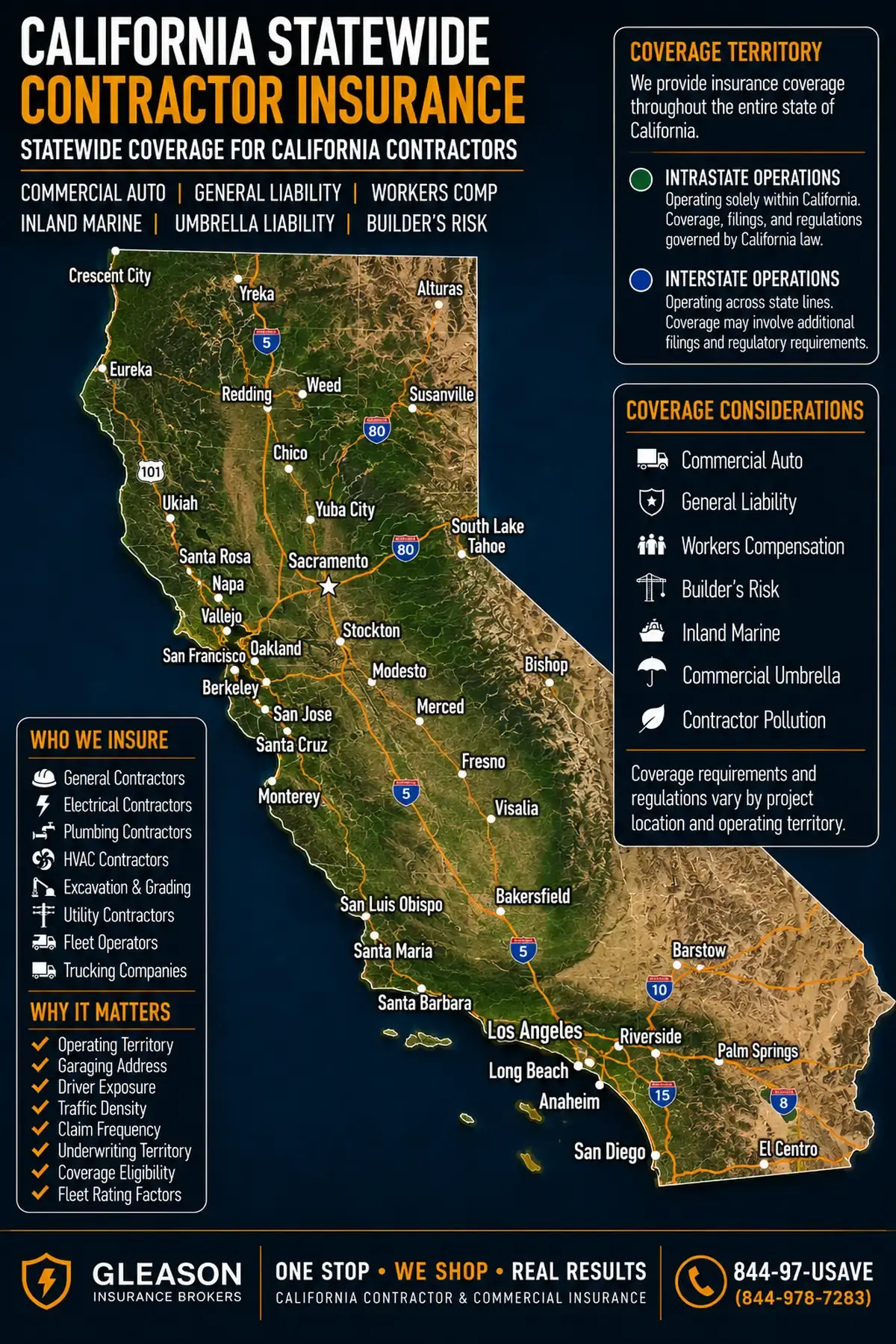
One Stop · We Shop · Real Results
844-978-7283- General contractors
- Electrical contractors
- Plumbing contractors
- HVAC contractors
- Excavation and grading
- Utility contractors
- Fleet operators
- Trucking companies
- Operating territory
- Garaging address
- Driver exposure
- Traffic density
- Claim frequency
- Underwriting territory
- Coverage eligibility
- Fleet rating factors
- Commercial auto
- General liability
- Workers compensation
- Builders risk
- Inland marine
- Commercial umbrella
- Contractor pollution
Radius, territory, vehicle use, jobsite locations and garaging ZIP code can all influence commercial insurance pricing and underwriting eligibility. The zones shown describe how far this agency places coverage; they are not a statement of what any policy covers.
Sources for this section
- California Department of Industrial Relations (DIR)Verified 2026-08-22
Technical reference and day-to-day operations
The Construction Insurance Lines Overview and Construction Technical Resource Guide guides are reference material — licensing classifications, code and permitting basics, safety requirements, and where to verify a technical detail directly with the regulator instead of a secondary source.
The Contractor Operations & Project Success and Utility Coordination & Strike Prevention guides are more operational — how the way a business runs day to day affects claims, audits and renewal pricing, and how to coordinate around underground utilities before digging starts.
Safety, licensing and back-office operations
Coverage is only part of running a compliant, insurable contracting business. Several newer guides cover the operational side that commonly comes up in underwriting and regulatory review: Cal/OSHA safety compliance, CSLB licensing compliance, project controls, estimating and preconstruction discipline, and fleet/DOT compliance.
These aren't insurance products to buy — they're the operational practices that directly affect what coverage costs, what terms are available, and how a claim gets handled when one happens.
Still have a specific question
The California Contractor Insurance FAQ answers specific questions pulled directly from real client conversations — loss runs, endorsements, X-Mods, USDOT compliance, builders risk, and more, organized so you can jump straight to the topic that applies.
For anything the library doesn't answer, the fastest path is a direct call — 844-978-7283 — or the quote form with a note on what's being asked. A broker can usually answer a specific question faster than searching for it.
Businesses whose insurance needs extend beyond construction-specific coverage should also see our Business Insurance for California Companies page. To see every metro and submarket Gleason Insurance Brokers covers across California in one place, browse the California contractor insurance coverage map.
Frequently asked questions
10 questions — start typing to filter
Is this resource center legal or regulatory advice?
No. It's general educational information reviewed against official sources. Licensing, bonding and regulatory requirements should always be verified directly with the applicable agency for your specific situation.
How often is this content updated?
Regulatory content is checked against official sources on an ongoing basis, with a target of re-verifying any cited figure or requirement at least every six months since agencies change names, URLs and requirements without much notice.
Can I request a topic that isn't covered yet?
Yes — call 844-978-7283 or use the quote form and mention the topic. Recurring client questions are the main source of new guides and blog posts.
Where do I start if I've never carried contractor insurance before?
Start with the Getting Started — Pre-Project Checklist guide, then the Insurance Underwriting Readiness Guide if you're preparing to request a quote soon.
Where do I start if I'm bidding a public works project?
Start with the Public Works Survival Guide, then the Bonding & Surety Guide before finalizing a bid — several compliance steps have lead time.
Does reading this library replace talking to a broker?
No. It's meant to make that conversation faster and more useful by getting the basic questions answered ahead of time, not to replace the review a specific account actually needs.
How do I get a specific question answered quickly?
The California Contractor Insurance FAQ covers specific questions by topic. For anything not covered, call 844-978-7283 directly.
Do these guides cover Arizona, Nevada, Texas and Utah too, or just California?
This resource center is California-specific. Arizona, Nevada, Texas and Utah contractors should start with their state's pillar page and the line-of-business quote pages for that state — licensing bodies, bond amounts and contractor classifications differ by state and aren't interchangeable with California's rules.
How is this different from the California Contractor Insurance FAQ?
This resource center groups content by process stage — getting started, bidding public works, technical reference — in longer guide-format pages. The FAQ library answers specific, narrower questions in a searchable Q&A format. Use whichever matches how you're looking for the answer.
Can I print or save one of these guides for reference?
Yes — each guide is a standard web page you can print or save as a PDF directly from your browser. There's no separate downloadable version at this time.