Gleason Insurance Brokers

Restaurant & Brewery Insurance · Liquor Liability · General Liability · Workers' Comp Start a Business Insurance Quote Today

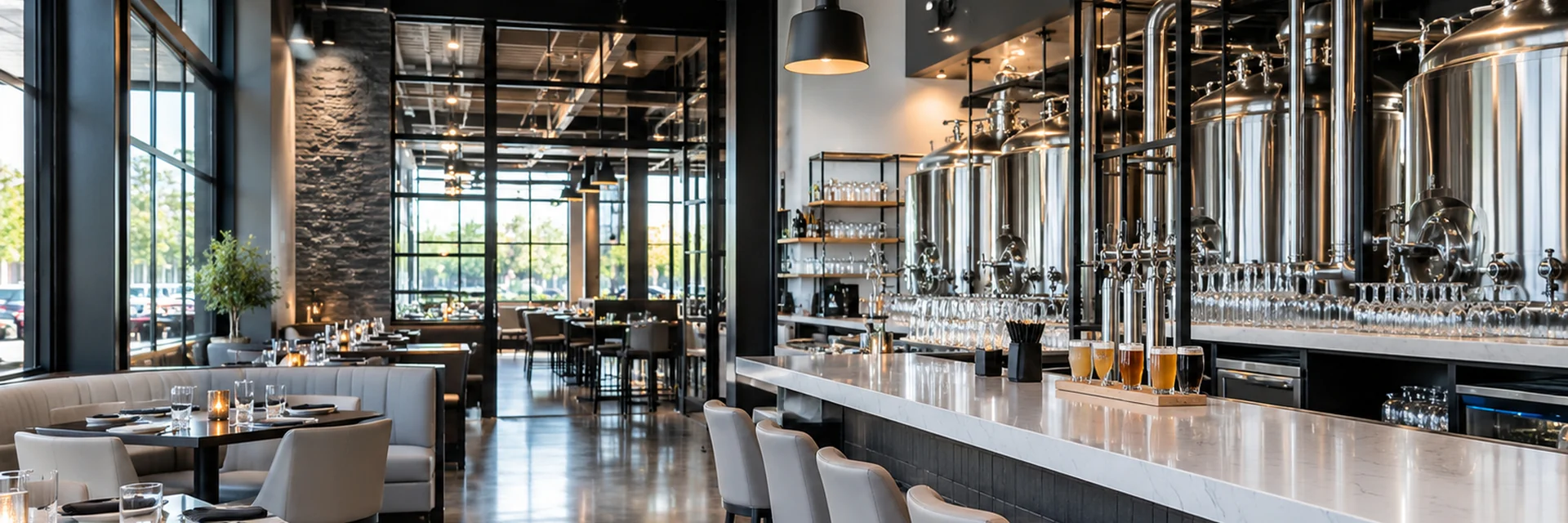
A restaurant and brewery dining room with a marble bar, beer taps and stainless brewing tanks behind it — restaurant and brewery insurance for California

California commercial insurance

Restaurants & Breweries Insurance — California

844-97-USAVE

Restaurants and breweries carry a genuinely different risk profile than a typical commercial tenant — alcohol service liability, kitchen fire and injury exposure, and food-related claims all layer on top of standard business coverage. This is a focus area for us, not our core specialty, and we're direct about that distinction.

  • Liquor Liability
  • Kitchen Fire Exposure
  • General Liability & Property

Reviewed by David Gleason, Principal — October 11, 2026

Next Level Experience. Insurance Done Right.

CaliforniaGeneral information only, not legal advice — illustrative scenarios and coverage, subject to change without notice. Content may be out of date or contain errors, and requirements vary by city, county, state, agency, project, contract, carrier and policy, among other factors; verifying what applies to your own situation is your responsibility. Full disclaimer

Interactive coverage guide

Build a coverage stack around how the business actually operates.

Start with the preselected industry or trade, then adjust the operational questions. The commonly considered stack updates live. Keep the coverages you want GIB to evaluate, remove ones you do not want included in your quote request, and add other available lines before continuing.

Common Starting Coverages

General LiabilityThird-party injury and property damage

What it is

General Liability commonly addresses covered third-party bodily injury, property damage and certain personal or advertising injury claims, subject to the policy.

Why businesses like yours commonly carry it

Businesses commonly use it as a starting liability policy and to satisfy customer, landlord or contract requirements.

Possible coverage gap

General Liability is not intended to replace policies for employee injuries, business vehicles, owned property, cyber events or professional errors.

Learn more about General Liability
Business Owners Policy / Commercial PackageLiability and property components evaluated together

What it is

A Business Owners Policy commonly combines liability and property coverages for eligible businesses. A Commercial Package Policy may combine multiple commercial coverage parts depending on the account and carrier.

Why businesses like yours commonly carry it

Businesses with premises, contents, inventory or other property exposures may ask GIB to evaluate whether liability and property components can be packaged where appropriate.

Possible coverage gap

Eligibility, included coverages and package structure vary by carrier. Commercial Property may also be written separately rather than as part of a package.

Learn more about Business Owners Policy / Commercial Package

Commonly Added Based on Operations

Equipment BreakdownMechanical, electrical and pressure-system breakdown

What it is

Equipment Breakdown may address certain sudden mechanical, electrical or pressure-system breakdown losses, subject to the policy.

Why businesses like yours commonly carry it

Businesses dependent on refrigeration, production, HVAC, electrical or other critical equipment commonly consider it.

Possible coverage gap

Standard property forms may not address every internal mechanical or electrical breakdown.

Learn more about Equipment Breakdown
Cyber Liability & Data BreachCyber events, data and system interruption

What it is

Cyber insurance may address certain first-party and third-party losses from covered data breaches, cyberattacks, ransomware and system interruption, depending on the policy.

Why businesses like yours commonly carry it

Restaurants increasingly rely on POS systems, payment processing, online ordering, employee information and vendor platforms.

Possible coverage gap

General Liability generally should not be assumed to address data breach response, ransomware or network interruption.

Learn more about cyber insurance for restaurants and breweries

Exposure-Dependent Coverages

Liquor LiabilityLiability connected with serving or selling alcohol

What it is

Liquor Liability may address covered claims arising from the sale or service of alcohol, subject to policy terms.

Why businesses like yours commonly carry it

Restaurants, bars, breweries and event operations that sell or serve alcohol commonly consider separate liquor liability coverage.

Possible coverage gap

General Liability commonly limits or excludes liquor liability for businesses in the business of selling or serving alcohol.

Learn more about Liquor Liability
Umbrella / Excess LiabilityAdditional limits above scheduled liability policies

What it is

Umbrella or Excess Liability may provide additional limits above identified underlying liability policies, subject to its own terms and exclusions.

Why businesses like yours commonly carry it

Businesses with larger contracts, vehicles, public exposure or higher severity potential commonly consider additional limits.

Possible coverage gap

An umbrella does not automatically broaden every exclusion or sit over every policy unless the issued terms say it does.

Learn more about Umbrella / Excess Liability

Loading quote and requirements options…

Educational guidance only. Results are not a coverage recommendation, quote, binder, policy interpretation, or guarantee of coverage. Actual needs, availability, forms, limits, exclusions and requirements vary. A licensed insurance professional should review the complete risk and issued policy terms.

Verified Google reviews

What restaurant and brewery owners say about us

5.0 / 5from 7 Google reviews

Reviews reflect individual client experiences and are not a guarantee of coverage, pricing or results.

91 Enterprise LLC

91 Enterprise LLC

March 24, 2026

We are using Gleason insurance for our commercial auto policy and GL policy. David is the best insurance broker I've worked with — very honest, responsive, and knowledgeable. Highly recommend.

Fito Plumbers

Fito Plumbers

February 20, 2026

We have been working with David at Gleason Insurance Brokers for 8+ years. David always goes above and beyond to make sure we have the appropriate coverages. He explains everything in detail and makes sure we feel confident and understand all of our policies. He is always available and responds right away!

Barry Stay

Barry Stay

February 17, 2026

David provides great service and I highly recommend him for your insurance needs.

Why restaurants and breweries need industry-specific coverage

Serving alcohol creates an exposure general liability is not built for: most general liability policies exclude claims connected to the sale or service of alcohol, which typically leaves neither coverage nor a defense for one.

Read more

California's own civil-liability rules in this area carry important limitations and exceptions, so what applies to your operation is a question for your own counsel — the coverage question is separate and more immediate, since a claim still has to be defended whatever its outcome, and leases, venues and event permits frequently require liquor liability regardless.

Kitchen operations carry elevated fire and injury exposure compared to most commercial operations — commercial cooking equipment, knife work, and high-volume food handling all contribute to a different workers compensation and property risk profile.

Liquor liability is a distinct exposure general liability doesn't cover
Leases, venues and event permits often require liquor liability — confirm yours
Kitchen operations carry elevated fire and injury exposure
This risk profile is genuinely different from typical retail or office coverage

Core coverage for California restaurants and breweries

General liability, property coverage for the physical location and equipment, workers compensation for kitchen and service staff, and liquor liability for any establishment serving alcohol form the foundation.

Read more

Business interruption coverage, protecting income if the business can't operate after a covered property loss — a kitchen fire, for example — is worth confirming explicitly rather than assumed as automatically included.

For more on exactly what liquor liability adds beyond standard general liability, see liquor liability basics.

One file of ours makes the point: a brewery had to show an event coordinator that both its liability lines reached beyond the taproom before it could pour at the event. Off-premises operations are excluded under plenty of hospitality programs — on one line or on both — so this is a question to settle at binding, not the week of a festival. Read the full case.

General liability, property, workers comp and liquor liability form the foundation
Kitchen fire and equipment breakdown are real property exposures
Business interruption coverage should be confirmed explicitly
Coverage should reflect your specific operations, not a generic restaurant assumption

Breweries carry additional considerations

A brewery combines restaurant/taproom liability with manufacturing exposure — equipment breakdown for brewing equipment, product liability for packaged product sold off-site, and sometimes distribution exposure if the brewery self-distributes.

Read more

Liquor liability for a brewery needs to account for both on-site consumption in a taproom and, where applicable, off-site sale of packaged product — confirm both are covered rather than assuming taproom coverage extends automatically to packaged sales.

Breweries combine restaurant/taproom liability with manufacturing exposure
Equipment breakdown coverage matters for brewing equipment specifically
Product liability applies to packaged product sold off-site
Confirm liquor liability covers both on-site and off-site sale where applicable

Being direct about our focus

Construction and transportation insurance is our strongest focus and where our broadest market relationships are — restaurants and breweries are a focus area we serve well, built on the same disciplined submission and coverage-review process, not a side note.

Read more

What that means in practice: we'll give a straight answer about whether a specific restaurant or brewery risk fits well with our current market access, rather than force-fitting every account into the same handful of carriers.

Construction is our strongest focus; hospitality is a genuine focus area
Same disciplined process applied to a different exposure
We'll give a straight answer about market fit for a specific risk
Not every account gets force-fit into the same carriers

A realistic scenario: percentage of receipts reported wrong

A restaurant reports its alcohol sales as a rough estimate at binding — rounding down because it "feels" mostly food revenue — without breaking out on-premises consumption, to-go alcohol, catering and merchandise the way the application actually asks for.

Read more

Illustrative only — this describes a typical pattern, not an actual case or guaranteed outcome. An inaccurate revenue breakdown can affect both pricing and how a claim is evaluated later, since the policy was rated against numbers that didn't reflect actual operations. Report the real percentage breakdown, even when it's not a clean round number.

Revenue breakdown by category affects both pricing and claims
Rounding or estimating instead of reporting real figures is a common gap
This applies to on-premises, to-go, catering and merchandise separately
Report the actual breakdown even when it's not a clean number

From our case files: workers' comp support after a minor injury

Not every case study is a cautionary tale.

Read more

After a small slip injury at one of our restaurant clients, quick reporting let the workers' comp carrier take over the claim, guide the owner, and help design a return-to-work plan with new floor-safety rules (case study 6).

Your lease and your vendors both move risk, and you sit between them

Almost every restaurant and brewery operates from space it does not own, which puts the business in the middle of a chain it rarely thinks of in those terms.

Read more

The landlord sets requirements above, and every vendor allowed through the door — the hood cleaner, the refrigeration tech, the fire suppression company, the pest control route, the plumber who comes out for a backed-up grease line — is somebody whose work happens inside the space the business is responsible for.

The insurance clause in a commercial lease is usually specific, and it commonly asks for more than a general liability policy carries as issued. Naming the building owner, and often a property manager and a lender with them, generally takes an endorsement written for a leased-premises relationship rather than the ones a construction contract asks for. A waiver of subrogation is frequently mutual in a lease, meaning neither side's insurer pursues the other after a loss — but a waiver promised in a lease still has to exist as an endorsement on the policy before it does anything.

The buildout is the part most often missed. A hood system, a walk-in, a bar, a tap wall and a tenant's fit-out are physically part of the landlord's building, and yet the lease frequently makes them the tenant's to insure as improvements and betterments. Leases differ, which is the point: this is a question to answer from the document rather than from habit.

Going the other way, a vendor's certificate collected once and never looked at again is the common failure, because coverage lapses quietly and a certificate records only the day it was issued. Where the lease requires the tenant to pass its obligations down, a vendor certificate naming only the restaurant can leave the restaurant carrying the difference. See our guide to certificates of insurance and what they actually prove.

Read the lease's insurance clause before renewal, not after a loss — it usually names the parties, the limits and the endorsements it expects
Confirm whether the buildout is yours to insure, and for how much, rather than assuming the building policy reaches it
Ask every vendor for a certificate before the first visit and again at each renewal, since a lease normally runs longer than a policy term
Anyone working on the premises should carry workers compensation, because an uninsured vendor's injured worker is a well-worn route to a claim against the business that hired them

How risk transfer works in a lease

Property Owner or Landlord → Tenant → Vendors and Service Contractors

A commercial lease moves risk the same way a construction contract does, and a tenant usually sits in the middle of it — answering to the landlord above and setting requirements for the vendors it lets through the door. Open a handoff to see what commonly travels with it.

Property Owner / Landlord
  • Additional insured on the tenant’s general liabilityoften CG 20 11Commercial leases commonly ask for the building owner to be named, and frequently a property manager and a lender alongside them. CG 20 11 covers managers or lessors of premises; a designated-party form such as CG 20 26 is also seen. Either way the form that fits a leased-premises relationship is not the one a construction contract asks for, which is a common reason a certificate issued for jobsite work does not satisfy a lease.
  • Waiver of subrogation, often mutualCG 24 04Many commercial leases waive recovery in both directions, so neither side’s insurer pursues the other after a loss. A waiver promised in a lease still has to exist as an endorsement on the policy.
  • Primary and non-contributoryoften CG 20 01Commonly decides whether the downstream policy responds first or shares with the upstream party’s own cover. Usually keyed to a written contract requiring it.
  • Who insures the improvements and bettermentsThe buildout — the hood system, the walk-in, the racking, the office fit-out — is frequently the tenant’s to insure even though it is physically part of the landlord’s building. Leases differ on this, and it is a common place to find a gap only after a loss.
  • Indemnity and hold-harmless in the leaseThe promise the insurance is meant to stand behind. It usually runs further than the tenant expects, covering the areas the tenant controls and sometimes the common areas its customers cross to get there.
  • Certificate, plus the endorsements behind itA certificate evidences that a policy existed on the day it was issued. It is not proof that any particular endorsement sits on that policy, which is why a requirement is commonly checked against the endorsement itself.

A lease is generally a multi-year agreement while a policy is usually annual, so the requirement outlives the certificate that evidenced it. Landlords commonly ask for a fresh certificate at each renewal for exactly that reason.

Tenant — the business leasing the space
Vendors and Service Contractors

The limits a contract asks for, and what each one means

A lease normally states its own required limits, and they are set by the agreement rather than by the trade — which is why a policy built for a contractor’s jobsite work does not automatically satisfy the lease on that contractor’s own shop. One million dollars per occurrence with a two million dollar general aggregate is a combination many commercial leases use, but the figures vary by landlord, by building and by what the space is used for.

Per occurrence
The most the policy generally pays for any one covered occurrence at the premises.
General aggregate, sometimes per location
A business operating from more than one leased space may find one shared aggregate spread thin across all of them. Applying it per location is its own endorsement.
Damage to premises rented to you
A separate and usually much smaller limit inside a general liability policy, covering fire damage to the space itself. Leases sometimes name a figure for it that is higher than the policy carries as standard.
Umbrella or excess above it
Leases on larger buildings frequently ask for one. If the underlying limits do not match what the umbrella requires beneath it, the tower may not respond as the lease assumes.

Lines we place for restaurants and breweries

Restaurant and brewery programs are built from a different set of lines than a construction account, and the order of importance is different too.

Read more

These are the ones that come up most often for a California restaurant, taproom or production brewery. Eligibility and terms depend on the operation, the alcohol split, the cooking exposure, the loss history and the market at the time.

Send the menu, the alcohol split, the lease requirements and any current loss runs and we will work the submission from there — start a restaurant or brewery quote. Coverage is not bound by submitting a request.

Liquor liability — the line most often missing or misunderstood where alcohol is served, and frequently named in a lease
Property and business personal property — kitchen equipment, tenant improvements, brewing vessels and stock
Business income — responds to lost earnings while the premises are unusable, which property alone does not address
Equipment breakdown — relevant to refrigeration, walk-ins, glycol and brewing systems
General liability — slips, guest injury and the certificate a landlord or vendor commonly asks for
Workers compensation — required for employees, and written on our restaurant and brewery workers compensation page
Umbrella and excess — commonly required by a lease, and sits above the liquor and general liability underneath it
Cyber — point-of-sale and reservation systems hold card and customer data

Getting restaurant or brewery coverage in place

Describe your actual operations — kitchen size, alcohol service type, taproom or packaged product, employee count — so the quote reflects real exposure.

Read more

Gleason Insurance Brokers places coverage for restaurants and breweries across California — call 844-978-7283 or request a quote to get started.

Restaurant and brewery operators in specific markets can find pages built for local licensing and exposure differences, including Santa Barbara Restaurant & Brewery Insurance, Santa Cruz Restaurant & Brewery Insurance, Stockton Restaurant & Brewery Insurance, Las Vegas Restaurant & Brewery Insurance, Phoenix Restaurant & Brewery Insurance, Reno Restaurant & Brewery Insurance and Tucson Restaurant & Brewery Insurance. For what liquor liability actually covers beyond general liability, see Liquor Liability 101. San Diego operators specifically should also see our San Diego Business Insurance page for how liquor liability fits into the broader business insurance picture.

Describe your actual kitchen, alcohol service and production operations
Note taproom vs. packaged product distribution if applicable
We serve restaurants and breweries throughout California
Request a quote online, or call 844-978-7283

Restaurant and brewery insurance by California metro

Local pages for restaurants, breweries and taprooms in the larger California markets.

Frequently asked questions

17 questions — start typing to filter

Do I need liquor liability if I only serve beer and wine, not spirits?

Generally yes — liquor liability requirements typically apply based on whether alcohol is served at all, not which specific type, though confirm the specific policy terms.

Is Gleason Insurance Brokers primarily a construction insurance agency?

Construction and transportation is our strongest focus and where our broadest market access is — restaurants and breweries are a genuine focus area we serve well, built on the same process.

Does my brewery's liquor liability cover both the taproom and packaged product I sell to stores?

Not necessarily automatically — confirm both on-site consumption and off-site packaged product sale are covered if both apply to your business.

Does general liability cover a kitchen fire?

Property coverage, not general liability, typically responds to a kitchen fire itself — general liability covers third-party claims. A restaurant needs both.

What's different about workers compensation for restaurant and brewery employees?

Kitchen and production work often carries a different injury risk profile than typical retail or office work — classification accuracy against actual duties matters accordingly.

Do I need business interruption coverage for my restaurant?

Worth confirming explicitly — it protects income if the business can't operate after a covered property loss, and isn't always automatically included in a standard package.

Does Gleason Insurance Brokers place coverage for both restaurants and breweries in California?

Yes — alongside our core construction and transportation focus, we place coverage for restaurants and breweries throughout California.

Does commercial builders insurance apply to a restaurant buildout or only ground-up construction?

It applies to both — commercial builders insurance covers the structure and materials during construction whether it's a new building or a tenant improvement buildout for a restaurant space, as long as the policy is written to match the actual scope of work.

Do you place restaurant and brewery coverage outside the largest California metro areas?

Yes — beyond the major metro areas, we place restaurant and brewery coverage in markets like Santa Barbara, Santa Cruz and Stockton.

Do breweries need a different general liability insurance quote than restaurants?

Breweries and restaurants are both covered under this page's general liability guidance, but a brewery's production side — brewing equipment, ingredient storage, distribution — can carry different exposure than a dining room. Make sure the quote reflects the brewery's actual operations, not just its taproom.

Does this cover coffee shops, not just restaurants and breweries?

Yes — coffee shops and cafés carry a similar mix of general liability, property and workers compensation exposure to a small restaurant, plus their own considerations around equipment and foot traffic. Request a quote reflecting the actual concept and operations.

Do bars and wine bars need different coverage than a full-service restaurant?

The core coverage lines are the same — general liability, liquor liability, property and workers compensation — but the mix and limits should reflect the actual concept, since a bar or wine bar's alcohol-to-food ratio and hours of operation differ from a full-service restaurant.

Does this page cover beverage distributors as well as restaurants and breweries?

Beverage distributors carry a different mix of exposure — product liability, cargo and warehouse considerations alongside liquor liability — worth a conversation specific to that operation rather than assumed to be identical to a restaurant or brewery policy.

Does Gleason write commercial auto insurance for restaurant and brewery vehicles?

It depends on how the vehicle is actually used. Hauling kegs or equipment between locations, supply runs, and general business-use vehicles are a typical fit for our commercial auto markets. Regular in-house food delivery using your own vehicles and drivers is a different, higher-frequency auto exposure that doesn't fit our typical restaurant and brewery appetite — call 844-978-7283 to talk through your specific vehicle use.

Do restaurants and breweries need pollution liability insurance?

It's worth reviewing for grease trap maintenance, used cooking oil storage and disposal, and brewery wastewater discharge — exposures a standard general liability policy typically excludes. A grease trap overflow or a cooking oil disposal issue that reaches a storm drain or a neighboring property can trigger real cleanup costs and regulatory involvement. Call 844-978-7283 to review whether pollution liability fits your specific operation.

My landlord wants to be named as an additional insured. Is that the same endorsement a general contractor asks for?

Usually not. A landlord's request is about the premises being leased, while a construction contract is about work being performed, and the endorsement forms commonly used for each are different. A certificate issued to satisfy a jobsite requirement therefore does not necessarily satisfy a lease. The practical step is to hand the lease's insurance clause to whoever places the coverage, rather than assuming an existing endorsement reaches it. Availability and wording are determined by the policy as issued.

Do I really need certificates from my hood cleaner and refrigeration company?

They are commonly asked for, and the reason is straightforward: those vendors work inside the space the business is responsible for, often on the systems most likely to cause a serious loss. If a vendor is uninsured, a claim arising from their work has a way of landing on the business that hired them, and where a lease requires obligations to be passed down the tenant can end up carrying the gap. Collecting a certificate before the first visit and again at each renewal is the usual practice, since coverage can lapse without notice.

Official resources

Verify current licensing, regulatory and program requirements directly with the responsible agency — this is general information, not legal advice, requirements change without notice, and what is summarized here may be out of date or contain errors. Confirming what applies to your own city, project, contract and policy is your responsibility.

Explore Related Coverage and Resources

Related coverage
Guides and resources

Updated October 11, 2026