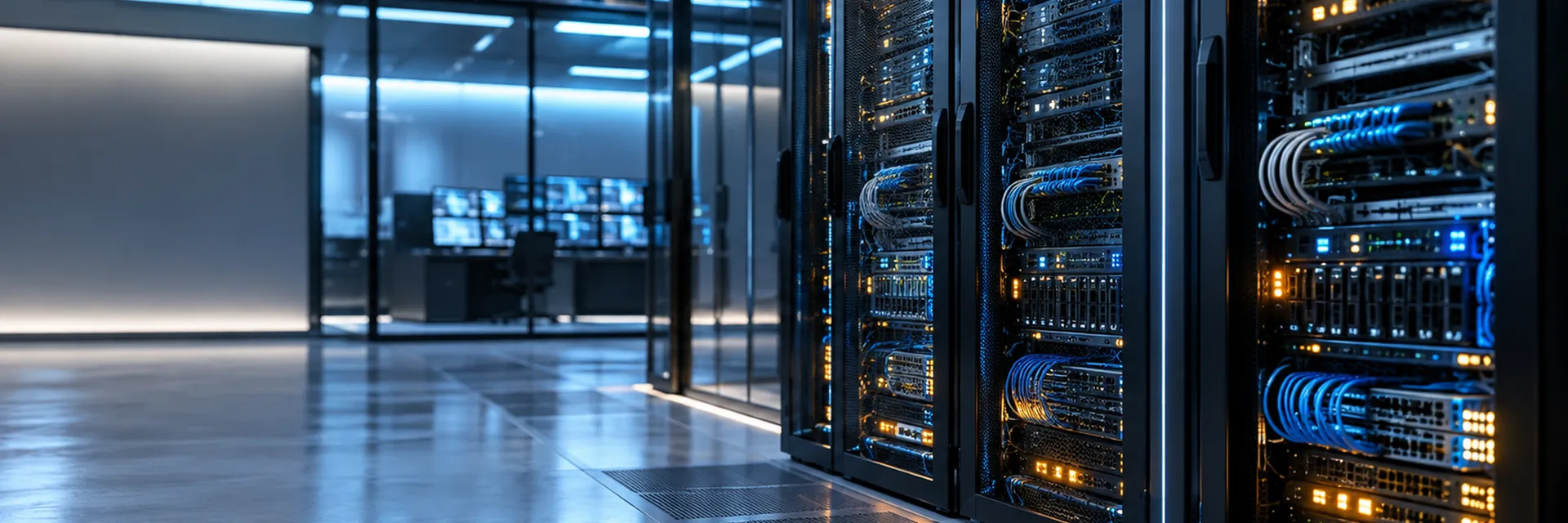
The cyber event that matters most to a data center may never start in a server rack. It can begin with a vendor credential used to access a building-management system, move into cooling controls or badge systems, and force a controlled shutdown even when customer servers were never encrypted.
✓Service Continuity
✓Operational Technology
✓First & Third-Party Cover
Reviewed by David Gleason, Principal — October 11, 2026
CaliforniaGeneral information only, not legal advice — illustrative scenarios and coverage, subject to change without notice. Content may be out of date or contain errors, and requirements vary by city, county, state, agency, project, contract, carrier and policy, among other factors; verifying what applies to your own situation is your responsibility. Full disclaimer
Prefer to send everything at once? Complete a streamlined submission — just needs your review. Especially worth it if your business does $2M+ in annual sales — it can meaningfully speed up carrier turnaround.
Interactive coverage guide
Build a coverage stack around how the business actually operates.
Start with the preselected industry or trade, then adjust the operational questions. The commonly considered stack updates live. Keep the coverages you want GIB to evaluate, remove ones you do not want included in your quote request, and add other available lines before continuing.
Common Starting Coverages
Business Owners Policy / Commercial PackageLiability and property components evaluated together
What it is
A Business Owners Policy commonly combines liability and property coverages for eligible businesses. A Commercial Package Policy may combine multiple commercial coverage parts depending on the account and carrier.
Why businesses like yours commonly carry it
Businesses with premises, contents, inventory or other property exposures may ask GIB to evaluate whether liability and property components can be packaged where appropriate.
Possible coverage gap
Eligibility, included coverages and package structure vary by carrier. Commercial Property may also be written separately rather than as part of a package.
Cyber Liability & Data BreachCyber events, data and system interruption
What it is
Cyber insurance may address certain first-party and third-party losses from covered data breaches, cyberattacks, ransomware and system interruption, depending on the policy.
Why businesses like yours commonly carry it
Operators depend on building management, DCIM and customer-facing systems where an attack can become an outage.
Possible coverage gap
General Liability generally should not be assumed to address data breach response, ransomware or network interruption.
General LiabilityThird-party injury and property damage
What it is
General Liability commonly addresses covered third-party bodily injury, property damage and certain personal or advertising injury claims, subject to the policy.
Why businesses like yours commonly carry it
Businesses commonly use it as a starting liability policy and to satisfy customer, landlord or contract requirements.
Possible coverage gap
General Liability is not intended to replace policies for employee injuries, business vehicles, owned property, cyber events or professional errors.
Educational guidance only. Results are not a coverage recommendation, quote, binder, policy interpretation, or guarantee of coverage. Actual needs, availability, forms, limits, exclusions and requirements vary. A licensed insurance professional should review the complete risk and issued policy terms.
Verified Google reviews
What our cyber insurance clients say about us
5.0 / 5from 7 Google reviews
Reviews reflect individual client experiences and are not a guarantee of coverage, pricing or results.
91 Enterprise LLC
March 24, 2026
We are using Gleason insurance for our commercial auto policy and GL policy. David is the best insurance broker I've worked with — very honest, responsive, and knowledgeable. Highly recommend.
Fito Plumbers
February 20, 2026
We have been working with David at Gleason Insurance Brokers for 8+ years. David always goes above and beyond to make sure we have the appropriate coverages. He explains everything in detail and makes sure we feel confident and understand all of our policies. He is always available and responds right away!
Barry Stay
February 17, 2026
David provides great service and I highly recommend him for your insurance needs.
Why "Data Center" Is Not One Cyber Class
Before discussing limits, the operator's actual model matters: a wholesale/powered-shell operator has modest privacy exposure but severe outage and physical-infrastructure exposure; a retail colocation provider can have hundreds of customer relationships where one facility event becomes many separate allegations; a managed hosting company takes on real Tech E&O exposure because it performs professional technology services. Cybersecurity is assessed differently in this class as well, with physical access control, tenant segregation and redundancy carrying as much underwriting weight as the software stack does.
California has more than 200 active data centers, and the California Energy Commission put data-center demand at roughly 1,000 MW in early 2026, with forecasts rising materially through 2040. For a middle-market or large operator, cyber insurance should be designed around continuity of service and control of critical infrastructure — not just breach notification.
Wholesale, retail colocation, managed hosting and AI compute providers carry different exposure
The application should describe the actual operator model, not a generic "technology company"
Continuity of service, not just breach notification, is the right design principle
AI-driven density growth is increasing power, cooling and hardware concentration
The Cyber Loss Chain and Why OT Is the Coverage Definition to Test
A useful way to evaluate the exposure: credential → control system → facility response → tenant interruption → contractual claim → recovery period. A stolen credential can be a network-security event; manipulation of a cooling controller can create a cyber-physical exposure; a shutdown can create network business interruption; a customer alleging missed uptime can create a Tech E&O claim — each link can land in a different coverage.
The operator should inventory systems that control the building, not only the corporate network: DCIM platforms, building management systems, chilled-water and liquid-cooling controls, generator and UPS monitoring, switchgear monitoring and access-control systems. A policy can have excellent ransomware wording and still be poorly aligned if the systems that can actually force the building offline sit outside the definition of a covered computer system.
The same incident can move across cyber, property, equipment breakdown and Tech E&O
Test whether facility-control (OT) systems actually fall inside the covered-system definition
A cooling-controller manipulation is a cyber-physical exposure, not a traditional data breach
Physical security systems (badges, biometrics) are networked systems too, not just IT
Operator Costs Versus Tenant and Customer Claims
The same first-party/third-party split applies to a data center's cyber program, it just shows up differently than it would for a typical office-based business. First-party coverage is what reimburses the operator directly — forensic investigation into an intrusion, legal costs, notification if tenant or customer data was exposed, and business-interruption income lost during a network outage — while third-party coverage responds when a colocation tenant, cloud customer or regulator holds the facility responsible and brings a claim, investigation or fine over the same incident.
The questions that decide a data center program sit where cyber meets the facility: whether the policy's definition of a computer system reaches building-management and DCIM platforms, how long an outage must last before income loss counts, and how tenant contracts allocate responsibility for downtime. Service credits and contractual penalties are often treated differently from covered damages, so the colocation and cloud agreements should be read alongside the form.
First-party: the operator's own investigation, notice and downtime costs
Third-party: claims from tenants, cloud customers or regulators
Test the computer-system definition against BMS and DCIM platforms
Service credits and penalties may sit outside covered damages
Network Business Interruption Should Be Modeled Like an Outage
The interruption model should start with operating reality: revenue per facility, largest-customer percentage, time to invoke manual procedures, time to validate OT safety, and potential customer attrition — not a generic industry BI assumption. Waiting periods matter significantly; a 12-hour waiting period can be a meaningful uninsured amount for a high-revenue facility.
Tech E&O belongs in the conversation early, because colocation and managed-infrastructure contracts create economic-loss allegations that don't depend on a privacy breach at all — "you failed to maintain contracted uptime" or "your failover process did not work" are professional-service allegations, and a combined cyber/Tech E&O form's shared limits mean one large customer claim can erode capacity needed for the operator's own incident costs.
Model the interruption against real facility revenue and customer concentration, not a generic figure
Distinguish network interruption (a cyber event) from ordinary utility or grid failure
Tech E&O allegations don't require a privacy breach — a missed uptime SLA is enough
Shared cyber/Tech E&O limits can mean one large claim erodes the operator's own recovery budget
Vendor Access, Systemic Risk and Commissioning-Stage Exposure
Data centers depend on specialist vendors for UPS systems, generators, chillers and controls — vendors that may require remote support. A facility can have mature internal security and still inherit a pathway through a maintenance provider, which is why MFA, jump servers, session recording and prompt revocation after service all belong in the underwriting conversation.
For multi-site operators, a shared identity platform, virtualization technology or BMS software across campuses reduces operational complexity but creates correlation — the real question isn't just "can one building go down," it's what single technology could impair several buildings at once. That exposure starts during commissioning too, well before the facility is formally "open," when temporary accounts, vendor laptops and incomplete segmentation are common.
Remote vendor access is a common pathway around an otherwise strong perimeter
Shared platforms across a multi-site portfolio create correlated, not independent, risk
Commissioning-stage vendor connections create real cyber exposure before operations begin
Cyber coverage should be active early enough to actually match this timeline
A Realistic Data Center Cyber Incident Scenario
A third-party maintenance credential is used to access the building-management environment — operators isolate systems and shut down one hall while controls are validated. The physical plant stays intact, but the facility loses revenue and several tenants demand SLA relief, raising network interruption, dependent-systems, Tech E&O and contractual-liability questions all at once.
In a separate pattern, a control issue causes temperature instability and a precautionary shutdown; a later inspection discovers physical damage to a cooling pump — testing whether the cyber trigger, equipment breakdown, and business interruption coverage all respond consistently to the same underlying event.
This example is illustrative, not a report of an actual case or a promise of how any real claim would resolve — real outcomes depend on the specific policy, the facts involved, and the carrier's own review. For a situation that's actually happened or is happening, talk to your broker, a licensed attorney, or the relevant regulatory authority directly.
A BMS credential compromise can shut down a hall with no server ever touched
SLA relief demands from tenants can follow an incident that caused no data breach at all
A cooling-control incident can cross into equipment breakdown if physical damage results
This is illustrative — real claims depend on the actual policy and facts
Getting a Cyber Program That Matches the Facility
A serious underwriting submission covers the business model (revenue by facility, customer concentration, wholesale vs. retail), critical architecture (power/cooling topology, OT segmentation, remote vendor access), security controls (MFA, PAM, EDR, backup strategy) and contract exposure (representative MSAs, SLA obligations, liability caps) — not a one-page application.
Gleason Insurance Brokers maintains carrier relationships built for data-center risk and works with California operators and colocation providers to structure a cyber and Tech E&O program around this specific risk profile — call 844-978-7283 or request a quote to get started.
Document business model, critical architecture, security controls and real contract exposure
A one-page cyber application rarely tells the full story an underwriter needs
Coordinate this page's coverage with the property and casualty operating program
Reach a broker on 844-978-7283, or request a quote
Frequently asked questions
10 questions — start typing to filter
Is data-center cyber insurance different from ordinary business cyber insurance?
Yes. Data centers have unusually high dependency on connected power, cooling, access and monitoring infrastructure, so outage and Tech E&O exposures can be more significant than privacy breach costs.
Do BMS and DCIM platforms need to be listed on the application?
They should be disclosed and discussed. The policy definition of a computer system should be tested against the actual OT and facility-control environment.
Can cyber insurance cover lost revenue from a forced shutdown?
Potentially, if the event triggers network business interruption under the form and the loss continues beyond the applicable waiting period.
Does cyber insurance cover damage to servers caused by a hacked cooling system?
Not automatically. Cyber forms can exclude physical damage, and property forms may restrict cyber-caused loss — the policies must be coordinated.
Why would a colocation company need Tech E&O?
Because customers can allege the operator failed to provide promised uptime, remote hands, monitoring, redundancy or managed services even without a privacy breach.
Are SLA credits covered?
They should not be assumed covered. Contractual service credits, penalties and liquidated damages can be restricted or excluded.
What is systemic cyber risk for a multi-site data-center operator?
It is the possibility that one common technology, vendor or vulnerability affects several facilities or many insureds at once.
Does a data center need cyber coverage during commissioning?
Potentially, yes. Control systems and vendor connections can create cyber exposure before commercial operations formally begin.
How should a data center select a cyber limit?
Model plausible outage cost, largest-customer exposure, incident response, customer claims and contractual requirements rather than relying only on annual revenue.
How does this compare to a general technology company's cyber exposure?
A data center's exposure centers on facility uptime and OT, not just software. See Technology & SaaS Cyber Insurance for how a pure software company's profile differs.
Official resources
Verify current licensing, regulatory and program requirements directly with the responsible agency — this is general information, not legal advice, requirements change without notice, and what is summarized here may be out of date or contain errors. Confirming what applies to your own city, project, contract and policy is your responsibility.