Gleason Insurance Brokers

General Liability · Workers' Comp · Commercial Auto · Pollution Insurance · Surety Bonds Start a Business Insurance Quote Today

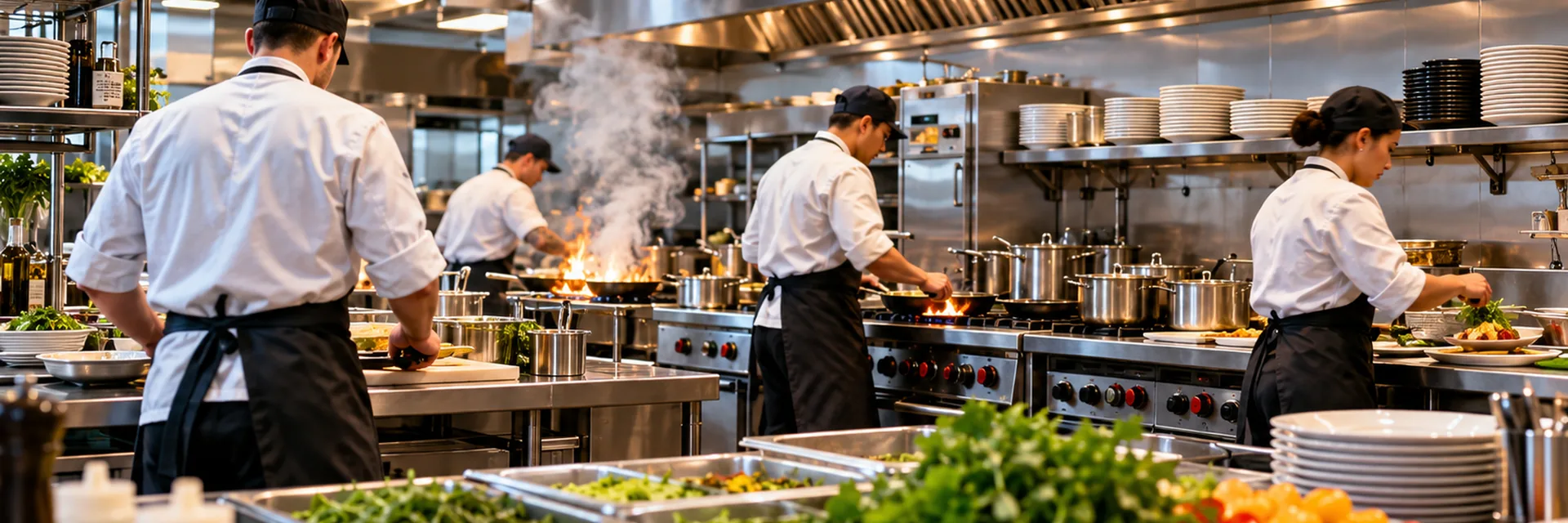
A commercial kitchen crew working the line, cooks at the ranges with pans over open flame under the hood, plates and prepped garnish staged alongside — workers compensation insurance for California

California commercial insurance

Workers Compensation — Restaurants & Breweries

844-97-USAVE

Kitchen and production work carries a different injury profile than typical retail or office employment — cuts, burns, slips and repetitive strain are common enough that workers compensation classification accuracy matters more here than in many industries.

  • Kitchen Injury Exposure
  • Classification Accuracy
  • Brewery Production

Reviewed by David Gleason, Principal — October 12, 2026

CaliforniaGeneral information only, not legal advice — illustrative scenarios and coverage, subject to change without notice. Content may be out of date or contain errors, and requirements vary by city, county, state, agency, project, contract, carrier and policy, among other factors; verifying what applies to your own situation is your responsibility. Full disclaimer

Interactive coverage guide

Build a coverage stack around how the business actually operates.

Start with the preselected industry or trade, then adjust the operational questions. The commonly considered stack updates live. Keep the coverages you want GIB to evaluate, remove ones you do not want included in your quote request, and add other available lines before continuing.

Common Starting Coverages

General LiabilityThird-party injury and property damage

What it is

General Liability commonly addresses covered third-party bodily injury, property damage and certain personal or advertising injury claims, subject to the policy.

Why businesses like yours commonly carry it

Businesses commonly use it as a starting liability policy and to satisfy customer, landlord or contract requirements.

Possible coverage gap

General Liability is not intended to replace policies for employee injuries, business vehicles, owned property, cyber events or professional errors.

Learn more about General Liability
Business Owners Policy / Commercial PackageLiability and property components evaluated together

What it is

A Business Owners Policy commonly combines liability and property coverages for eligible businesses. A Commercial Package Policy may combine multiple commercial coverage parts depending on the account and carrier.

Why businesses like yours commonly carry it

Businesses with premises, contents, inventory or other property exposures may ask GIB to evaluate whether liability and property components can be packaged where appropriate.

Possible coverage gap

Eligibility, included coverages and package structure vary by carrier. Commercial Property may also be written separately rather than as part of a package.

Learn more about Business Owners Policy / Commercial Package

Commonly Added Based on Operations

Equipment BreakdownMechanical, electrical and pressure-system breakdown

What it is

Equipment Breakdown may address certain sudden mechanical, electrical or pressure-system breakdown losses, subject to the policy.

Why businesses like yours commonly carry it

Businesses dependent on refrigeration, production, HVAC, electrical or other critical equipment commonly consider it.

Possible coverage gap

Standard property forms may not address every internal mechanical or electrical breakdown.

Learn more about Equipment Breakdown
Cyber Liability & Data BreachCyber events, data and system interruption

What it is

Cyber insurance may address certain first-party and third-party losses from covered data breaches, cyberattacks, ransomware and system interruption, depending on the policy.

Why businesses like yours commonly carry it

Restaurants increasingly rely on POS systems, payment processing, online ordering, employee information and vendor platforms.

Possible coverage gap

General Liability generally should not be assumed to address data breach response, ransomware or network interruption.

Learn more about cyber insurance for restaurants and breweries

Exposure-Dependent Coverages

Liquor LiabilityLiability connected with serving or selling alcohol

What it is

Liquor Liability may address covered claims arising from the sale or service of alcohol, subject to policy terms.

Why businesses like yours commonly carry it

Restaurants, bars, breweries and event operations that sell or serve alcohol commonly consider separate liquor liability coverage.

Possible coverage gap

General Liability commonly limits or excludes liquor liability for businesses in the business of selling or serving alcohol.

Learn more about Liquor Liability
Umbrella / Excess LiabilityAdditional limits above scheduled liability policies

What it is

Umbrella or Excess Liability may provide additional limits above identified underlying liability policies, subject to its own terms and exclusions.

Why businesses like yours commonly carry it

Businesses with larger contracts, vehicles, public exposure or higher severity potential commonly consider additional limits.

Possible coverage gap

An umbrella does not automatically broaden every exclusion or sit over every policy unless the issued terms say it does.

Learn more about Umbrella / Excess Liability

Loading quote and requirements options…

Educational guidance only. Results are not a coverage recommendation, quote, binder, policy interpretation, or guarantee of coverage. Actual needs, availability, forms, limits, exclusions and requirements vary. A licensed insurance professional should review the complete risk and issued policy terms.

Verified Google reviews

What restaurant and brewery owners say about us

5.0 / 5from 7 Google reviews

Reviews reflect individual client experiences and are not a guarantee of coverage, pricing or results.

91 Enterprise LLC

91 Enterprise LLC

March 24, 2026

We are using Gleason insurance for our commercial auto policy and GL policy. David is the best insurance broker I've worked with — very honest, responsive, and knowledgeable. Highly recommend.

Fito Plumbers

Fito Plumbers

February 20, 2026

We have been working with David at Gleason Insurance Brokers for 8+ years. David always goes above and beyond to make sure we have the appropriate coverages. He explains everything in detail and makes sure we feel confident and understand all of our policies. He is always available and responds right away!

Barry Stay

Barry Stay

February 17, 2026

David provides great service and I highly recommend him for your insurance needs.

Why restaurant and brewery workers comp is different

Commercial kitchens combine sharp tools, hot surfaces, slippery floors and physically demanding, fast-paced work — a genuinely different injury risk profile than typical retail or office employment, which is reflected in how this classification is rated. Workers compensation sits alongside the alcohol insurance side of the account rather than replacing it: one answers for staff injuries, the other for what a patron does after leaving, and a restaurant generally needs both quoted together.

Brewery production work adds its own considerations — heavy lifting, work around brewing equipment and hot liquids, and sometimes confined-space or elevated work depending on the facility.

Kitchen work carries elevated cut, burn and slip injury risk
Fast-paced, physically demanding work is standard in this classification
Brewery production adds heavy lifting and equipment-adjacent exposure
Classification should reflect actual duties, not a generic hospitality label

From our case files: a kitchen slip handled the right way

In one of our restaurant files, an employee's minor sprain from a slip was reported to the carrier without delay. The workers' comp carrier handled the paperwork, walked the owner through the process, and helped put a return-to-work program and new slip-prevention steps in place (case study 6). Fast reporting kept a minor injury minor.

Getting classification right

California requires workers compensation once a restaurant or brewery has a single employee — the same requirement as any other employer, with no small-business exemption.

Kitchen staff, service staff, and production staff can carry different classifications reflecting their actual duties — combining them under one generic label is a common source of premium inaccuracy and audit corrections.

Required once there's a single employee, no small-business exemption
Kitchen, service and production roles may carry different classifications
Combining distinct roles under one label creates audit inaccuracy
Accurate classification against actual duties drives fair pricing

What drives premium and how audits work

Payroll by classification is the primary rating basis, with claims history and the Experience Modification Rate affecting pricing over time the same way they do for any employer.

Premium is typically estimated up front and trued up against actual payroll at audit — accurate payroll records by role throughout the year make the audit process smoother and the final bill more predictable.

Payroll by classification is the primary rating basis
X-Mod reflects claims history relative to similar businesses
Premium is trued up against actual payroll at audit
Accurate year-round payroll records by role smooth the audit process

Injury prevention and its effect on long-term costs

Non-slip flooring, proper knife handling and burn-prevention training, and clear incident reporting procedures are standard risk-management practices in food service — and they translate directly into fewer and less severe claims over time.

Fewer and less severe claims improve the Experience Modification Rate over time, which can meaningfully affect workers compensation pricing at future renewals — safety practice and insurance cost are directly connected here.

Non-slip flooring and safety training are standard risk-management practices
Clear incident reporting procedures support both safety and claims handling
Fewer, less severe claims improve the X-Mod over time
Safety practice and long-term insurance cost are directly connected

A realistic scenario: kitchen and front-of-house misclassified together

A restaurant reports all staff — line cooks, dishwashers, servers, bartenders — under one blended payroll classification to simplify the application, rather than splitting kitchen and front-of-house the way workers comp actually rates them.

Illustrative only — this describes a typical pattern, not an actual case or guaranteed outcome. Kitchen roles typically carry meaningfully higher classification rates than front-of-house service roles, and combining them usually means overpaying on the lower-risk portion of payroll while creating an audit surprise either way. Report payroll by actual role.

Kitchen and front-of-house roles rate very differently
Blending classifications usually means overpaying on lower-risk payroll
This creates a real audit surprise, not just a pricing inefficiency
Report payroll split by the actual role each employee performs

Getting workers compensation coverage in place

Share your current payroll by role — kitchen, service, production, management — and employee count so the quote reflects real operations.

Gleason Insurance Brokers places workers compensation for restaurants and breweries across California — call 844-978-7283 or request a quote to get started. For how California workers comp works across industries, including State Fund, private carriers and the experience mod, see California workers compensation insurance.

Share payroll by role, not just a total figure
Include employee count and any established X-Mod
We place coverage for restaurants and breweries throughout California
Call 844-978-7283 or request a quote to get started

Frequently asked questions

8 questions — start typing to filter

Can a restaurant get workers comp through State Compensation Insurance Fund?

Yes, and for some restaurants it is the realistic route. State Compensation Insurance Fund cannot decline an eligible California employer, which matters for a first-year restaurant with no loss history or an operation that has had kitchen injuries. Private workers comp insurance companies often price a clean, established restaurant more competitively, so both are usually worth marketing before a decision is made.

Do I need workers compensation if I only have one employee at my restaurant?

Yes — California requires workers compensation once there's a single employee, with no small-business exemption.

Should kitchen staff and service staff be classified differently for workers comp?

Often yes — their actual duties and injury risk profiles genuinely differ, and combining them under one generic classification is a common source of premium inaccuracy.

What drives workers comp premium for a restaurant or brewery?

Payroll by classification is the primary factor, along with claims history reflected in your Experience Modification Rate over time.

How does a workers comp audit work for a restaurant?

Premium is typically estimated up front and trued up against actual payroll at audit — accurate year-round records by role make this process smoother.

Does safety training actually reduce my workers comp costs?

Over time, yes indirectly — fewer and less severe claims improve your Experience Modification Rate, which affects future premium.

Is brewery production work classified the same as restaurant kitchen work?

Not necessarily — brewery production carries its own considerations like heavy lifting and equipment-adjacent exposure, which should be reflected in accurate classification.

Does Gleason Insurance Brokers place workers compensation for restaurants and breweries?

Yes — throughout California, alongside our core construction and transportation focus.

Official resources

Verify current licensing, regulatory and program requirements directly with the responsible agency — this is general information, not legal advice, requirements change without notice, and what is summarized here may be out of date or contain errors. Confirming what applies to your own city, project, contract and policy is your responsibility.

Updated October 12, 2026