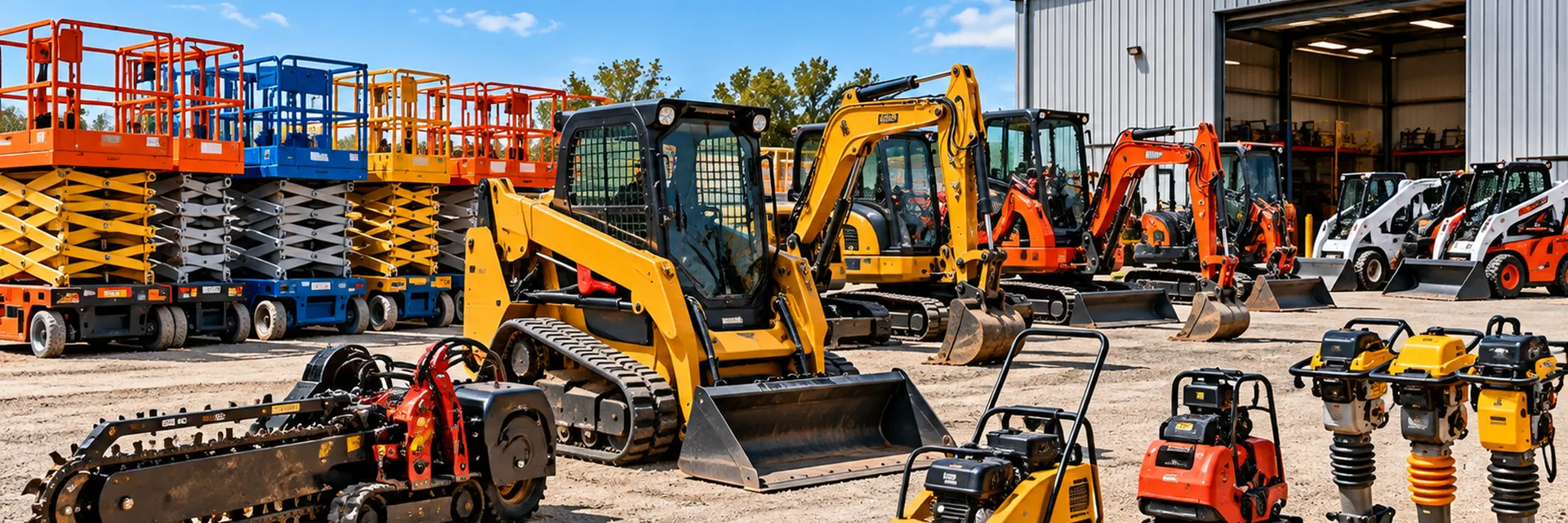
A standard contractor rental yard can have thousands of moving assets instead of a few hundred heavy machines. That creates a frequency and inventory-control problem more than a single-unit severity problem. The target customer is the California company renting generators, compressors, saws, trenchers, compactors, lifts, pumps, scaffolding, ladders, drain equipment, temporary power, concrete tools and specialty trade equipment to general contractors and specialty trades.
✓Inventory Concentration
✓Access Equipment
✓Generators & Temporary Power
Reviewed by David Gleason, Principal — October 11, 2026
CaliforniaGeneral information only, not legal advice — illustrative scenarios and coverage, subject to change without notice. Content may be out of date or contain errors, and requirements vary by city, county, state, agency, project, contract, carrier and policy, among other factors; verifying what applies to your own situation is your responsibility. Full disclaimer
Interactive coverage guide
Build a coverage stack around how the business actually operates.
Start with the preselected industry or trade, then adjust the operational questions. The commonly considered stack updates live. Keep the coverages you want GIB to evaluate, remove ones you do not want included in your quote request, and add other available lines before continuing.
Common Starting Coverages
General LiabilityThird-party injury and property damage
What it is
General Liability commonly addresses covered third-party bodily injury, property damage and certain personal or advertising injury claims, subject to the policy.
Why businesses like yours commonly carry it
Businesses commonly use it as a starting liability policy and to satisfy customer, landlord or contract requirements.
Possible coverage gap
General Liability is not intended to replace policies for employee injuries, business vehicles, owned property, cyber events or professional errors.
Business Owners Policy / Commercial PackageLiability and property components evaluated together
What it is
A Business Owners Policy commonly combines liability and property coverages for eligible businesses. A Commercial Package Policy may combine multiple commercial coverage parts depending on the account and carrier.
Why businesses like yours commonly carry it
Businesses with premises, contents, inventory or other property exposures may ask GIB to evaluate whether liability and property components can be packaged where appropriate.
Possible coverage gap
Eligibility, included coverages and package structure vary by carrier. Commercial Property may also be written separately rather than as part of a package.
Cyber Liability & Data BreachCyber events, data and system interruption
What it is
Cyber insurance may address certain first-party and third-party losses from covered data breaches, cyberattacks, ransomware and system interruption, depending on the policy.
Why businesses like yours commonly carry it
Rental operations keep renter identification, card data and telematics on connected systems.
Possible coverage gap
General Liability generally should not be assumed to address data breach response, ransomware or network interruption.
Educational guidance only. Results are not a coverage recommendation, quote, binder, policy interpretation, or guarantee of coverage. Actual needs, availability, forms, limits, exclusions and requirements vary. A licensed insurance professional should review the complete risk and issued policy terms.
Verified Google reviews
What contractors say about us
5.0 / 5from 7 Google reviews
Reviews reflect individual client experiences and are not a guarantee of coverage, pricing or results.
91 Enterprise LLC
March 24, 2026
We are using Gleason insurance for our commercial auto policy and GL policy. David is the best insurance broker I've worked with — very honest, responsive, and knowledgeable. Highly recommend.
Fito Plumbers
February 20, 2026
We have been working with David at Gleason Insurance Brokers for 8+ years. David always goes above and beyond to make sure we have the appropriate coverages. He explains everything in detail and makes sure we feel confident and understand all of our policies. He is always available and responds right away!
Barry Stay
February 17, 2026
David provides great service and I highly recommend him for your insurance needs.
Inventory Control Is an Insurance Control
Blanket limits need to reflect the largest realistic concentration in one trailer, van, yard or customer location. Serial numbers, barcode/RFID tracking, checkout photos and overdue alerts reduce both theft and claim disputes.
What an underwriter is really testing is whether the business can say where an asset is without walking the yard. A rental operation that cycle-counts a category every week and reconciles against open contracts can produce a credible schedule of values and a credible loss description; one that counts annually usually discovers a loss months after it happened, by which point the contract trail has gone cold and the claim looks like unexplained disappearance rather than theft. That distinction frequently decides how a claim is treated, because many policies handle mysterious disappearance differently from a theft with evidence behind it.
Barcode or RFID tagging at the item level matters for the same reason, and the value is less about the technology than about what it produces: a timestamped record of which contract an item left on and when it was due back. Where that record exists, a shrinkage figure can be separated into genuine theft, customer non-return and administrative error, and only the first of those is an insurance question. Presenting an undifferentiated shrinkage percentage invites the underwriter to price all of it as theft.
Blanket limits need to reflect the largest realistic concentration in one trailer, van, yard or customer location
Serial numbers, barcode/RFID tracking, checkout photos and overdue alerts reduce both theft and claim disputes
Access Equipment Creates Bodily Injury Severity
Scaffolding, ladders and lifts can lead to claims alleging missing components, poor maintenance, inadequate instructions or unsafe setup. If employees erect scaffolding or set equipment up onsite, the GL and WC exposure changes materially.
Scaffolding, ladders and lifts can lead to claims alleging missing components, poor maintenance, inadequate instructions or unsafe setup
If employees erect scaffolding or set equipment up onsite, the GL and WC exposure changes materially
Generators and Temporary Power Have Their Own Loss Pattern
Portable power can create fire, carbon monoxide, electrical injury, fuel and breakdown issues. Maintenance documentation and clear customer instructions become part of risk control.
Portable power can create fire, carbon monoxide, electrical injury, fuel and breakdown issues
Maintenance documentation and clear customer instructions become part of risk control
Specialty Trade Equipment
Plumbing and electrical inventory can include sewer cameras, drain machines, pipe threaders, cable pullers, conduit benders and core drills. These should not disappear inside a vague "small tools" limit.
Plumbing and electrical inventory can include sewer cameras, drain machines, pipe threaders, cable pullers, conduit benders and core drills
These should not disappear inside a vague "small tools" limit
Delivery and Trailer Losses
Pickups, vans, stake beds and enclosed trailers create backing, theft, hitch, load-securement and employee-driver exposure. Trailer physical damage and the contents inside the trailer may require separate treatment.
Loading is where a high-frequency fleet generates its most avoidable claims. A compact excavator walked onto a tilt trailer by a yard employee, a scissor lift winched up a ramp, a bundle of shoring dropped onto a flatbed — each is a short task repeated many times a day, and the loss is rarely the machine alone. It is commonly the machine, the trailer, a bystander claim and a day of lost rental on a unit that was already booked.
Tie-down discipline and trailer maintenance are therefore underwriting questions rather than housekeeping ones. Where a rental business delivers with its own trucks, the driver file, the trailer inspection record and the load-securement training are read alongside the commercial auto exposure, because the same employee who secures the load is the one driving it. A business that delivers through third-party haulers has a different file to present: the hauler's certificates, the contractual allocation of in-transit risk, and whether its own policy picks up the gap when a hauler's limits fall short.
Pickups, vans, stake beds and enclosed trailers create backing, theft, hitch, load-securement and employee-driver exposure
Trailer physical damage and the contents inside the trailer may require separate treatment
Common Claim Patterns
Fraudulent renter: a new customer uses false information and never returns a generator package.
Scaffold injury: a customer alleges the rented components were incomplete.
Trailer theft: a locked trailer containing dozens of rental tools disappears overnight.
Drain-machine damage: the customer disputes responsibility for major internal damage.
Fraudulent renter: a new customer uses false information and never returns a generator package
Scaffold injury: a customer alleges the rented components were incomplete
Trailer theft: a locked trailer containing dozens of rental tools disappears overnight
Drain-machine damage: the customer disputes responsibility for major internal damage
Underwriting Package
Revenue by equipment category, inventory value, largest unit, number of items, customer mix, delivery percentage, setup/installation work, rental agreement, tracking system, driver list and loss history.
Revenue by equipment category, and total inventory value
Largest single unit and the number of items on rent
Customer mix and the share of revenue that is delivered
Setup and installation work performed by your own staff
The rental agreement itself, and any tracking system in use
Driver list and loss history
Middle-Market Coverage Stack
A larger tool-and-equipment rental company should combine rented-to-others inland marine with yard property, GL/products, auto, workers compensation, umbrella, crime and cyber. Cyber becomes increasingly relevant when online reservations, customer accounts, inventory software and card/payment systems are central to daily operations.
Cyber becomes increasingly relevant when online reservations, customer accounts, inventory software and card/payment systems are central to daily operations
Damage Waiver and Customer Insurance
Damage waiver language should be compared with the insurance policy rather than marketed as if it were insurance. Higher-value lifts, generators or specialty equipment may justify customer COI requirements or different contract terms than ordinary hand tools.
A damage waiver is a contractual limitation of the customer's liability sold by the rental company. It is not insurance, it is not regulated as insurance, and the revenue from it sits on the rental company's own books — which means the rental company is retaining that risk rather than transferring it. Where waiver take-up is high, the business is effectively self-insuring a slice of its own fleet damage, and that shows up in loss experience rather than in premium.
The practical review is whether the waiver's exclusions and the business's own policy line up. A waiver that excludes theft, overturn or misuse leaves those events with the customer or with the rental company, depending on what the rental agreement says, and a certificate from the customer naming the rental company does not by itself establish that the customer's policy responds to damage to rented equipment. Reading the waiver, the rental agreement and the customer's actual coverage together is what shows where a given loss would land, and the legal effect of those documents is a matter for legal counsel. When the fleet grows into excavators, cranes or earthmoving equipment, the exposures shift to those described on heavy equipment rental insurance.
Damage waiver language should be compared with the insurance policy rather than marketed as if it were insurance
Higher-value lifts, generators or specialty equipment may justify customer COI requirements or different contract terms than ordinary hand tools
How risk transfer works in a rental agreement
Equipment Rental Company → Renter → The Jobsite It Goes To
A rental agreement moves risk before the equipment leaves the yard, and the machine then sits on a site governed by contracts the rental company never signed. Open a handoff to see what commonly travels with it.
Equipment Rental Company
The rental agreement itselfThe contract doing the work here, and not a subcontract. It commonly sets who bears physical damage, who carries liability while the machine is in use, what happens if it is stolen, and what is owed for the time it cannot be re-rented. Those terms generally govern regardless of what either party’s policy says, which is why reading it first tends to be the useful order.
A damage waiver is not insuranceA waiver is the rental company agreeing, by contract, to limit what it will pursue the renter for. It is not a policy, there is no insurer behind it, and it commonly carries exclusions — overturn, misuse, operating outside the manufacturer’s specifications, theft without signs of forced entry, and unattended equipment are frequently among them. A renter who declines it is not uninsured, and a renter who accepts it is not fully covered.
Rented or leased equipment coverageThe renter’s own inland marine cover for equipment in its care. The limit has to reach the largest single unit on rent, not the average one, and a contract that names a flat figure may sit well below the machine actually being collected.
The rental company named on the renter’s policyCommonly as loss payee on the equipment cover and as an additional insured on the liability side for operations involving the machine. These are two different things on two different policies, and a certificate showing one is not evidence of the other.
Waiver of subrogationCG 24 04Gives up the insurer’s right to recover from the upstream party after paying a claim. Frequently named alongside additional insured status rather than instead of it.
Certificate, plus the endorsements behind itA certificate evidences that a policy existed on the day it was issued. It is not proof that any particular endorsement sits on that policy, which is why a requirement is commonly checked against the endorsement itself.
Collected once at account opening and never again is the common failure. A rental relationship frequently outlives the policy term that was evidenced when it started.
Renter — the contractor or business renting
Who is responsible in transitDelivery and pickup are their own exposure and commonly fall to whoever is hauling. Where the rental company delivers, that is its fleet; where the renter collects, it is generally the renter’s. Overturn on the road and damage during loading tend to be argued about afterwards unless the agreement addressed them.
Operator liability is not equipment damageTwo separate questions that a single conversation often blurs. Harm the machine causes to people or property is a liability matter; harm to the machine itself is a property one. A renter can be well covered for one and carry nothing for the other.
Additional insured, ongoing operationsoften CG 20 10Extends the downstream party’s general liability to the upstream party for work still in progress. It is the form most contracts have in mind when they say "name us as additional insured", and on its own it generally stops responding once the work is finished.
Whether a wrap-up or builders risk reaches itOn a project with an OCIP, CCIP or builders risk policy, rented equipment is commonly outside what that program covers — those generally respond to the work and the structure rather than to somebody else’s machine sitting on the site. Worth confirming against the actual program documents rather than assumed either way.
Lost rental income while it is out of serviceA damaged machine stops earning. Whether that loss is recoverable, and from whom, is usually a term of the rental agreement rather than a standard feature of a policy, and it is frequently sub-limited where it is covered at all.
The rental company generally has the least visibility of anyone here and the most value at stake, since the machine is its asset sitting on a site it does not control.
The Jobsite, and whoever controls it
The limits a contract asks for, and what each one means
Rental agreements and the contracts on the sites equipment goes to both commonly state limits. One million dollars per occurrence with a two million dollar general aggregate is a combination many of these agreements use, but for a rental account the equipment limit is frequently the number that decides whether a loss is made whole, and it varies by fleet rather than by contract.
Per occurrence
The most the policy generally pays for any one covered occurrence.
Rented or leased equipment limit
Needs to reach the largest single unit on rent rather than a typical one. A fleet average is a common way to end up short on exactly the machine that was damaged.
General aggregate
The most the policy generally pays across the term, covering the yard and the operation as well as the equipment in the field.
Auto liability for delivery and pickup
A rental company that delivers is running a fleet business alongside a rental one, and it is commonly the higher-frequency half of the account.
Umbrella or excess above it
Sits above the underlying limits. What it sits over matters as much as how high it reaches, since a tower built only over general liability leaves the fleet and the equipment short of what an agreement may assume.
Branch and Multi-Location Growth
As the company adds branches, underwriters will focus on consistency of checkout procedures, inspection, maintenance, driver hiring, security and inventory controls. A strong centralized process can help distinguish a sophisticated regional operator from a collection of loosely managed yards.
A strong centralized process can help distinguish a sophisticated regional operator from a collection of loosely managed yards
Frequently asked questions
10 questions — start typing to filter
Is a tool rental business insured the same as a heavy equipment rental company?
No. Tool rental has higher transaction volume, more units and different theft and bodily-injury patterns.
What if a customer damages equipment?
Coverage depends on the rented-to-others form, cause of damage and contract terms.
What if a customer never returns equipment?
Fraudulent rental, conversion and theft can be treated differently.
Does a rental company need products liability?
GL/products exposure should be reviewed because customers can allege unsafe equipment or poor maintenance.
What if employees install or erect rented equipment?
The operation becomes more than simple rental and may materially change GL and workers compensation.
Are trailers and trailer contents insured together?
Not necessarily. Each may require separate scheduling or coverage treatment.
Does a smaller rental item still need scheduling?
Often, in aggregate — individually low-value tools can still represent a large combined exposure across a full rental counter, and blanket limits should be sized to the real total, not just the largest single item.
How is shrinkage treated differently from theft?
They are priced differently, so the separation matters. Shrinkage that cannot be tied to a contract, a date or a customer commonly reads as mysterious disappearance, which many policies treat differently from a theft supported by evidence. An item-level record showing which contract a unit left on and when it was due back is what lets genuine theft, customer non-return and administrative error be separated. Presenting one undifferentiated shrinkage percentage invites all of it to be priced as theft.
Does a damage waiver reduce what we need to insure?
Not in the way it is often assumed to. A damage waiver limits the customer's liability by contract and the revenue stays on the rental company's books, so the business is retaining that risk rather than transferring it. High waiver take-up tends to show up in loss experience instead of premium. What is worth reviewing is whether the waiver's exclusions and the company's own policy line up, and the legal effect of the waiver is a question for legal counsel.
We deliver with our own trucks. Does that change the program?
Yes, and in more than one place. The driver file, trailer inspection records and load-securement training are read alongside the commercial auto exposure, because the employee securing the load is usually the one driving it. A business that delivers through third-party haulers presents a different file instead: the hauler's certificates, how in-transit risk is allocated in the contract, and what happens when a hauler's limits fall short of the unit's value.
Official resources
Verify current licensing, regulatory and program requirements directly with the responsible agency — this is general information, not legal advice, requirements change without notice, and what is summarized here may be out of date or contain errors. Confirming what applies to your own city, project, contract and policy is your responsibility.