Gleason Insurance Brokers

General Liability · Workers' Comp · Commercial Auto · Pollution Insurance · Surety Bonds Start a Business Insurance Quote Today

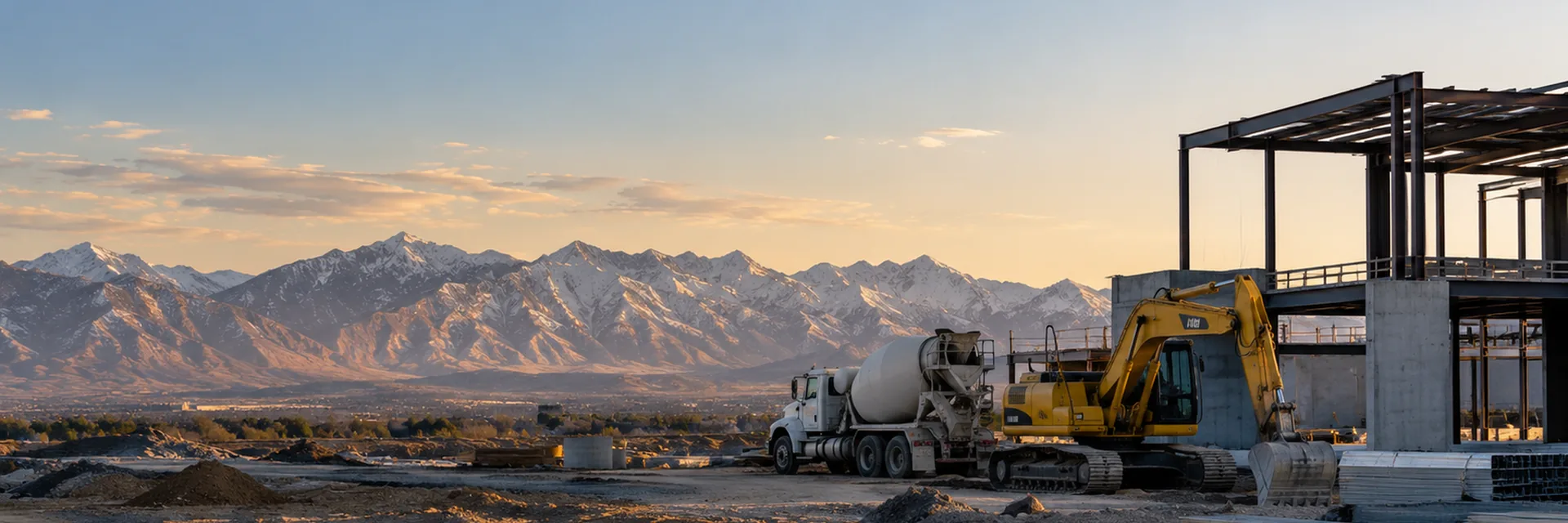
A Utah construction site in a wide valley, excavator and concrete mixer at a steel frame building with the snow-capped Wasatch range behind — Utah contractor insurance

Utah commercial insurance

Utah — Contractors Insurance

844-97-USAVE

Utah requires a DOPL contractor license for construction work unless an exemption applies — the main one, for small repair and remodeling jobs, ends at $7,000 in labor and materials — and each classification defines the scope of work it covers. Coverage should be built around the specific classification held, not a generic "Utah contractor" assumption. For construction projects large and small, an independent broker licensed across Utah can typically move faster than a single-carrier agent tied to one company's terms.

  • General Liability & Workers Comp
  • Commercial Auto
  • Exemption Thresholds

Reviewed by David Gleason, Principal — October 11, 2026

UtahGeneral information only, not legal advice — illustrative scenarios and coverage, subject to change without notice. Content may be out of date or contain errors, and requirements vary by city, county, state, agency, project, contract, carrier and policy, among other factors; verifying what applies to your own situation is your responsibility. Full disclaimer

Interactive coverage guide

Build a coverage stack around how the business actually operates.

Start with the preselected industry or trade, then adjust the operational questions. The commonly considered stack updates live. Keep the coverages you want GIB to evaluate, remove ones you do not want included in your quote request, and add other available lines before continuing.

Common Starting Coverages

General LiabilityThird-party injury and property damage

What it is

General Liability commonly addresses covered third-party bodily injury, property damage and certain personal or advertising injury claims, subject to the policy.

Why businesses like yours commonly carry it

Businesses commonly use it as a starting liability policy and to satisfy customer, landlord or contract requirements.

Possible coverage gap

General Liability is not intended to replace policies for employee injuries, business vehicles, owned property, cyber events or professional errors.

Learn more about General Liability

Commonly Added Based on Operations

Contractor Equipment / Inland MarineMobile tools, equipment and property away from premises

What it is

Inland Marine is commonly used for tools, equipment and certain mobile property that moves between locations or jobsites.

Why businesses like yours commonly carry it

Contractors frequently move tools, testing equipment and mobile machinery among jobsites.

Possible coverage gap

General Liability should not be assumed to insure the business's own tools and equipment against theft or physical damage.

Learn more about Contractor Equipment / Inland Marine
Cyber Liability & Data BreachCyber events, data and system interruption

What it is

Cyber insurance may address certain first-party and third-party losses from covered data breaches, cyberattacks, ransomware and system interruption, depending on the policy.

Why businesses like yours commonly carry it

Contractors commonly use email, electronic banking, project platforms, payroll systems and cloud document storage.

Possible coverage gap

General Liability generally should not be assumed to address data breach response, ransomware or network interruption.

Learn more about cyber insurance for contractors

Exposure-Dependent Coverages

Installation FloaterMaterials awaiting or undergoing installation

What it is

An Installation Floater may cover certain materials and equipment in transit, temporary storage and during installation, subject to the policy.

Why businesses like yours commonly carry it

Businesses responsible for materials before final installation commonly consider this coverage.

Possible coverage gap

A basic liability policy generally should not be assumed to cover the insured's materials against physical loss before installation is complete.

Learn more about Installation Floater
Builder's RiskProject property during construction

What it is

Builder's Risk may insure covered buildings, materials and certain project property while construction is underway.

Why businesses like yours commonly carry it

Owners, developers and contractors commonly consider it when a structure or major renovation is exposed during construction.

Possible coverage gap

Commercial Property and General Liability are not automatic substitutes for course-of-construction property coverage.

Learn more about Builder's Risk
Contractors Pollution LiabilityPollution conditions and cleanup liability

What it is

Pollution Liability may address covered cleanup costs and third-party injury or property damage arising from pollution conditions.

Why businesses like yours commonly carry it

Businesses working with fuels, chemicals, soil, water, demolition or environmental conditions may have pollution exposures.

Possible coverage gap

Standard General Liability commonly contains pollution exclusions or limitations.

Learn more about Contractors Pollution Liability
Umbrella / Excess LiabilityAdditional limits above scheduled liability policies

What it is

Umbrella or Excess Liability may provide additional limits above identified underlying liability policies, subject to its own terms and exclusions.

Why businesses like yours commonly carry it

Businesses with larger contracts, vehicles, public exposure or higher severity potential commonly consider additional limits.

Possible coverage gap

An umbrella does not automatically broaden every exclusion or sit over every policy unless the issued terms say it does.

Learn more about Umbrella / Excess Liability

Loading quote and requirements options…

Educational guidance only. Results are not a coverage recommendation, quote, binder, policy interpretation, or guarantee of coverage. Actual needs, availability, forms, limits, exclusions and requirements vary. A licensed insurance professional should review the complete risk and issued policy terms.

Verified Google reviews

What contractors say about us

5.0 / 5from 7 Google reviews

Reviews reflect individual client experiences and are not a guarantee of coverage, pricing or results.

91 Enterprise LLC

91 Enterprise LLC

March 24, 2026

We are using Gleason insurance for our commercial auto policy and GL policy. David is the best insurance broker I've worked with — very honest, responsive, and knowledgeable. Highly recommend.

Fito Plumbers

Fito Plumbers

February 20, 2026

We have been working with David at Gleason Insurance Brokers for 8+ years. David always goes above and beyond to make sure we have the appropriate coverages. He explains everything in detail and makes sure we feel confident and understand all of our policies. He is always available and responds right away!

Barry Stay

Barry Stay

February 17, 2026

David provides great service and I highly recommend him for your insurance needs.

Why Utah contractors need Utah-specific underwriting

Utah's Division of Professional Licensing (DOPL) requires a state contractor license for construction work unless an exemption applies.

Read more

Utah's handyman exemption covers repair, remodeling, alteration or improvement of an existing building only while the contracted value — labor, materials and every change order — stays under $7,000, and plumbing, electrical, HVAC, gas appliance, fire-sprinkler, alarm and radon work still has to be done by the appropriately licensed trade (Utah Code 58-55-305). DOPL runs it in three bands: under $3,000 there is nothing to file; from $3,000 up to $7,000 the work stays exempt only if the person files an Affirmation of Exemption with DOPL, pays the $45 fee and carries general liability of at least $1,000,000 for each incident and $3,000,000 in total with the Division named as certificate holder, plus workers' compensation or a Labor Commission waiver (Rule R156-55a-305a); at $7,000 the work needs a licensed contractor.

Classification matters directly to what a contractor can legally build — B100 (General Building) covers buildings of any size, while R100 (Residential and Small Commercial: homes, multifamily up to four units, and commercial buildings up to three stories and 20,000 square feet) is limited by building type and size rather than contract value, alongside specialty classifications.

Under $3,000: nothing to file with DOPL
$3,000 to $7,000: Affirmation of Exemption, $45, and GL of $1M each incident / $3M total
$7,000 and above: a DOPL contractor license
Classification determines the maximum project size allowed
B100 covers any building; R100 is limited by building type and size
Confirm your specific classification's actual scope before bidding

Sources for this section

What changed in Utah's contractor insurance requirements

Utah raised its general liability floor for contractor licensing sharply in 2026 — tenfold on the per-occurrence limit.

Read more

Both limits moved, and DOPL applies the new minimums to all contractors: there is no exemption for licenses issued before the change, so an existing license holder has to show the higher limits at renewal, however long the license has been held.

The certificate must also name DOPL as certificate holder, the policy has to cover the scope of work actually performed, and it must stay in force for the whole license period (Utah Administrative Rule R156-55a-302d). A policy still written to the former minimum needs to be raised before the renewal is filed, not after DOPL flags it.

DOPL describes the new minimums as applying to all contractors, and the rule sets one floor with no carve-out by trade or business size. That covers, among others: B100 General Building, E100 General Engineering, R100 Residential and Small Commercial, H100 HVAC, E200/E201 electrical and P200/P201 plumbing contractors, and every S-classification specialty trade, such as S280 Roofing.

Per occurrence: $100,000 → $1,000,000
Aggregate: $300,000 → $2,000,000
Applies to applications and renewals submitted on or after April 20, 2026
No grandfather provision for existing license holders

Core coverage most Utah contractors carry

General liability is a condition of DOPL licensure at no less than $1,000,000 per incident and $2,000,000 in total, with DOPL named as certificate holder, coverage that fits the scope of work actually performed, and the policy kept in force for the whole license period (Utah Administrative Rule R156-55a-302d).

Read more

Workers compensation is required once the business has employees, with DOPL named as certificate holder — or a Utah Labor Commission waiver when there are none. A license bond is a separate condition and applies only when DOPL's review of the financial history of the applicant, its owners and qualifiers calls for one.

General liability: $1,000,000 per incident / $2,000,000 total
DOPL named as certificate holder on the certificate
Workers compensation required once there's an employee
A license bond applies only when DOPL requires one

Utah contractor licensing and bonding — Division of Professional Licensing (DOPL)

A state contractor license is required for construction work unless an exemption applies; the handyman exemption for repair and remodeling ends at $7,000 in combined labor and materials, it requires a registered Affirmation of Exemption and insurance once a job passes $3,000, and trade work such as plumbing, electrical and HVAC needs a licensed trade at any value.

Read more

Main classifications: B100 (General Building), R100 (Residential and Small Commercial: homes, multifamily up to four units, and commercial buildings up to three stories and 20,000 square feet), plus specialty classifications such as S280 Roofing.

General liability insurance must meet DOPL's current minimum of $1,000,000 per incident and $2,000,000 in total, and the certificate has to name DOPL as holder. The license bond is conditional rather than universal: under Rule R156-55a-602, DOPL sets whether one is needed, and how much, from the financial history of the applicant and its owners and qualifiers. Workers' compensation is required once the business has employees. These figures are general information, not legal advice. They change without notice and may be out of date or contain errors, and requirements also vary by city, county, project and contract, among other factors — verify what applies to your own work with the regulator named above, the permitting agency and your own contract documents before relying on it.

Exempt under $7,000; registration with DOPL from $3,000 up
B100 and R100 define different building scopes
GL minimum $1M / $2M; a license bond only when DOPL requires one
Workers' compensation required once employees are on payroll

Contracts and project requirements in Utah

Utah general contractors, developers and public agencies set their own insurance requirements through the contract — additional insured status, waiver of subrogation and specific limits are contract-driven in Utah the same way they are in any other state.

Read more

Confirming a project's actual classification requirement — whether a commercial building exceeds R100's three-story, 20,000-square-foot limit, for example — matters both for licensing compliance and for making sure the insurance program actually matches the scope of work being bid.

Additional insured and waiver of subrogation are contract-driven
Confirm project classification requirements before bidding
A project size mismatch is both a licensing and insurance issue
Read the actual contract requirements before binding coverage

A realistic scenario: misjudging the $7,000 exemption

A handyman-scale contractor takes on a $6,000 remodeling job, files nothing with DOPL, then a change order pushes the contracted value past $7,000 — without a DOPL license or the insurance a license requires, assuming the work still counts as small enough to skip licensing.

Read more

Illustrative only — this describes a typical pattern, not an actual case or guaranteed outcome. The threshold applies to the actual combined cost of the completed project, not the contractor's initial estimate — verify against DOPL's current rule before assuming a project stays under it. For a case-specific question, consult a licensed attorney or DOPL directly.

The exemption counts labor, materials and every change order — and needs a DOPL registration above $3,000
A project can cross the threshold after work starts, not just at bidding
Verify against DOPL's current rule rather than an initial estimate
See our dedicated post on this exact rule for more detail

Working across California and Utah together

Contractors expanding into the Salt Lake City, Provo-Orem or Ogden markets alongside California operations need a program that recognizes both a CSLB license and a DOPL classification (B100, R100 or a specialty class) without treating them as unrelated businesses.

Read more

Coverage on both sides of the border is placed and coordinated directly by us, so a single broker with full visibility into your actual operations handles certificate requirements wherever the work lands.

One coordinated program across CA and UT operations
Salt Lake City, Provo-Orem and Ogden markets covered under one broker relationship
Certificates issued consistently across both states' jobs
See our Arizona, Nevada and Texas coverage below if you work further afield

Working with Gleason Insurance Brokers as a Utah contractor

We're licensed to place coverage in Utah (Lic.

Read more

1032803) alongside California, Arizona, Nevada and Texas, with the same construction and transportation focus across every state we serve.

Share your DOPL classification, typical project size and current operations — call 844-978-7283 or request a quote to start the review.

Licensed in Utah (Lic. 1032803) and four other states
Same construction and transportation focus statewide to statewide
Share DOPL classification and operations to start the review
Call 844-978-7283 or request a quote to get started

Utah coverage pages and metro areas

Each core line has its own Utah page, and the larger metro areas have pages covering local permits, projects and contract requirements.

Frequently asked questions

8 questions — start typing to filter

When does a Utah project require a state contractor license?

For construction work generally, unless an exemption applies. The handyman exemption covers repair, remodeling and improvement of an existing building only while the contracted value, including labor, materials and change orders, stays under $7,000 — and plumbing, electrical, HVAC and similar trade work needs a licensed trade regardless (Utah Code 58-55-305). Between $3,000 and $7,000 the exemption also depends on filing an Affirmation of Exemption with DOPL ($45) and carrying general liability of at least $1,000,000 each incident and $3,000,000 in total, with DOPL as certificate holder (Rule R156-55a-305a).

What's the difference between Utah's B100 and R100 classifications?

B100 (General Building) covers structures of any size. R100 (Residential and Small Commercial) covers single-family homes, multifamily buildings up to four units, and commercial buildings up to three stories above ground and 20,000 square feet (Utah Code 58-55-102(42)). Specialty classifications cover individual trades; B200 is now the Modular Unit Installation classification.

What is Utah's required general liability minimum?

At least $1,000,000 per incident and $2,000,000 in total, with DOPL named as certificate holder, under Utah Administrative Rule R156-55a-302d. DOPL applies these minimums to all contractors from April 20, 2026, so older sources quoting lower figures are out of date.

Is Utah's contractor bond a flat amount or does it vary?

It varies, and it is not automatic. Under Rule R156-55a-602 a license bond is required only when DOPL's review of financial history calls for one, and DOPL sets the amount from that history — see our Utah license bond page for the published minimums by classification.

Do I need workers compensation in Utah if I have employees?

Yes — Utah requires workers compensation once the business has employees, the same as most states in this program.

What happens if my project exceeds my Utah classification's project cap?

It's both a licensing compliance issue and a reason to review whether your current insurance program still matches the actual scope of work — confirm classification requirements before bidding a project near or above the cap.

Does Gleason Insurance Brokers handle both Utah and multi-state coverage?

Yes — we're licensed in California, Arizona, Nevada, Texas and Utah, and coordinate coverage for contractors operating across state lines.

How quickly can an independent contractors insurance agency put together a quote in Utah?

Gleason Insurance Brokers is a Utah-licensed broker, not a single-carrier agent, so contractors insurance in Utah can be shopped across multiple markets rather than one company's terms. Actual turnaround and pricing depend on submission completeness, the scope of your construction projects, and carrier appetite — share your timeline and budget when requesting a quote so we can prioritize accordingly.

Additional official resources

Verify current licensing, regulatory and program requirements directly with the responsible agency — this is general information, not legal advice, requirements change without notice, and what is summarized here may be out of date or contain errors. Confirming what applies to your own city, project, contract and policy is your responsibility.

Updated October 11, 2026