
Why wildfire exposure changed the builders risk conversation
Builders risk carriers price and sometimes restrict coverage based on a property's specific wildfire risk score, not just its general California location — a project in a high or very-high fire hazard severity zone (as mapped by CAL FIRE) can face a materially different builders risk submission than an otherwise similar project in a lower-risk area, even within the same county.
This has made early carrier engagement more important than it used to be. A builders risk submission for a project in a fire-exposed area benefits from being started earlier in the planning process, since some carriers need more underwriting information — defensible space, construction materials, fire-resistant design elements — than a standard submission requires.
Sources for this section
- CAL FIRE — Fire Hazard Severity ZonesVerified 2026-08-23
Rebuild and restoration work carries its own considerations
Contractors doing wildfire rebuild and restoration work face a different set of questions than new-construction builders — completed operations and long-tail defect exposure matter here too, since rebuild work often happens under time pressure with displaced homeowners, insurance-carrier deadlines and sometimes unusual site conditions from the original loss.
Workers compensation classification for rebuild and debris-removal crews should also be reviewed specifically for this kind of work rather than assumed to match standard residential construction classifications — the site conditions and labor involved can differ meaningfully from a typical ground-up residential build.
One Stop · We Shop · Real Results
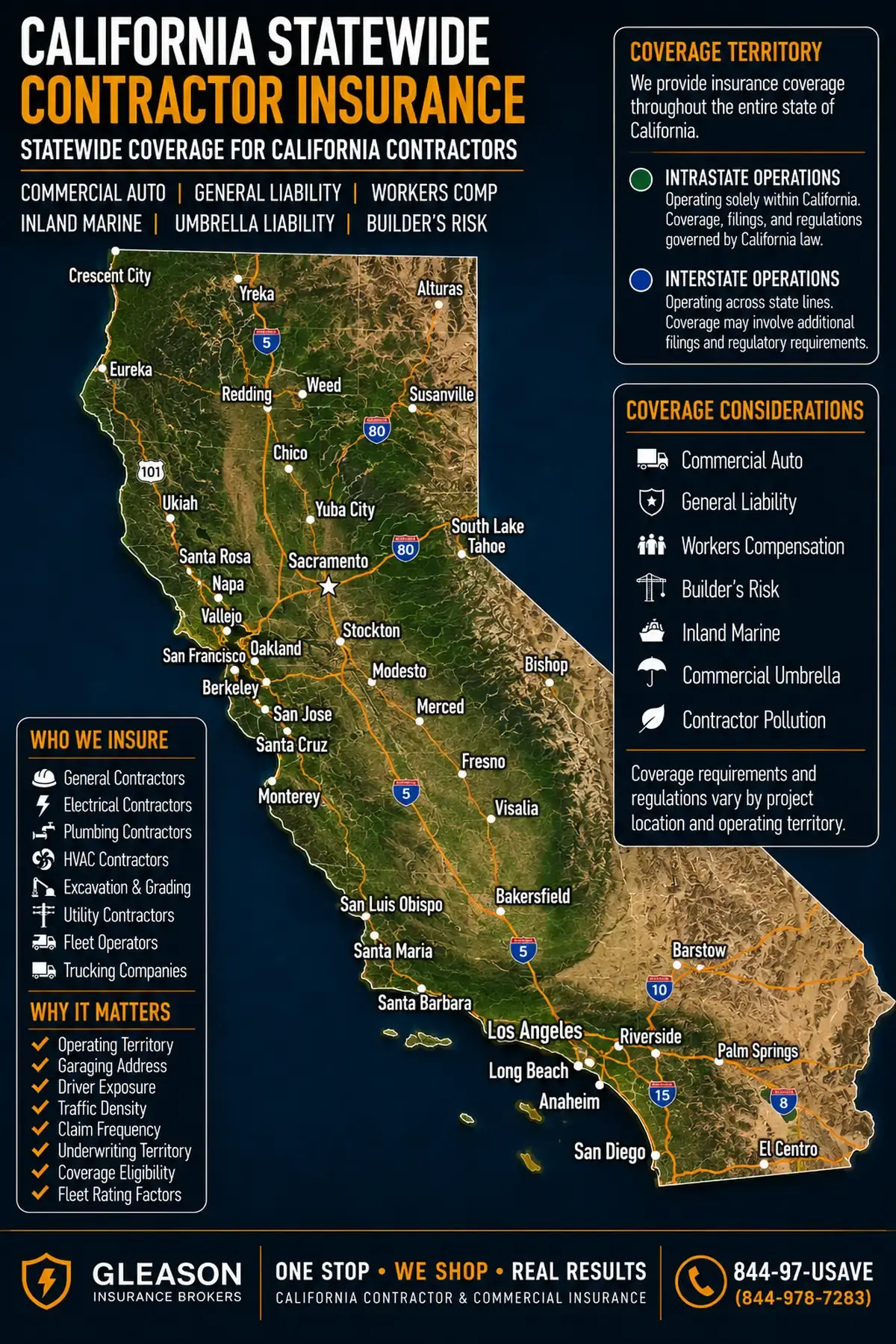
844-978-7283- General contractors
- Electrical contractors
- Plumbing contractors
- HVAC contractors
- Excavation and grading
- Utility contractors
- Fleet operators
- Trucking companies
- Operating territory
- Garaging address
- Driver exposure
- Traffic density
- Claim frequency
- Underwriting territory
- Coverage eligibility
- Fleet rating factors
- Commercial auto
- General liability
- Workers compensation
- Builders risk
- Inland marine
- Commercial umbrella
- Contractor pollution
Radius, territory, vehicle use, jobsite locations and garaging ZIP code can all influence commercial insurance pricing and underwriting eligibility. The zones shown describe how far this agency places coverage; they are not a statement of what any policy covers.
What this means for a contractor's broader insurance program
Wildfire-driven market conditions have contributed to broader property and builders risk market hardening across California in recent years — tighter carrier appetite and more underwriting scrutiny generally, not limited only to properties in the highest-risk zones. This affects a contractor's own commercial property insurance — the coverage on a permanent shop, yard or office — just as much as builders risk on active projects, since both are underwritten against the same wildfire risk data. This makes proactive underwriting readiness more valuable across the board, not just for contractors working directly in fire-exposed areas.
For a growing contractor or developer taking on more projects in a range of California locations, understanding which of those locations carry elevated wildfire exposure — and building extra submission lead time into projects that do — has become a practical part of project planning rather than an unusual precaution.
More from State Rules
Utah's $7,000 Handyman Exemption: When a Project Needs a Licensed Contractor
Utah's handyman exemption ends at $7,000 in labor and materials, covers only work on an existing building, and never covers trade work such as plumbing or electrical — so far more jobs need a licensed contractor than people expect
By David Gleason · Published August 24, 2026 · Updated October 11, 2026
Nevada's Small-Job Exemption: Why It's Riskier Than It Sounds
Nevada has a narrow exemption from contractor licensing for very small jobs — repair or maintenance work under $1,000 in labor and materials (NRS 624.031) — but treating it as a reliable way to skip licensin
By David Gleason · Published August 24, 2026 · Updated October 11, 2026
Why Texas Doesn't License General Contractors (and What That Means for You)
Texas is the outlier among the five states GIB serves — there's no statewide general contractor license at all, which surprises contractors used to how California, Arizona and Neva
By David Gleason · Published August 24, 2026 · Updated October 11, 2026
California Title 24 Energy Efficiency Standards: What Insulation, Electrical, HVAC and Roofing Contractors Need to Know
How California's Title 24 energy standards touch insulation, electrical, HVAC and roofing on the same project, and what it means for completed-operations risk.
By David Gleason · Published August 24, 2026 · Updated October 11, 2026
Frequently asked questions
7 questions — start typing to filter
Does wildfire risk affect general contractor insurance or just builders risk?
Builders risk is where wildfire risk shows up most directly, since it's tied to a specific property's exposure — but broader market hardening driven partly by wildfire losses has also affected commercial property and, to some degree, general liability pricing and underwriting scrutiny across California more broadly.
How do I find out if my project is in a high wildfire hazard zone?
CAL FIRE publishes Fire Hazard Severity Zone maps covering both State Responsibility Areas and Local Responsibility Areas — checking your specific parcel against the current map is the direct way to confirm zone status before assuming a builders risk submission will be standard.
Does wildfire rebuild work need different insurance than new construction?
The core coverage lines are similar, but classification, timeline pressure and completed operations exposure are worth reviewing specifically for rebuild and restoration work rather than assuming standard new-construction assumptions apply cleanly.
Should I start my builders risk submission earlier for a fire-exposed project?
Generally yes — fire-exposed submissions often require more underwriting detail than a standard one, and starting earlier in project planning avoids discovering a coverage gap or limited carrier appetite close to a financing deadline.
Are contractors doing wildfire-prevention work (defensible space, vegetation clearing) at different insurance risk than rebuild contractors?
Yes — different operational exposures apply, and a contractor doing both prevention and rebuild work should confirm their policy reflects both scopes rather than assuming one covers the other.
Does a property's wildfire risk score affect a contractor's own insurance, or just the property owner's?
It can affect a contractor's builders risk pricing and availability for a specific project in a high-risk zone, separate from how it affects the property owner's homeowners or commercial property coverage.
Has California limited insurers' ability to non-renew policies in high wildfire risk areas?
California has adopted regulatory measures affecting non-renewals in some high-risk areas in recent years — confirm current rules with the California Department of Insurance, since this area has seen active regulatory change.