
General liability and workers compensation come first
General liability responds to third-party bodily injury and property damage from your work; workers compensation is required once there's any employee, and for a growing list of CSLB classifications, even without one. Nearly every California contractor carries both from day one, regardless of trade.
These two lines cover different categories of harm — third parties versus your own employees — and neither substitutes for the other, even when both could plausibly respond to the same incident.
The CSLB bond and commercial auto follow closely
The $25,000 CSLB license bond (plus a separate $100,000 bond for LLC licensees) is a licensing requirement, not insurance — it has to be in place to hold an active license, so it's effectively mandatory alongside GL and workers comp. Commercial auto becomes necessary the moment a vehicle is titled to the business or regularly used for work.
A personal auto policy typically excludes business use, which is why waiting until after an accident to add commercial auto is one of the more common, avoidable gaps.
Sources for this section
- CSLB — Contractors State License BoardVerified 2026-08-22
Builders risk and umbrella round out most programs
Builders risk covers the structure itself during construction, usually required by the construction lender — this is project-specific coverage, not part of an annual policy. Umbrella liability raises limits above the primary GL, auto and employer's liability policies, most often added when a contract requires a total limit no single underlying policy reaches on its own.
These two tend to arrive as a contractor's typical project size grows, rather than being part of the very first policy a new contractor buys.
One Stop · We Shop · Real Results
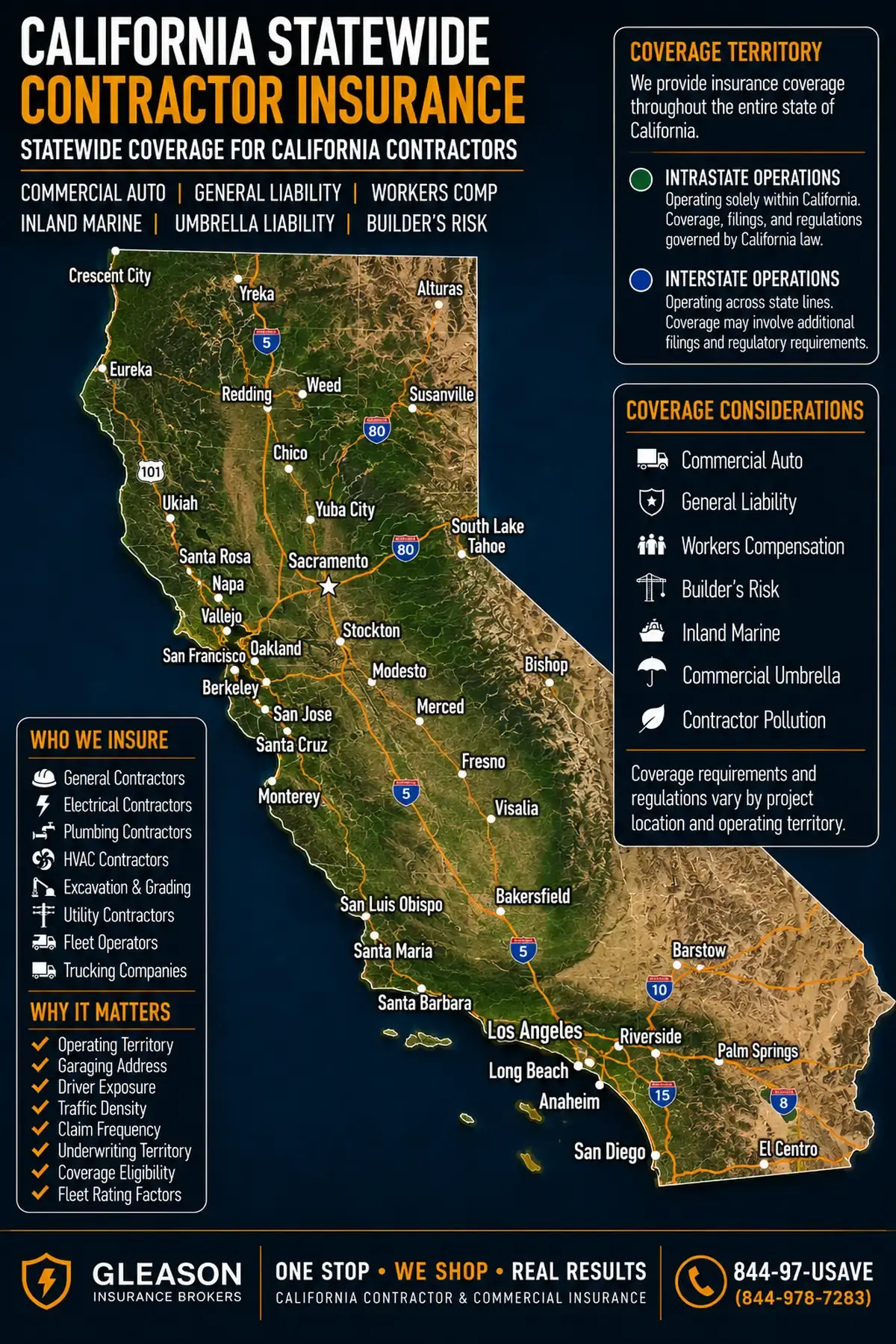
844-978-7283- General contractors
- Electrical contractors
- Plumbing contractors
- HVAC contractors
- Excavation and grading
- Utility contractors
- Fleet operators
- Trucking companies
- Operating territory
- Garaging address
- Driver exposure
- Traffic density
- Claim frequency
- Underwriting territory
- Coverage eligibility
- Fleet rating factors
- Commercial auto
- General liability
- Workers compensation
- Builders risk
- Inland marine
- Commercial umbrella
- Contractor pollution
Radius, territory, vehicle use, jobsite locations and garaging ZIP code can all influence commercial insurance pricing and underwriting eligibility. The zones shown describe how far this agency places coverage; they are not a statement of what any policy covers.
The order isn't arbitrary — it follows real risk
This sequence isn't a sales script — GL and workers comp address the most universal, immediate exposures; the bond is a licensing gate; auto and builders risk track real operational milestones (a company vehicle, a bigger project); umbrella responds to what contracts start demanding as the business grows.
A contractor reviewing their program should check it against actual current operations, not just against what was purchased when the business was smaller.
More from Coverage & Endorsements
How Much General Liability Coverage Does a California Contractor Need?
There is no single required general liability limit for California contractors. CSLB does not set one, and the number that matters in practice is usually the one written into the s
By David Gleason · Published August 24, 2026 · Updated October 11, 2026
Additional Insured Endorsements: What Subcontractors Get Asked to Provide, and Why
A request to be named "additional insured" is one of the most common insurance requirements a subcontractor sees — and one of the most commonly misunderstood, because a certificate
By David Gleason · Published August 24, 2026 · Updated October 11, 2026
Primary and Noncontributory Wording: What It Means and Why GCs Ask for It
"Primary and noncontributory" shows up in almost every GC contract's insurance requirements — and most subcontractors sign off on it without knowing what it actually changes about
By David Gleason · Published August 24, 2026 · Updated October 11, 2026
Frequently asked questions
7 questions — start typing to filter
Do all California contractors need all six of these coverage lines?
Not necessarily all six from day one — GL, workers compensation and the CSLB bond are close to universal; commercial auto, builders risk and umbrella typically get added as operations, fleet and contract size grow.
Which coverage line should a brand-new contractor get first?
General liability and the CSLB bond are needed to operate at all; workers compensation becomes required the moment there's an employee.
Does a bigger business automatically need higher limits on all six lines?
Not automatically — limits should track actual project size, fleet exposure and specific contract requirements, not just revenue growth.
How often should this six-line program be reviewed?
At least annually, and any time operations change materially — a new vehicle, a larger project, a new contract requirement.
What's usually the first coverage line a new contractor adds beyond the basics?
Surety bonds are often the first addition beyond general liability and workers compensation, since a CSLB license requires an active bond before work can legally begin.
Does adding more coverage lines mean separate policies with separate carriers?
Not necessarily — some carriers offer package policies bundling several of these lines together, which can simplify administration, though not every combination is available from every carrier.
Which of these six lines is most often missing from an otherwise complete program?
Inland marine (equipment coverage) is commonly overlooked, since contractors sometimes assume mobile equipment is automatically covered under commercial property or auto policies when it typically isn't.