
Why "personal use" and "business use" are treated differently
Personal auto policies are priced and underwritten around personal, non-business use. Many personal policies specifically exclude or limit coverage for vehicles used substantially for business — hauling tools, materials or equipment to job sites, transporting employees, or vehicles with more than 1,000 pounds of upfit equipment.
The exclusion is about how the vehicle is actually used, not just its title or registration — a truck personally owned and titled can still trigger a business-use exclusion if it's regularly used for the business.
What commercial auto insurance is built for
A commercial auto policy is underwritten for business use from the start — hauling equipment, multiple drivers, higher mileage patterns and job-site travel are expected, not exceptions. It also typically allows for higher liability limits and can be written alongside physical damage and equipment coverage for tools carried in the vehicle.
Commercial auto is usually required outright once a vehicle is titled to the business, carries commercial plates, or is used to transport employees as part of the job.
One Stop · We Shop · Real Results
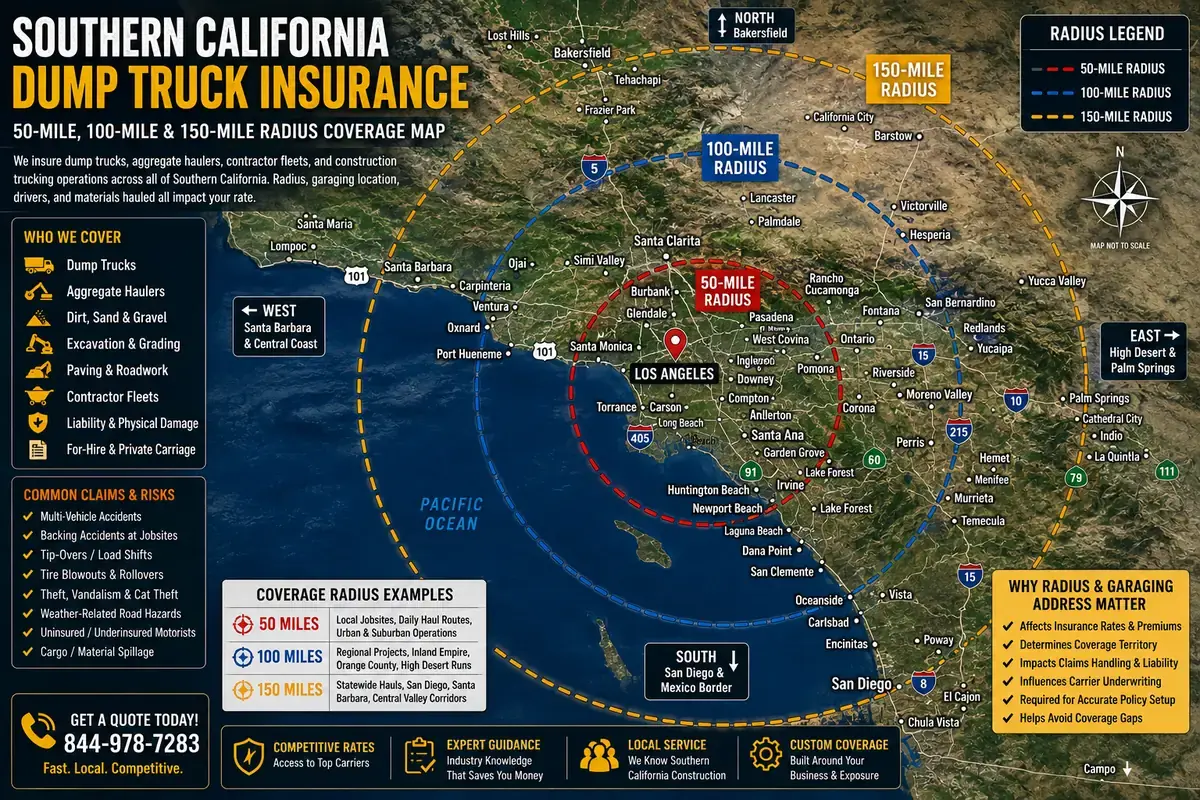
844-978-7283- Dump trucks
- Aggregate haulers
- Dirt, sand and gravel
- Excavation and grading
- Paving and roadwork
- Contractor fleets
- Liability and physical damage
- For-hire and private carriage
- Multi-vehicle accidents
- Backing accidents at jobsites
- Tip-overs and load shifts
- Tire blowouts and rollovers
- Theft, vandalism and catalytic converter theft
- Weather-related road hazards
- Uninsured and underinsured motorists
- Cargo and material spillage
- Affects rates and premiums
- Determines coverage territory
- Impacts claims handling and liability
- Influences carrier underwriting
- Required for accurate policy setup
50 miles — Local jobsites, daily haul routes, urban and suburban operations
100 miles — Regional projects, Inland Empire, Orange County, High Desert runs
150 miles — Statewide hauls, San Diego, Santa Barbara, Central Valley corridors
Radius, garaging location, drivers and the materials hauled can all influence commercial insurance pricing and underwriting eligibility. The zones shown describe how far this agency places coverage; they are not a statement of what any policy covers.
Where this gets missed
A common scenario: an owner-operator starts a business, keeps insuring the truck personally because that's how it's always been done, and the vehicle's use gradually shifts toward hauling materials and equipment for paying jobs. Coverage that was adequate at the start can become a real gap without any single obvious moment where it should have changed.
A loss involving a vehicle whose actual use doesn't match what was disclosed on the personal policy application can result in a denied claim, not just a coverage gap for future events.
What to check before assuming coverage is in place
Confirm with the current auto carrier, in writing, whether business use of a specific vehicle is covered and under what conditions — don't rely on a verbal assumption from when the policy was first written. If the vehicle hauls tools or equipment, ask specifically whether that property is covered or needs separate inland marine coverage.
For businesses running several vehicles or a mix of owned and leased trucks, a dedicated commercial auto or fleet policy is generally the more reliable structure than trying to keep several personal policies compliant with business use.
A real example: liability limits without physical damage
Picking the right policy is only half the review; the coverage parts matter too. A general contractor in our files carried a $1,000,000 commercial auto liability limit but no comprehensive or collision. After an at-fault accident the other party was paid in full, while the contractor covered the company truck's repairs personally (case study 8).
More from Fleet & Auto
Frequently asked questions
7 questions — start typing to filter
Can I keep insuring my work truck under my personal auto policy?
It depends on the policy and how the vehicle is actually used. Many personal policies exclude or limit substantial business use, hauling equipment, or employee transport — confirm directly with the carrier in writing rather than assuming.
What triggers the need for commercial auto coverage?
Common triggers include titling the vehicle to the business, commercial plates, regularly hauling tools or materials for paying jobs, or transporting employees as part of the work — no single factor is universal, so ask the carrier directly.
Does commercial auto insurance cover tools and equipment in the truck?
Not always automatically — equipment carried in a vehicle is sometimes covered separately under an inland marine or equipment policy. Confirm what's included before assuming tools are covered.
What happens if a claim reveals undisclosed business use?
A personal auto claim can be denied if the vehicle's actual use didn't match what was disclosed when the policy was written or renewed.
Does a magnetic business sign on a personal vehicle trigger the need for commercial coverage?
Not by itself, but frequent business use — hauling tools, visiting job sites, transporting materials — typically does, regardless of whether the vehicle displays signage.
Are 1099 subcontractors' vehicles the contractor's insurance responsibility?
Generally no — an independent subcontractor's vehicle is typically their own insurance responsibility, though the contract should clarify this and confirm the sub carries the coverage the contract requests.
Does the vehicle need to be titled to the business to qualify for commercial auto coverage?
Not necessarily — commercial auto coverage is based on use, not title, though how a vehicle is titled and financed can affect which policy structure fits best.