
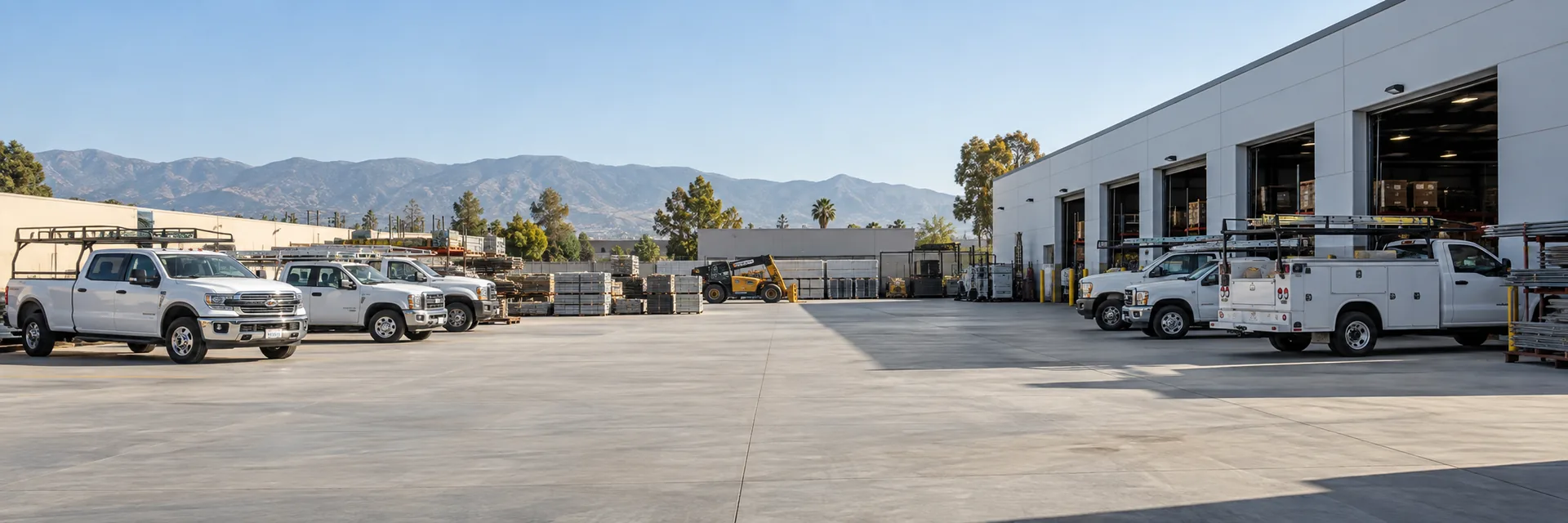
The San Jose/South Bay construction landscape
Corporate campus construction and expansion, high-density residential infill near transit, and ongoing commercial tenant-improvement work across Santa Clara County and the South Bay all coexist here — often with institutional developers and large corporate tenants setting their own detailed insurance requirements.
Contractors working directly with major employers or their developers should expect more detailed vetting and specific endorsement requirements than typical residential or small commercial work.
Public works in Santa Clara County includes both new construction (schools, municipal facilities keeping pace with the region's growth) and renovation of existing public buildings, alongside highway and transit-corridor work that carries the same elevated liability requirements seen on public infrastructure projects statewide. South of San Jose, contractor insurance in Morgan Hill covers new-build work in south Santa Clara County.
Core coverage for South Bay contractors
General liability, workers compensation and a CSLB bond form the baseline — for contractors working corporate campus or major tenant-improvement projects, higher limits and specific additional insured wording from institutional clients are common.
Professional liability is worth reviewing for contractors offering design-build or value-engineering services on tech campus projects, where design input is more common than on standard residential work.
Utility locating and jobsite compliance in the South Bay
USA North 811 covers Northern and Central California including Santa Clara County — required before excavation on any project.
High-density infill work near existing transit and utility corridors often involves more complex underground coordination than greenfield construction — locate compliance and careful site documentation matter accordingly.
Sources for this section
- USA North 811 — Northern/Central California Utility LocateVerified 2026-08-22
Beyond contractors: developers, restaurants and breweries in San Jose
Construction and transportation are our strongest focus in San Jose, but the same disciplined submission and coverage-review process extends to two more industries with real presence here: real estate developers and subdividers managing project-specific risk through entitlement and construction, and restaurants and breweries carrying liquor liability, property and hospitality workers compensation exposure. Contractors who handle restaurant remodels in the San Jose area can point owners to San Jose restaurant and brewery coverage for the operating side.
We treat it as the same account, not a separate one — a tech-sector GC branching into a side restaurant venture, or a developer syncing subdivision bonds with a contractor's builders risk, gets a single point of contact instead of split relationships. Subdivision and site-development work in the San Jose area often runs on owner-specified limits, and San Jose developer and subdivider coverage explains what the developer carries.
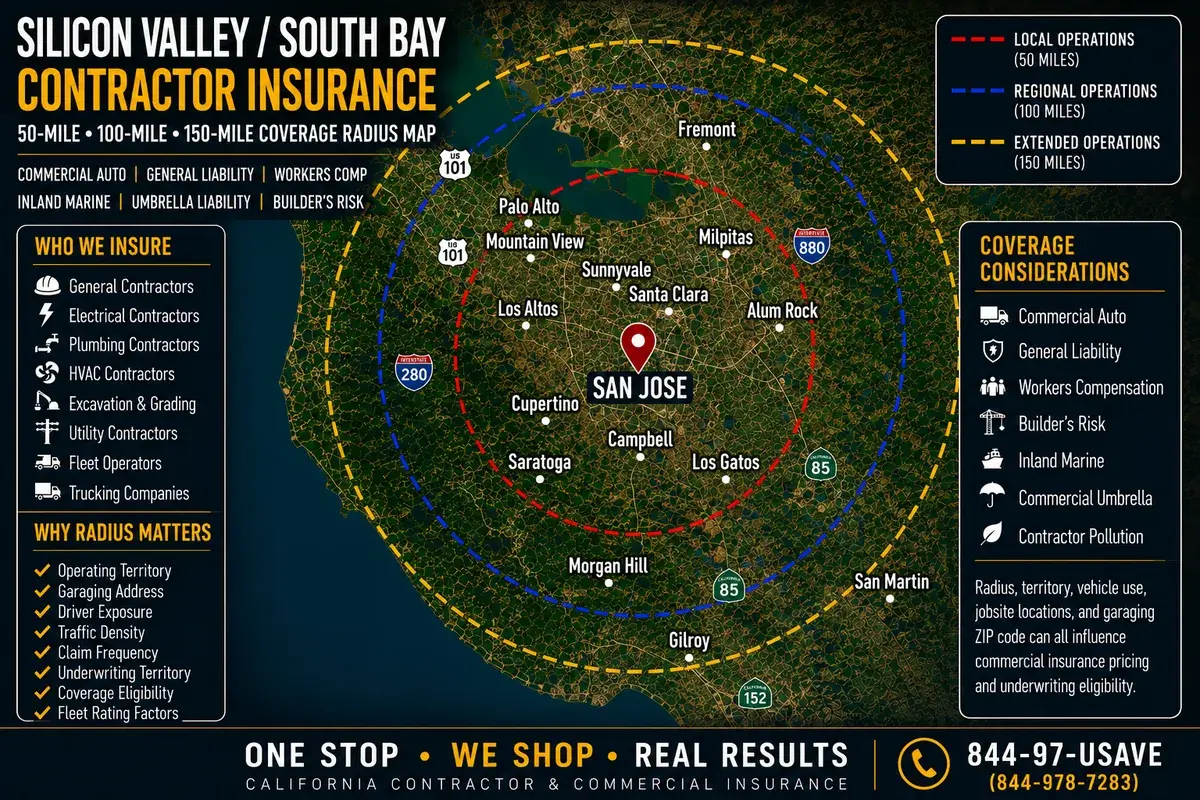
One Stop · We Shop · Real Results
844-978-7283- General contractors
- Electrical contractors
- Plumbing contractors
- HVAC contractors
- Excavation and grading
- Utility contractors
- Fleet operators
- Trucking companies
- Operating territory
- Garaging address
- Driver exposure
- Traffic density
- Claim frequency
- Underwriting territory
- Coverage eligibility
- Fleet rating factors
- Commercial auto
- General liability
- Workers compensation
- Builders risk
- Inland marine
- Commercial umbrella
- Contractor pollution
Radius, territory, vehicle use, jobsite locations and garaging ZIP code can all influence commercial insurance pricing and underwriting eligibility. The zones shown describe how far this agency places coverage; they are not a statement of what any policy covers.
Local permitting and compliance
The figures below are the minimums a city commonly requires before it issues a permit. They are not a recommendation and not a coverage benchmark — several are decades old, and none of them reflect what a general contractor's subcontract, a lender or an owner will require on the same job. Treat $1,000,000 per occurrence as the practical floor for commercial general liability and confirm the current municipal requirement with the department named before you rely on any figure here. What is published here may also be out of date or contain errors, and requirements vary by city, county, state, agency, project and contract, among other things — verifying what applies to your own job, with the permitting agency and your own contract documents, is your responsibility.
The City of San José issues encroachment permits through Public Works Development Services for work by private developers and residents in the public right-of-way: revocable encroachments for construction activity such as crane work, covered walkways, lane closures and monitoring wells (Municipal Code 13.36), long-term private improvements over the right-of-way (13.37), sewer laterals, and private utility or joint-trench work built by contractors for a developer. Every encroachment permit type typically requires plans, fees and a security deposit sized during review to guarantee repair of any public improvement the work damages, and insurance filed with the City's Risk Manager. San José's contractor insurance requirements go further than most cities in one respect: alongside general liability at $1,000,000 per occurrence on ISO CG 00 01 including completed operations, $1,000,000 auto liability for owned, non-owned and hired vehicles, and $1,000,000 employers liability, they call for contractor's pollution liability of $1,000,000 per contamination incident, covering completed operations as well. The City has to be added as an insured under both the liability and auto policies, including completed operations, on a primary basis with a waiver of subrogation on every line and 30 days' warning before any cancellation or cut in coverage; deductibles and self-insured retentions must be declared and approved, and each subcontractor is either covered by the contractor's own policies or files their own certificates and endorsements. Sidewalk repair and replacing an existing driveway in the same place go through the Department of Transportation instead. In unincorporated Santa Clara County, the Roads and Airports Department requires an encroachment permit for any work in a County road right-of-way and publishes its own insurance requirements with the application; that document blocks automated access, so confirm the terms with the permit office at (408) 573-2475 before a certificate goes out. On a state highway, the permit comes from Caltrans District 4.
Sources for this section
- City of San José encroachment permitsVerified 2026-09-21
- City of San José Public Works contractor insurance requirements (PDF)Verified 2026-09-21
- Santa Clara County encroachment permits (unincorporated county roads)Verified 2026-09-21
- Caltrans encroachment permitsVerified 2026-09-21
Getting South Bay coverage in place
Describe your actual operating cities, typical project type — corporate campus, infill, tenant improvement — and any specific institutional client requirements.
Gleason Insurance Brokers places coverage for contractors throughout the San Jose/South Bay metro — call 844-978-7283 or request a quote to get started.
Electrical contractor insurance in San Jose: the data center buildout
San Jose's electrical contractor demand is being driven directly by an active 2026 data center buildout — Microsoft broke ground on a 48-megawatt campus in San Jose's Alviso neighborhood in June 2026, and Prologis filed a permit for a 99-megawatt facility in July 2026. Notably, this growth is concentrated in San Jose specifically rather than Santa Clara: Santa Clara's own electric grid capacity is now effectively maxed for new large loads, pushing new development toward San Jose instead — a real distinction worth knowing rather than assuming the two cities carry identical current demand.
Electrical contractor insurance for San Jose data center work involves genuinely different exposure than standard commercial electrical — high-voltage utility-scale power infrastructure, generator and switchgear installation, and coordination with the utility on interconnection. See our full Electrical & Solar Contractor Insurance guide for the coverage considerations specific to this scope of work.
Frequently asked questions
7 questions — start typing to filter
Do corporate campus projects require different insurance than residential work?
Often yes — institutional developers and major corporate tenants commonly set higher limits and specific endorsement requirements beyond standard residential contractor coverage.
Which utility locate service applies in the South Bay?
USA North 811 serves Northern and Central California including Santa Clara County — required before any excavation.
Does Gleason Insurance Brokers cover contractors throughout the South Bay, including submarkets like Sunnyvale and Palo Alto?
Yes — we place coverage across the full San Jose/South Bay metro and its submarket cities.
Do I need professional liability coverage for tech campus design-build work?
Potentially — if you provide any design input or value engineering as part of the work, that exposure isn't automatically covered by general liability alone.
Do you also place coverage for developers and restaurants in San Jose?
Yes — alongside contractor insurance, we place Developer & Subdivider and Restaurant & Brewery coverage throughout the San Jose/South Bay metro.
How quickly can contractor coverage actually be put in place in San Jose?
The timeline depends on the specific coverage and how complete the submission is going in — incomplete information is the most common cause of delay. Sharing prior loss runs and current operations details upfront avoids the back-and-forth that slows most submissions down.
Does Gleason Insurance Brokers need to visit my San Jose location in person?
No in-person visit is required — what matters is accurate information about your actual operations, not physical proximity to a broker's office. This is true across every state we serve — physical distance doesn't change how coverage gets placed.