
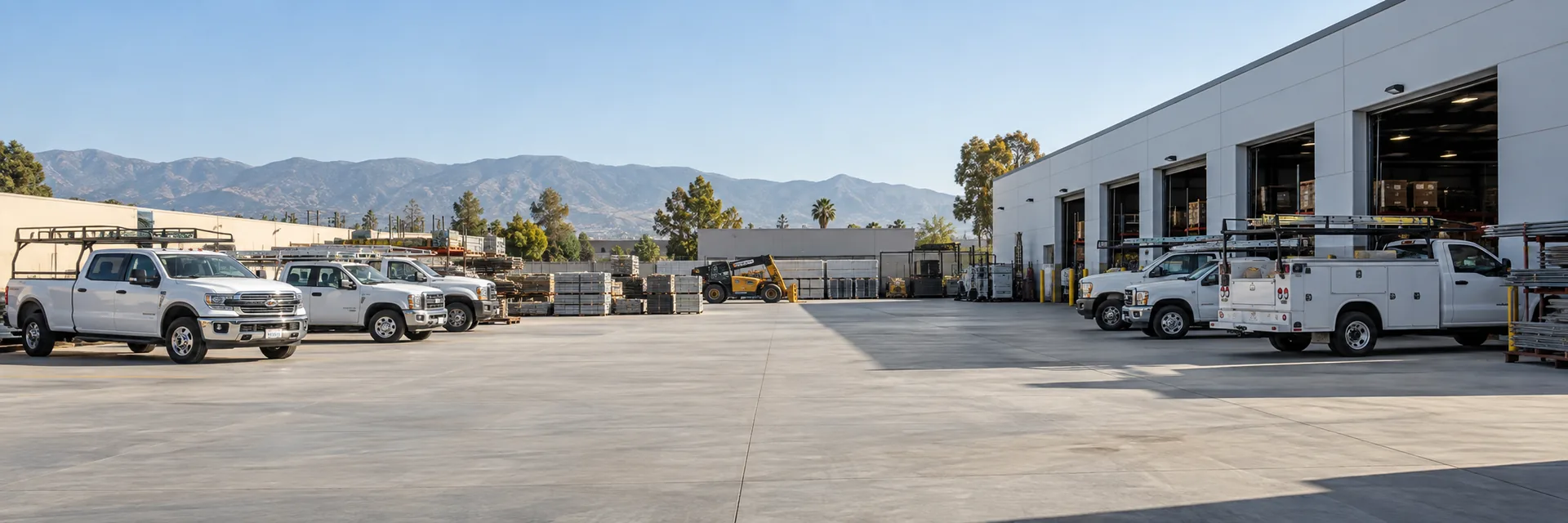
The Inland Empire construction landscape
Large-scale logistics and warehouse/distribution center construction has driven significant growth across the Inland Empire over the past decade, alongside continued residential development in communities like Corona, Murrieta and Temecula.
Warehouse and logistics construction carries a different risk and equipment profile than residential work — larger project values, different equipment needs, and often different contract requirements from institutional developers and REITs.
Public infrastructure work here includes highway and freight-corridor projects supporting the region's major logistics economy, alongside new and renovated municipal and school facilities keeping pace with rapid population growth across Riverside and San Bernardino counties.
Core coverage for Inland Empire contractors
General liability, workers compensation and a CSLB bond form the baseline — for contractors working large logistics and warehouse projects, higher limits and specific additional insured requirements from institutional developers are common.
Builders risk on large warehouse and distribution projects can involve substantial project values — confirm the policy structure fits the actual project scale rather than assuming standard terms.
Utility locating and jobsite compliance in the Inland Empire
DigAlert covers Southern California including San Bernardino and Riverside counties — required before excavation on any project.
Large logistics and warehouse sites often involve significant grading and underground utility work — locate compliance and coordination with site civil engineers matters more on these larger-scale projects.
Sources for this section
- DigAlert — Southern California Utility LocateVerified 2026-08-22
- Southern California Edison (SCE) — Electric UtilityVerified 2026-08-23
Beyond contractors: developers, restaurants and breweries in the Inland Empire
Construction and transportation are our strongest focus in the Inland Empire, but the same disciplined submission and coverage-review process extends to two more industries with real presence here: real estate developers and subdividers managing project-specific risk through entitlement and construction, and restaurants and breweries carrying liquor liability, property and hospitality workers compensation exposure. Contractors who handle restaurant remodels in the Inland Empire can point owners to Inland Empire restaurant and brewery coverage for the operating side.
We keep it to one relationship — a warehouse-sector contractor who also owns a restaurant, or a developer coordinating bonding alongside a contractor's builders risk, works through the same broker and process across both lines. Subdivision and site-development work in the Inland Empire often runs on owner-specified limits, and Inland Empire developer and subdivider coverage explains what the developer carries.
One Stop · We Shop · Real Results
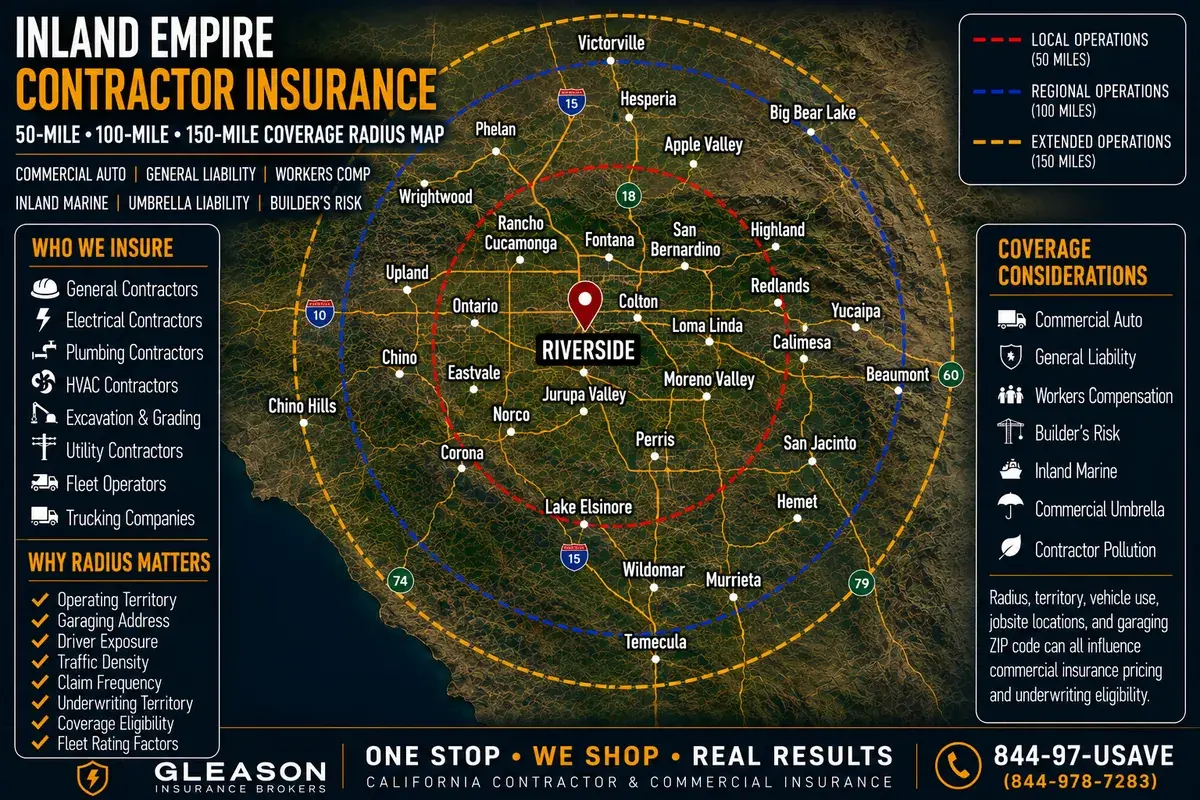
844-978-7283- General contractors
- Electrical contractors
- Plumbing contractors
- HVAC contractors
- Excavation and grading
- Utility contractors
- Fleet operators
- Trucking companies
- Operating territory
- Garaging address
- Driver exposure
- Traffic density
- Claim frequency
- Underwriting territory
- Coverage eligibility
- Fleet rating factors
- Commercial auto
- General liability
- Workers compensation
- Builders risk
- Inland marine
- Commercial umbrella
- Contractor pollution
Radius, territory, vehicle use, jobsite locations and garaging ZIP code can all influence commercial insurance pricing and underwriting eligibility. The zones shown describe how far this agency places coverage; they are not a statement of what any policy covers.
Newer growth cities across the Inland Empire
The Inland Empire's growth isn't confined to the established logistics corridor along the 60 and 10 freeways — a newer wave of high-growth communities across southwest Riverside County and the High Desert is bringing the same warehouse, mixed-use and residential construction demand further out. Menifee is currently one of California's fastest-growing cities, and Eastvale, Perris and Jurupa Valley are seeing the same logistics-driven commercial development that reshaped the core Inland Empire a decade earlier, now pushing into these newer growth corridors.
Chino is approaching 100,000 residents with active mixed-use development on the western edge of the region, and Victorville anchors a separate High Desert logistics corridor along the I-15 — a genuinely different jobsite environment from the core Inland Empire, with its own permitting and site-access considerations. A contractor working across both the core Inland Empire and these newer or more remote growth cities benefits from coverage reviewed against the full geographic footprint, not just the traditional metro core.
Getting Inland Empire coverage in place
Describe your actual operating cities, typical project type — logistics/warehouse or residential — and any specific institutional developer requirements.
Gleason Insurance Brokers places coverage for contractors throughout the Inland Empire — call 844-978-7283 or request a quote to get started.
Concrete and paving contractor insurance in the Inland Empire: the warehouse economy
The Inland Empire is one of the largest warehouse and logistics clusters in the United States, and a large share of the cargo moving through the ports of Los Angeles and Long Beach passes through its warehouses before reaching the rest of the country. That scale translates directly into concrete and paving demand: massive tilt-up warehouse slabs, truck court paving built for constant heavy-truck loading, and the site/grading work that comes before it.
Concrete and paving contractor insurance for Inland Empire warehouse construction needs to reflect that scale — large single-project exposure, heavy equipment traffic loading on paved surfaces designed for it, and often a public works or developer-driven insurance requirement layered on top of standard coverage for a project of this size. See our full Concrete & Paving Insurance guide and Excavation & Grading Insurance guide for the site-work side of the same projects.
Frequently asked questions
7 questions — start typing to filter
Do warehouse and logistics projects need different coverage than residential work?
Often yes — institutional developers commonly require higher limits and specific additional insured endorsements beyond what standard residential contractor coverage provides.
Which utility locate service applies in the Inland Empire?
DigAlert serves Southern California including San Bernardino and Riverside counties — required before any excavation.
Does Gleason Insurance Brokers cover contractors throughout the Inland Empire, including submarkets like Corona and Temecula?
Yes — we place coverage across the full Inland Empire metro and its submarket cities.
Does builders risk work differently for large warehouse projects?
The mechanics are similar, but policy structure needs to match the actual project value and scale — confirm this rather than assuming standard terms fit a large logistics project.
Do you also place coverage for developers and restaurants in the Inland Empire?
Yes — alongside contractor insurance, we place Developer & Subdivider and Restaurant & Brewery coverage throughout the Inland Empire.
How quickly can contractor coverage actually be put in place in Inland Empire?
Turnaround varies by carrier and how complete the submission is, but standard coverage can often be bound within a few business days once all the information is in. A missing loss run or an incomplete schedule is the most common reason a quote takes longer than expected.
Does Gleason Insurance Brokers need to visit my Inland Empire location in person?
No — coverage is placed based on your actual operations and documentation, not a physical office visit. What actually protects your business is accurate underwriting information, not a broker's ZIP code.