
Coverage lines at a glance7 sections
The baseline: general liability and workers compensation
General liability covers third-party bodily injury and property damage arising from your work — the policy most construction contracts point to first. Workers compensation is required once a California business has any employee, and for a growing list of CSLB classifications, even without one.
These two lines address fundamentally different categories of harm (third parties vs. your own employees) and neither substitutes for the other, even though both can trigger from the same incident.
Licensing and project guarantees: bonds
The CSLB license bond ($25,000, plus a separate $100,000 bond for LLC licensees) is required to hold an active contractor license. Bid, performance and payment bonds apply per-project on larger work, guaranteeing the contractor will honor a winning bid and complete the work as contracted.
Bonds run on credit-based underwriting, distinct from insurance's loss-history-based underwriting — see the Bonding & Surety Guide for the full mechanics.
Vehicles and equipment: commercial auto and inland marine
Any vehicle titled to the business or regularly used for business purposes needs commercial auto coverage — a personal auto policy typically excludes business use and can deny a claim outright. Inland marine covers tools and equipment that move between jobsites, which a location-based commercial property policy typically doesn't reach.
Hired and non-owned auto (rented trucks, employee personal-vehicle use for business errands) is a commonly missed gap worth confirming explicitly rather than assumed bundled into the main auto policy.
Project-specific coverage: builders risk and OCIP/CCIP
Builders risk covers the physical structure while under construction — a different job than general liability, and one most construction lenders require as a loan condition. On larger projects, an OCIP or CCIP wrap-up program may replace individual subcontractor policies for that specific job, purchased by the owner or GC respectively.
Both are project-specific rather than annual/ongoing coverage, which means they need to be arranged per-project rather than assumed to already exist within a standard annual program.
Raising the ceiling: umbrella and excess liability
Umbrella and excess liability extend coverage above your primary GL, auto and employer's liability limits — frequently the specific ask in a GC's insurance requirement letter when a contract demands a total limit no single underlying policy reaches on its own.
An umbrella only works in coordination with the policies underneath it; it isn't a standalone product and can't fill a gap in coverage type, only extend a limit that already exists at the primary level.
Specialized exposures: pollution, professional liability, cyber
Pollution liability addresses contamination discovered during excavation, grading or demolition — an exposure standard GL typically excludes entirely. Professional liability (E&O) addresses design or judgment failures for contractors who provide engineering input or value-engineering suggestions. Cyber liability addresses business email compromise and data-related incidents, increasingly relevant given the size of typical construction progress payments.
None of these three are needed by every contractor, but each is easy to underestimate specifically because they don't come up until the one project or the one email that actually triggers them.
Putting the map together for your business
Map
Most contractors start with GL, workers compensation and the CSLB bond, add commercial auto and builders risk as fleet and project size grow, and layer in umbrella, inland marine, and specialized coverage as contracts and operations demand it — the sequence follows actual business growth, not a fixed checklist applied on day one.
Gleason Insurance Brokers reviews the full picture together rather than selling one line at a time — call 844-978-7283 or request a quote, and we'll map which of these lines your actual operations need now versus later.
One Stop · We Shop · Real Results
844-978-7283- General contractors
- Electrical contractors
- Plumbing contractors
- HVAC contractors
- Excavation and grading
- Utility contractors
- Fleet operators
- Trucking companies
- Operating territory
- Garaging address
- Driver exposure
- Traffic density
- Claim frequency
- Underwriting territory
- Coverage eligibility
- Fleet rating factors
- Commercial auto
- General liability
- Workers compensation
- Builders risk
- Inland marine
- Commercial umbrella
- Contractor pollution
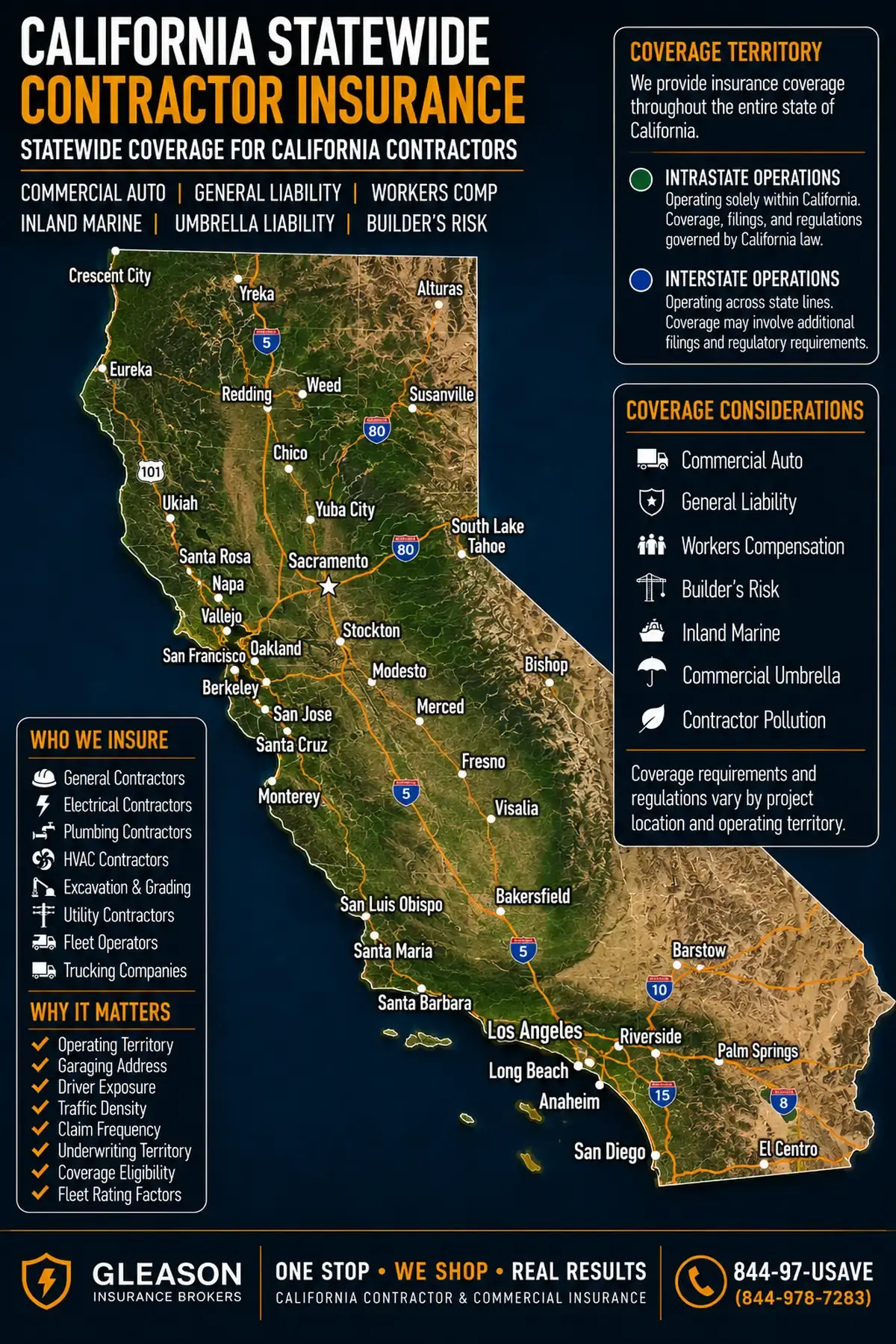
Radius, territory, vehicle use, jobsite locations and garaging ZIP code can all influence commercial insurance pricing and underwriting eligibility. The zones shown describe how far this agency places coverage; they are not a statement of what any policy covers.
How premium and defect risk actually work5 sections
Specialty structures: captives, risk retention groups, and coverage fine print worth knowing
Two structures come up as contractors scale: a captive is a company-owned or group-owned insurance arrangement that can make sense once a contractor has a strong, established safety record and wants more control over claims handling and cost — it's not a fit for a business still building loss history. A risk retention group (RRG) is a member-owned alternative to a traditional carrier, licensed in one state and operating in others under federal law; before accepting RRG coverage it's worth asking directly about the group's state of domicile, financial strength, and claims-paying history, since RRGs aren't regulated identically to admitted carriers in every state they operate in.
Two policy details are also easy to overlook until they matter. An installation floater and builders risk sound similar but cover different things — a floater covers a contractor's own materials and equipment during transit and installation, while builders risk covers the broader project. And a sunset clause on completed operations coverage caps how long after project completion the policy may respond to a claim — if a legitimate defect claim surfaces after that window closes, the policy simply doesn't respond, regardless of when the work was actually done.
Construction defect prevention: what the coverage actually depends on
California's construction defect exposure is genuinely long-tail — a latent defect claim can surface years after a project is complete, which is why completed operations coverage (not just ongoing operations) matters so much on a general liability policy, and why the specific endorsement language covering completed work needs to be confirmed rather than assumed to carry over automatically from the ongoing-operations coverage. A policy that lapses, or a carrier that's no longer writing coverage by the time a years-later claim surfaces, can leave a real gap if prior-acts and tail coverage weren't addressed when coverage changed.
Prevention matters as much as coverage here: documentation from testing, inspection and closeout (the same records covered in the Technical Resource Guide) is frequently what determines whether a defect claim years later is defensible or not. A contractor with thorough, contemporaneous documentation of what was actually built, tested and accepted is in a materially different position than one reconstructing the record from memory once a claim is filed.
Firestopping (sealing penetrations through fire-rated assemblies) and waterproofing are two of the most common sources of a later construction-defect claim precisely because both are concealed once the next trade covers them — photo documentation before cover-up is inexpensive insurance against a dispute over whether the work was actually done correctly. Both also tend to fall into the specific trade coverage gaps discussed throughout this page's exclusions-by-trade breakdown, which is worth reviewing against your specific scope of work.
Certificates of insurance vs. actual endorsements: the gap that causes claims
This distinction comes up across nearly every line of coverage on this page, which is exactly why it earns its own section here: a certificate of insurance (COI) is evidence that a policy existed on the date it was issued — it is not proof that a specific additional insured endorsement, a waiver of subrogation, or primary and noncontributory wording is actually attached to that policy. A COI can be entirely accurate about the policy's existence while the contract's actual insurance requirements go unmet, because the certificate holder field and the endorsement requirement are two different things that only sometimes match.
The practical fix is procedural: request the actual endorsement, not just the certificate, whenever a contract requires additional insured status, and confirm the specific endorsement form (CG 20 10, CG 20 37, or the applicable equivalent) rather than accepting "additional insured" as a generic assurance. This single habit — verifying the endorsement, not just the certificate — closes one of the most common and most expensive gaps across general liability, commercial auto and umbrella coverage alike.
Exclusions: why the right coverage matters more than the lowest price
A policy's limit only matters for claims the policy actually covers — an exclusion removes a specific type of claim from coverage entirely, and a low price on a policy that excludes your actual work isn't a bargain, it's a policy that won't respond when you need it most. Exclusions are trade-specific in practice even when the underlying policy language looks generic across every contractor: a roofer needs to specifically check for an open roof exclusion or height-related restrictions, since some carriers restrict or exclude steep-slope and tear-off work entirely. An excavator needs to check for an underground utility damage exclusion, since standard general liability policies commonly limit or exclude damage to underground utilities unless specifically endorsed. A pool contractor needs to check pollution exclusions given chemical handling exposure; a demolition contractor needs to check for asbestos and lead exclusions specifically.
The practical habit worth building: before assuming a policy covers your actual field risk, ask directly whether the specific type of work you perform — not just your general trade category — is excluded, restricted, or requires a separate endorsement. This is exactly the kind of question a broker should be answering as part of the review, not something discovered for the first time when a claim is denied.
Exclusions by trade & classification10 sections
How to use this trade-by-trade exclusions breakdown
The sections below break down the highest risk exposure for each trade currently covered on this site, and how that exposure commonly plays out differently across residential, townhome/multi-family, new construction, commercial and industrial work — the same trade can carry a meaningfully different risk profile depending on which of these settings the work is actually performed in. This is a California-focused reference, reflecting patterns common among CA-licensed contractors and carriers writing CA business.
None of this replaces reading an actual policy. Carriers, forms and specific exclusion wording vary — what's described here as "commonly excluded" or "often sublimited" reflects patterns seen across the industry, not a guarantee about any specific policy. If you're licensed or working outside California, confirm the equivalent classifications, exclusions and requirements with your state's licensing board and your broker directly — California's rules, classifications and common carrier practices don't automatically transfer to Arizona, Nevada, Texas, Utah or any other state.
Exclusions by trade: structural and site work
General contractors carry the broadest exposure of any trade on this list, since a GC is typically responsible for coordinating every subcontractor's risk on a project, not just their own direct work. Residential production/tract home work is often underwritten separately from custom or remodel work, since production housing carries different construction-defect litigation exposure. Townhome and condo work is frequently the most heavily scrutinized residential category — shared-wall, common-area and HOA-governed construction defect litigation is one of the largest sources of California GL claims industrywide, and some carriers sublimit or decline habitational work specifically because of it. New construction is generally the baseline exposure most GL policies are priced for. Commercial tenant improvement work often needs its own scope confirmation, since TI work inside an occupied building raises different exposure than ground-up construction. Industrial GC work typically requires higher limits and, on larger projects, OCIP/CCIP wrap-up participation.
Framing and drywall carries a specific, often-overlooked exposure: moisture intrusion behind improperly installed framing or drywall is a leading root cause of mold claims, and mold is one of the most commonly excluded or sublimited perils on standard general liability policies. This applies across residential, townhome and new construction work about equally, since the underlying cause — a moisture barrier or flashing detail done wrong — doesn't change much by setting. Townhome and multi-family framing carries the added exposure of shared-wall and common-area defect litigation described above. Commercial and industrial framing (metal stud, structural steel coordination) shift the exposure profile away from mold and toward structural defect and completed-operations claims on a larger scale.
Concrete and paving work is defined by a long-tail exposure: cracking, settling and heaving defects often don't surface for years, making completed operations coverage the single most important protection for this trade, more than the ongoing-operations coverage most contractors focus on when shopping price. Residential driveway and foundation work carries this long-tail crack exposure directly. Townhome and shared-driveway work adds multi-party liability disputes over whose work actually caused a shared-surface defect. New construction foundation work is the standard baseline exposure. Commercial paving (parking lots, ADA-compliant slopes) adds public foot-traffic and trip-and-fall liability on top of the defect exposure. Industrial concrete (heavy equipment pads, load-bearing specifications) can raise engineering-adjacent exposure that overlaps with professional liability if specifications were part of the scope.
Excavation and grading carries the highest acute-injury and property-damage severity of the structural trades: underground utility strikes, soil subsidence, and trench or shoring collapse are all real, well-documented exposures — trench collapse specifically is one of the more severe workers compensation exposures in construction. Residential excavation is typically smaller in scope but still carries strike and subsidence risk. Townhome and multi-lot grading adds drainage and shared-boundary disputes between adjacent units. New construction site development is the full-scope baseline exposure. Commercial excavation often involves larger cuts and retaining wall structural risk. Industrial excavation — deep foundations, confined space entry, heavier shoring requirements — carries the highest severity in this trade cluster, and pollution liability becomes a real question any time contaminated soil is a possibility.
Exclusions by trade: mechanical, electrical and plumbing
Plumbing's defining exposure is water damage — consistently one of the most frequent and costly general liability claim categories in construction, which is exactly why some policies sublimit water damage specifically rather than covering it at the full policy limit. Residential plumbing carries this water-damage exposure directly, plus gas line work adding fire and explosion risk. Townhome and multi-family plumbing raises the exposure further — shared risers and common plumbing systems mean a single failure can affect multiple units at once, and multi-unit water-intrusion claims are a recurring category in California condo defect litigation. New construction rough-in plumbing is the standard baseline exposure. Commercial plumbing adds backflow prevention and cross-connection liability on larger systems. Industrial plumbing (process piping, higher-pressure systems) shifts toward equipment-breakdown and higher-severity failure exposure.
Electrical and solar work centers on fire and electrocution exposure, with solar specifically adding roof-penetration and leak risk from panel mounting — the same open-roof-adjacent concern covered for roofing contractors, since solar installers are physically working on and penetrating a roof surface. Residential solar carries this roof-penetration exposure plus completed-operations fire risk that can surface well after installation. Townhome and multi-family solar (shared roofs, HOA approval processes) adds coordination and access-liability complications. New construction electrical rough-in is the standard baseline. Commercial electrical (panel and service upgrades) raises higher-voltage exposure. Industrial electrical — three-phase systems, arc flash exposure — carries the highest severity potential in this trade and often needs specific arc-flash and higher-voltage underwriting attention.
Mechanical, HVAC and refrigeration contractors already have their own dedicated depth on this site (see the Mechanical & HVAC guide) covering the commercial/residential/industrial distinction directly, including cooling tower Legionella/water-treatment exposure and boiler installation severity. Worth adding here specifically: townhome and multi-family HVAC work often involves shared rooftop unit access and ductwork running through common areas, which raises the same multi-party liability question seen in townhome plumbing and framing work — confirm who's responsible if shared equipment or ductwork is the source of a claim, not just the unit being actively serviced.
Exclusions by trade: roofing, pools, demolition and utility/pipeline
Roofing's defining exposure is the open roof exclusion covered elsewhere on this guide — water intrusion during a tear-off or re-roof — combined with fall injury risk, which makes roofing one of the highest workers compensation severity trades in construction. Residential roofing carries the open-roof and steep-slope exposure directly. Townhome and multi-family roofing (shared roof systems) raises the same multi-unit water-intrusion and HOA-dispute exposure seen in townhome plumbing and HVAC work. New construction roofing is the standard baseline. Commercial roofing (flat and low-slope) carries a genuinely different exposure profile than steep residential work — ponding water and membrane system failures replace tear-off exposure as the main concern. Industrial roofing is similar to commercial but often at larger scale with correspondingly higher severity potential.
Swimming pool contractors carry chemical/pollution exposure (covered on the dedicated Swimming Pool guide) plus completed-operations tail risk on gunite and shotcrete work. Residential pools are the baseline exposure. Townhome, HOA and shared-facility pools add higher foot-traffic liability and questions about supervision/lifeguard responsibility that a single-family backyard pool doesn't raise. New construction pool work built alongside a home carries the coordination question covered elsewhere on this site about which policy covers which scope. Commercial pools (hotels, gyms, public facilities) raise public-accommodation and ADA compliance exposure on top of the standard pool construction risk. Industrial application is uncommon for this trade.
Demolition contractors carry asbestos and lead pollution exposure (covered on the dedicated Demolition guide) as arguably the single most important line for this trade, plus adjacent-property damage risk from any demolition method. Residential demolition (single structure) carries adjacent-property risk on a smaller scale. Townhome and attached-structure demolition is meaningfully more complex — partial demolition of a shared-wall structure raises structural risk to the remaining attached units that standalone residential demolition doesn't. New construction demolition (site clearing before a build) is generally the more straightforward end of this trade's risk spectrum. Commercial demolition of older buildings carries higher likelihood of asbestos/lead discovery given building age. Industrial demolition — larger structures, more complex methods, sometimes explosive — carries the highest severity in this trade by a wide margin.
Utility and pipeline contractors carry underground utility strike exposure (covered in depth on the Utility Coordination & Strike Prevention guide) as the defining risk, with pollution exposure added any time fuel lines or contaminated soil are involved. Residential utility work (service line connections) is the smaller-scale end of this trade. Townhome and multi-unit utility work involves shared infrastructure serving multiple units at once. New construction utility installation is the standard baseline exposure for this trade. Commercial utility work involves larger distribution systems and correspondingly higher strike severity. Industrial and pipeline work — highest-pressure, highest-volume systems — carries the most severe pollution and strike exposure in this entire trade cluster, and contractors pollution liability is worth treating as close to essential rather than optional at this scale.
Exclusions by CSLB classification: finish and interior trades (C-33, C-29, C-15, C-6, C-2)
Painting and decorating contractors (C-33) carry a defining exposure most people don't expect from a trade that looks low-risk: overspray and fume/VOC exposure damaging adjacent surfaces or vehicles, plus fall risk on any exterior or multi-story work. Residential painting carries overspray and completed-operations exposure (peeling, adhesion failure showing up months later). Townhome and multi-family painting raises overspray liability across shared common areas and neighboring units at once. New construction painting is the standard baseline. Commercial painting (larger crews, higher structures) raises fall exposure and often requires higher limits given the scale of a single job. Industrial painting — specialized coatings, confined spaces, sometimes hazardous surface prep — carries meaningfully higher severity and sometimes needs pollution liability for coating chemicals.
Masonry contractors (C-29) carry heavy-material handling and structural risk — a masonry wall or veneer failure is a structural defect claim, not just a cosmetic one, and scaffolding/fall exposure applies on any multi-story work. Residential masonry (fireplaces, veneer, retaining walls) carries standard structural defect exposure. Townhome and multi-family masonry (shared retaining walls, shared exterior veneer) raises the same multi-party liability question seen across other townhome trades. New construction masonry is the baseline exposure. Commercial masonry (larger structural walls) raises severity given scale. Industrial masonry is less common but follows the same structural-severity pattern at an even larger scale.
Flooring and floor covering contractors (C-15) carry adhesive/chemical exposure (VOC fumes, flammable adhesives) plus slip-and-fall liability from improperly installed or transitioned flooring. Residential flooring carries standard installation-defect and completed-operations exposure. Townhome and multi-family flooring (shared hallways, common-area carpet/tile) raises public slip-and-fall exposure beyond a single unit. New construction flooring is the baseline. Commercial flooring (higher foot traffic, ADA transition requirements) raises slip-and-fall severity meaningfully. Industrial flooring (epoxy coatings, specialized chemical-resistant surfaces) adds its own chemical-handling exposure on top of standard installation risk.
Cabinet, millwork and finish carpentry contractors (C-6) — a distinct CSLB classification from framing and rough carpentry (C-5) — carry lower structural risk but real fire exposure from sawdust and finishing chemicals, plus completed-operations exposure on custom work (warping, adhesion failure). Residential finish carpentry (custom cabinetry, trim) is the standard baseline exposure. Townhome and multi-family finish carpentry adds the usual shared-space liability question. New construction finish work follows the project's overall completed-operations timeline. Commercial finish carpentry (retail buildouts, office millwork) is generally similar risk at larger scale. Industrial application is uncommon for this specific trade.
Insulation and acoustical contractors (C-2) carry a specific, often-overlooked exposure: improperly installed insulation is a real contributing factor in both mold claims (moisture-related) and fire claims (improper clearance around heat sources, or flammable insulation materials used incorrectly). Residential insulation carries both exposures directly. Townhome and multi-family insulation (shared attic spaces, party walls) raises multi-unit mold and fire exposure at once. New construction insulation is the standard baseline. Commercial insulation (larger systems, sometimes mechanical insulation on piping/ductwork) shifts toward fire and mechanical-system-adjacent exposure. Industrial insulation (process piping, high-temperature systems) carries the highest fire/burn severity in this trade.
Exclusions by CSLB classification: glazing, fire protection and structural steel (C-17, C-16, C-51, A)
Glazing contractors (C-17) carry a defining exposure in glass breakage and fall risk — a broken pane on a multi-story installation is both a property-damage and a bodily-injury exposure at once, and large-format glass handling itself carries real worker injury risk. Residential glazing (windows, shower enclosures) is the baseline exposure. Townhome and multi-family glazing adds shared-building-envelope liability. New construction glazing follows the standard completed-operations timeline. Commercial glazing (storefront systems, curtain wall) raises both severity and public-liability exposure given pedestrian proximity to large glass surfaces. Industrial glazing is less common but follows the same severity pattern at scale.
Fire protection contractors (C-16) — sprinkler systems, fire alarm installation — carry some of the highest stakes of any specialty trade, since a failed or improperly installed fire protection system can be the difference in a catastrophic loss, not just a property-damage claim. This is a trade where professional liability/E&O exposure often applies alongside general liability, since system design and code compliance are part of the scope. Residential fire protection (sprinkler retrofits) carries this design-and-installation exposure directly. Townhome and multi-family fire protection raises the stakes further given occupant density. New construction fire protection is the standard baseline, typically inspected and signed off before occupancy. Commercial fire protection (larger, code-driven systems) carries meaningfully higher severity. Industrial fire protection (specialized suppression systems for process hazards) carries the highest severity and complexity in this trade.
Structural steel contractors (C-51) carry acute injury risk (falls from height, crane/rigging exposure) and structural defect exposure if connections or welds fail — a structural steel failure is rarely a minor claim. Residential structural steel work is less common but follows standard structural-defect exposure when it occurs. Townhome and multi-family structural steel adds the usual shared-structure liability question. New construction structural steel is the standard, and largest, exposure for this trade. Commercial structural steel (larger spans, higher loads) raises severity. Industrial structural steel — heavy industrial framing, higher load requirements — carries the highest severity in this trade by a significant margin.
General Engineering Contractors (Class A) are a genuinely distinct classification from General Building Contractors (Class B) — Class A covers fixed works requiring specialized engineering knowledge and skill, like roads, bridges, utility systems, sewers and other heavy civil infrastructure, rather than the vertical building construction Class B covers. The risk profile differs accordingly: Class A work skews toward underground utility, excavation, public infrastructure and public works exposure covered elsewhere on this site, often at a larger project scale with correspondingly higher limits and bonding capacity requirements. If your license is actually a Class A rather than Class B, confirm your coverage is built around heavy civil/infrastructure exposure specifically rather than a generic "general contractor" policy sized for vertical building work.
Exclusions by CSLB classification: building systems (C-7, C-11, C-28, C-42)
Low voltage systems contractors (C-7) — data cabling, security wiring, low-voltage controls — carry lower shock/fire risk than full electrical work but real completed-operations exposure if a system fails to perform as designed (a security or access-control system that doesn't work is a real liability exposure, not just a warranty issue). Residential and townhome low voltage work (smart home, security wiring) carries this design-performance exposure directly. New construction low voltage is the standard baseline, typically coordinated with the electrical rough-in. Commercial low voltage (data centers, larger security systems) raises both scale and the stakes of a system failure. Industrial application is less common for this specific trade.
Elevator contractors (C-11) carry some of the highest severity exposure of any specialty trade — an elevator or lift failure is a life-safety event, not a property-damage claim, and this trade is typically underwritten with significant scrutiny and often requires specific manufacturer certifications alongside the CSLB license. Residential elevator work (accessibility lifts) carries this severity at a smaller scale. Townhome and multi-family elevator work raises occupant exposure given shared-building use. New construction elevator installation is the standard, most common exposure for this trade. Commercial and industrial elevator work (higher-capacity, higher-use systems) carries the highest severity and typically the most underwriting scrutiny in this trade.
Lock and security equipment contractors (C-28) carry a distinct exposure: a security system or lock that fails to actually secure a property can create liability for a burglary, theft or break-in loss that follows — a different kind of completed-operations claim than most trades face. Residential lock and security work carries this exposure directly, often tied to a specific security promise made to a homeowner. Townhome and multi-family security work raises shared-access and common-area exposure. New construction is the standard baseline. Commercial security systems (larger-scale access control) raise both complexity and stakes. Industrial application follows the commercial pattern at larger scale, sometimes with higher-value asset protection expectations attached.
Sanitation system contractors (C-42) — septic systems, sewage disposal — carry pollution and public health exposure as the defining risk, similar in kind to utility/pipeline work but specific to waste systems. Residential septic system work carries this pollution exposure at a smaller scale. Townhome and multi-family sanitation systems (shared septic or sewage infrastructure) raise multi-unit exposure if a system fails. New construction sanitation system installation is the standard baseline. Commercial sanitation systems (larger capacity, sometimes regulated discharge) raise both scale and regulatory exposure. Industrial sanitation/wastewater work carries the highest pollution severity in this trade, often requiring contractors pollution liability specifically.
Exclusions by CSLB classification: site, landscape and traffic trades (C-13, C-27, C-31, C-32, C-49)
Fencing contractors (C-13) carry boundary-dispute and property-line exposure alongside standard installation defect risk — a fence built on the wrong side of a property line is a real, recurring claim category distinct from workmanship quality. Residential fencing carries this boundary exposure directly. Townhome and HOA fencing work adds shared-boundary and common-area disputes. New construction fencing is the standard baseline. Commercial fencing (security fencing, larger perimeters) raises scale. Industrial fencing (often security-critical) follows the same pattern with higher stakes attached to a breach.
Landscaping contractors (C-27) carry irrigation/water-damage exposure (a broken line flooding a structure or neighboring property) plus tree and heavy-equipment injury risk. Residential landscaping carries this water-damage and equipment exposure directly. Townhome and HOA landscaping (shared common areas, irrigation systems serving multiple units) raises multi-party exposure if a system fails. New construction landscaping is generally the final-phase, standard exposure. Commercial landscaping (larger properties, public-facing grounds) raises public liability exposure. Industrial landscaping is less common but follows the commercial pattern.
Construction zone traffic control contractors (C-31) carry direct public-safety exposure — a traffic control error is one of the more severe liability categories in construction given the potential for a vehicle collision. This trade is almost entirely commercial/public-works by nature; residential and townhome application is minimal. New construction and commercial road-adjacent work carry the standard, defining exposure for this trade. Industrial and public infrastructure traffic control carries the highest severity given traffic volume and speed on larger roadways.
Parking and highway improvement contractors (C-32) carry similar public-infrastructure exposure to traffic control, plus long-tail pavement defect claims similar to concrete/paving work. This trade skews heavily commercial and public works; residential and townhome application is limited to smaller private driveway/parking work. New construction parking lot installation is a standard baseline exposure. Commercial and industrial highway/parking work carries the largest scale and highest severity for this trade.
Tree and palm contractors (C-49) carry acute injury risk from height work and heavy equipment (chippers, cranes for large removals) as the defining exposure, plus property damage risk from a tree or limb falling on a structure or vehicle during removal. Residential tree work carries this property-damage exposure directly. Townhome and HOA tree work (shared common-area trees) raises multi-party exposure. New construction site-clearing tree work is a standard baseline. Commercial and industrial tree work (larger properties, utility-line-adjacent removals) raises both scale and the risk of utility contact during the work.
Exclusions by CSLB classification: structural and finish specialties (C-23, C-35, C-43, C-50, C-54)
Ornamental metal contractors (C-23) — railings, gates, decorative ironwork — carry fall-prevention liability specifically, since railings and guardrails exist to prevent falls, making a failure claim particularly serious regardless of the metalwork's decorative purpose. Residential ornamental metal (railings, gates) carries this fall-prevention exposure directly. Townhome and multi-family ornamental metal (shared stairwells, balconies) raises occupant-safety exposure across multiple units. New construction is the standard baseline. Commercial and industrial ornamental metal (larger structures, code-mandated guardrails) raises both scale and code-compliance exposure.
Lathing and plastering contractors (C-35) carry moisture-intrusion and mold exposure similar to drywall and insulation work, since improperly applied plaster or stucco is a common source of water intrusion behind the finished surface. Residential lathing/plastering (stucco exteriors) carries this moisture exposure directly. Townhome and multi-family plastering (shared exterior walls) raises multi-unit water-intrusion exposure. New construction is the standard baseline. Commercial and industrial application follows the same moisture-exposure pattern at larger scale.
Sheet metal contractors (C-43) — a distinct CSLB classification from general HVAC/mechanical work, though closely related — carry fabrication and installation defect exposure (ductwork leaks, improperly sealed joints) plus fall risk on rooftop and elevated installation work. Residential sheet metal (ductwork, flashing) carries standard installation-defect exposure. Townhome and multi-family sheet metal work (shared ductwork systems) raises the same multi-unit exposure question seen in townhome HVAC work. New construction is the standard baseline. Commercial and industrial sheet metal (larger ductwork systems, rooftop equipment) raises both scale and fall-risk severity.
Reinforcing steel contractors (C-50) carry structural defect exposure directly tied to a building's load-bearing integrity — improperly placed or tied rebar is a structural failure risk, not a cosmetic one, making this trade's completed-operations coverage particularly important. Residential reinforcing steel work is less common but carries standard structural exposure when it occurs. Townhome and multi-family reinforcing steel raises the usual shared-structure liability question. New construction is the primary, defining exposure for this trade. Commercial and industrial reinforcing steel (larger structures, higher loads) carries the highest severity in this trade.
Ceramic and mosaic tile contractors (C-54) carry slip-and-fall exposure (tile surfaces, especially wet areas) plus adhesive/moisture-related completed-operations claims if tile fails or delaminates. Residential tile work (bathrooms, kitchens) carries standard installation-defect and slip exposure. Townhome and multi-family tile work (shared wet areas, pool decks) raises public slip-and-fall exposure. New construction is the standard baseline. Commercial tile work (higher foot traffic, code-mandated slip resistance in some applications) raises exposure meaningfully.
Exclusions by CSLB classification: specialty and hazard trades (C-22, C-45, C-47, C-55, C-57, C-60, C-61)
Asbestos abatement contractors (C-22) carry pollution and long-tail bodily injury exposure as high as almost any trade on this list — asbestos-related illness claims can surface decades after exposure, making completed operations and pollution liability coverage genuinely essential rather than optional for this specific work. This exposure applies broadly across residential, townhome, new construction, commercial and industrial settings alike, since the hazard comes from the material being abated, not the setting it's abated in — though older commercial and industrial buildings generally carry higher likelihood of asbestos presence given construction era.
Sign contractors (C-45) carry installation and structural exposure (a sign falling or a mounting failure) plus electrical exposure on illuminated signage. Residential sign work is minimal for this trade. New construction and commercial signage (storefront, monument signs) is the standard, defining exposure — a large commercial sign failure carries real property-damage and injury risk given placement near public areas. Industrial signage follows a similar pattern at larger scale.
General manufactured housing contractors (C-47) carry a distinct regulatory framework — manufactured/mobile homes are governed differently than site-built construction in California, with their own installation and foundation-tie-down standards. Residential manufactured housing installation is the primary exposure for this trade. New construction (setting a new manufactured home) is the standard baseline. Commercial and industrial application is uncommon for this classification specifically.
Water conditioning contractors (C-55) — water softeners, filtration systems — carry water-damage exposure similar to plumbing, tied specifically to system installation and connection points. Residential water conditioning is the most common application for this trade. Townhome and multi-family systems (shared filtration serving multiple units) raise multi-unit exposure. New construction is a standard baseline. Commercial and industrial water conditioning (larger systems, sometimes tied to process water quality) raises both scale and, in industrial settings, potential regulatory exposure around water quality compliance.
Well drilling contractors (C-57) carry groundwater contamination and pollution exposure as the defining risk, alongside standard equipment and excavation-adjacent injury exposure. Residential well drilling carries this groundwater exposure directly — contaminating a residential water source is a serious, health-adjacent claim. Rural and agricultural application is common for this trade beyond the residential/commercial/industrial framework used elsewhere on this page. Commercial and industrial well drilling (larger-scale water access, sometimes for irrigation or industrial process water) raises both scale and regulatory exposure around groundwater use.
Welding contractors (C-60) carry fire and burn exposure as the defining risk of this trade, plus structural exposure when welding is part of a structural connection (overlapping with reinforcing steel and structural steel work covered elsewhere on this page). This exposure applies broadly across residential, new construction, commercial and industrial welding work, with severity generally increasing with project scale — industrial welding (pressure vessels, structural connections on larger buildings) carries meaningfully higher stakes than smaller residential or repair welding work.
Limited Specialty (C-61) is a catch-all classification for trades that don't fit neatly into another CSLB category — the specific risk exposure depends entirely on what the actual scope of work is, which makes a generic "C-61 contractor" insurance policy a real risk if it isn't matched to the specific work being performed. If your license is a C-61, the single most important step is describing your actual scope of work in detail to your broker rather than relying on the general classification alone to determine what coverage you need.
Endorsements & risk transfer9 sections
ASB and HAZ certifications: add-ons to an existing license, not standalone trades
Asbestos (ASB) and Hazardous Substance Removal (HAZ) are CSLB certifications layered onto an existing contractor license, not separate license classifications on their own — CSLB only issues the HAZ certification to contractors who already hold an A, B, C-12, C-21, C-36, C-57 or C-61/D-40 license. Both certifications add real pollution and long-tail bodily injury exposure to whatever underlying trade the contractor is already licensed in, and that exposure needs to be reflected in the insurance program alongside the base trade's own coverage — a contractor who adds a HAZ certification without updating their pollution liability coverage accordingly is carrying real exposure their policy may not have been priced for.
Additional insured endorsements: scheduled vs. blanket, and the discontinued form GCs still ask for
Diagram
"Additional insured" isn't one endorsement — it's a family of forms, and which one actually gets attached changes what's covered. CG 20 10 (Additional Insured — Owners, Lessees or Contractors, current 04/13 edition) adds a specific, named party as an additional insured for the named insured's ongoing operations. Since ISO's 2004 revision, CG 20 10 no longer covers completed operations — that's a separate form, CG 20 37, covering liability arising after the work is finished. A GC that only has CG 20 10 on file has ongoing-operations coverage only; if the contract requires completed operations too (common on anything with a warranty period), CG 20 37 has to be attached as well.
The historic CG 20 10 11 85 edition — issued in November 1985 — combined both ongoing and completed operations into a single endorsement, using "arising out of your work" language broad enough that it didn't require the named insured to be at fault for the additional insured to be covered. That edition is generally no longer available for new policies, but many construction contracts still literally demand "CG 20 10 11 85 or its equivalent" — a request that can't actually be fulfilled with a current-edition form, since the modern CG 20 10 doesn't carry the same completed-operations scope. Confirming what a contract can actually be satisfied with — current CG 20 10 plus CG 20 37 together — rather than chasing a discontinued form, is a genuinely common point of confusion worth resolving before a bid, not after a certificate is rejected.
Scheduled forms (CG 20 10, CG 20 37) name a specific party in the endorsement's schedule — one party, one endorsement, updated every time a new obligee needs AI status. Blanket forms (CG 20 33 for ongoing operations, CG 20 38 extending that automatic status to upstream parties without a direct contract with the named insured) instead grant AI status automatically to whoever a written contract requires, without re-issuing a new endorsement for every project or party. CG 20 33 specifically requires direct contractual privity with the named insured; CG 20 38 is broader, picking up an upstream party — an owner above a GC's own direct sub-contract, for example — even without that direct relationship. A contractor working on many projects with many different obligees generally benefits from a blanket endorsement precisely because it removes the administrative lag of scheduling each new AI individually. If an abbreviation in a contract or certificate is unfamiliar, the construction acronym library defines it in plain English.
Which endorsement actually applies
Additional insured: three real paths, not one generic box to check
Named, specific party
CG 20 10 — ongoing operations
CG 20 37 — completed operations
Scheduled — names one obligee. Re-issued every time a new party needs AI status.
Automatic, by written contract
CG 20 33 — direct contract privity
CG 20 38 — extends to upstream parties
Blanket — no per-project reissue. Applies automatically whenever a contract requires AI status.
Government agency issued a permit
CG 20 12 — state or governmental agency
Only when the agency issued a permit or authorization — not when the agency is the project owner (that still uses CG 20 10/CG 20 37).
A contract naming a specific form by number generally isn't satisfied by a different form covering the same party in practice — confirm which of these three a specific project actually requires before assuming a standard endorsement fits.
Additional insured for government agencies and permits: a genuinely different endorsement
Diagram
CG 20 12 (Additional Insured — State or Governmental Agency or Subdivision or Political Subdivision — Permits or Authorizations) is not the same endorsement as adding a public agency as AI when that agency is the actual project owner — a distinction that matters and gets confused often. CG 20 12 applies specifically when a state or governmental agency issued a permit or authorization to the named insured for the operations being performed — the Caltrans encroachment permit scenario covered in the Bonding & Surety guide is exactly this situation.
When the government IS the project owner — a public works contract where a city or school district hired the contractor directly — the standard CG 20 10 (ongoing operations) and CG 20 37 (completed operations) endorsements apply instead, naming the awarding agency as the scheduled additional insured the same way a private GC would be named. CG 20 12 is narrower and specific to the permit relationship, not a general-purpose "government AI" substitute.
The insurance and public works impact: confirming which of these two genuinely different endorsements a specific contract or permit actually requires — rather than assuming any "government additional insured" language means the same form — avoids submitting the wrong endorsement and having a permit application or bid package rejected on a technicality that has nothing to do with whether coverage actually exists.
What tends to raise the bar
Where higher limits and extra endorsements are commonly requested
Patterns this agency typically sees, not a statement of what any particular project, agency or carrier will ask for.
Projects around two million dollars and up
Mid-sized and larger jobs are where umbrella or excess limits start being written into the insurance exhibit, and where a per-project aggregate is most often asked for. The figure is a rough threshold we tend to see rather than a rule — plenty of smaller contracts ask for more, and some larger ones ask for less.
Pulling a permit with a city or county
Some jurisdictions set their own insurance conditions before a permit is issued, separate from anything the project owner asks for. It is worth reading the permit conditions as its own document rather than assuming the contract covers it.
Encroachment permits and work in the public right of way
Working in a city, county or Caltrans right of way commonly carries its own limits, its own additional insured wording naming the agency, and sometimes a bond as well.
Public works
The awarding agency writes its requirements into the bid package, and they are rarely identical to what a standard commercial policy already provides. Bonding, DIR registration and certified payroll usually travel with them.
Property management companies and landlords
The manager, the building owner and sometimes a lender are commonly all named, and the waiver of subrogation is often mutual. A management company typically has one standard insurance exhibit it applies to every vendor.
Commercial retail, shopping centers and malls
Mall and shopping center rules commonly set named additional insureds and specific limits before anyone is cleared to work on site, and the requirement frequently comes from the center itself or its property management company rather than from the tenant who hired you.
High-rise buildings
Height, occupancy and water damage exposure commonly push limits up and bring specific endorsements with them. Building rules for contractor access are frequently a separate document again.
Colleges, universities and school districts
Institutional contract templates commonly specify limits and endorsements directly, and depending on the work may ask about coverages a construction policy does not carry as standard.
Caltrans and other government work
State and federal agencies commonly specify their own forms, their own wording and their own limits, and are usually the least flexible about substitutions.
What tends to be asked for alongside the higher limits
- Per-project aggregate
CG 25 03 or CG 25 04 - The one that surprises people most. A general aggregate is normally shared across every job running in the policy term, so a claim on one project can erode the limit the next contract assumed was there. A per-project aggregate sets a limit for the designated project instead.
- Additional insured, scheduled or blanket
CG 20 10 and CG 20 37 - Ongoing operations and completed operations are two separate endorsements, and larger contracts commonly ask for both.
- Primary and non-contributory
often CG 20 01 - Decides whether the downstream policy responds first or shares with the upstream party’s own cover.
- Waiver of subrogation
CG 24 04 - Frequently named alongside additional insured status rather than instead of it.
- Higher umbrella or excess limits
- Commonly the first thing an insurance exhibit raises. If the underlying limits do not match what the umbrella sits above, the tower may not respond the way the contract assumes.
Two real examples, published by the agencies themselves
Reading an actual insurance clause is worth more than any summary of one. Both of these are public, and they ask for different things — which is the point.
- City of Los Angeles Bureau of Engineering — liability insurance for permitsStates a commercial minimum of $1 million with a $2 million aggregate, a thirty-day written cancellation notice, and the City named both as certificate holder AND as additional insured. It also expects proof to stay on file for as long as the encroachment exists, not just through construction.
- Caltrans Encroachment Permits Manual — Chapter 200, section 203.3Asks for an endorsement naming the State of California, the Department and its directors, officers, employees and agents as additional named insureds — and for the certificate AND the endorsement to be furnished. A good illustration of why a certificate on its own is rarely what an agency means.
The endorsement package that actually travels with additional insured status
Additional insured status alone doesn't deliver everything a typical construction contract requires — it's usually paired with several other, separate endorsements, each doing a distinct job. A waiver of subrogation (CG 24 04) stops the insurer from pursuing recovery against a designated party after paying a claim — but it does NOT make coverage primary and noncontributory; that's a completely separate endorsement (CG 20 01) requiring its own written-contract trigger and requiring the additional insured to actually carry its own separate policy for the condition to apply.
"Primary and noncontributory" (CG 20 01) means the named insured's policy pays first and doesn't seek contribution from the additional insured's own policy — exactly the wording most GC contracts demand. One nuance worth knowing: an umbrella or excess policy carries its own separate "other insurance" condition and generally does NOT automatically follow the underlying CGL's primary/noncontributory wording — confirming the umbrella policy independently, not assuming it inherits the primary CGL's endorsement, matters on any project where the umbrella limit is actually in play.
Per-project (or per-location) aggregate limits — CG 25 03 for a designated construction project, CG 25 04 for a designated location — give each listed project its own separate aggregate limit instead of sharing one policy-wide aggregate across every job a contractor has running. Without this endorsement, a large claim on one project can erode the aggregate limit available to every other project the same policy covers — a real, easy-to-miss exposure for a contractor running multiple simultaneous jobs. Finally, cancellation notice requirements — commonly a 30-day notice for most reasons and a shorter 10-day notice specifically for nonpayment of premium — are added via an endorsement (such as CG 02 24) that extends notice beyond whatever a state's statutory minimum otherwise requires, giving a certificate holder actual advance warning before coverage lapses.
Risk transfer: how contracts actually shift risk beyond just buying insurance
Diagram
Risk transfer is the broader concept that additional insured status, waivers of subrogation, indemnification clauses and bonding all serve — shifting the financial consequence of a loss from one party to another, contractually, before a loss ever happens. Buying insurance is one tool within risk transfer, not the whole concept; a contract's indemnification language, its insurance requirements, and its bonding requirements all work together as a single risk-transfer strategy, not three unrelated boxes to check.
A real-world example: a GC's subcontract requires the sub to indemnify the GC for claims arising from the sub's work, AND to name the GC as additional insured, AND to waive subrogation in the GC's favor — three separate mechanisms working together so that if the sub's work causes a claim, the GC is protected contractually (indemnification), has direct insurance access (AI status), and isn't exposed to the sub's insurer pursuing the GC afterward (waiver of subrogation). The responsible parties are whoever drafts the contract (setting the risk-transfer requirements) and whoever has to actually satisfy them (confirming the insurance program genuinely backs up what the contract promises).
The insurance and bonding impact: a contract that promises risk transfer language the actual insurance program can't support — indemnification broader than what the GL policy's contractual liability coverage responds to, for example — creates a real gap that only surfaces during a claim, when it's the most expensive time to discover it. Reviewing risk-transfer language against the actual policy in hand, not just against the contract's own wording, is what closes that gap before it matters.
Read the mechanics above as how these forms normally operate, not as an assurance of what any insurer will do for you. Requirements of this kind often arrive as a subject-to or inside a policy's terms and conditions, and they vary between carriers and between accounts. Anything turning on your own contract wording is worth putting in front of legal counsel.
Before the transfer can work
Having the right endorsement is only half of it
A general illustration of common practice, not a description of any particular contract, carrier or policy.
What generally has to be in place
Two endorsements commonly named alongside additional insured status
| Endorsement | Form commonly used | What it generally does |
|---|---|---|
| Primary and non-contributory | often CG 20 01 | Commonly decides whether the downstream policy responds first, or shares with the upstream party’s own cover. Usually keyed to a written contract requiring it. |
| Waiver of subrogation | CG 24 04 | Gives up the insurer’s right to recover from the upstream party after paying a claim. Frequently named alongside additional insured status rather than instead of it. |
Contract review: what actually needs checking before signing
Contract review, from an insurance and risk-management standpoint, means reading the actual insurance and indemnification clauses against the policies already in place — not just skimming for the coverage types named and assuming a standard program covers them. A contract's insurance requirements section is frequently more specific and more demanding than a contractor's existing policy, and the gap only becomes visible if someone actually compares the two documents side by side.
A real-world example: a contract requires $2 million per-occurrence GL coverage with a $4 million aggregate, primary and noncontributory wording, a waiver of subrogation, and additional insured status on both ongoing and completed operations — a contractor with a standard $1 million/$2 million GL policy and no endorsements on file can't actually satisfy that contract as written without either increasing limits or attaching the missing endorsements, and discovering that gap after signing puts the contractor in breach from day one.
The insurance, bonding and public works impact of skipping real contract review is direct: signing a contract that promises insurance terms the actual policy doesn't support is a real, enforceable commitment regardless of what coverage genuinely exists — and it's discovered at the worst possible time, during a claim, not during a calm pre-bid review. Sending the actual insurance and indemnification pages to a broker before signing, not after, is what actually catches a mismatch while there's still time to fix it or negotiate the terms.
Insurance project killers: the coverage gaps that actually derail a project
A handful of insurance-specific failures show up again and again as the actual cause of a stalled or lost project: submitting a COI without confirming the underlying endorsement is actually attached; assuming a discontinued form (like CG 20 10 11 85) satisfies a current contract requirement when it can't be issued anymore; missing that primary/noncontributory doesn't automatically transfer to an umbrella policy; and discovering a per-project aggregate gap only after a large claim on one job has already eaten into the limit available for every other active project.
What makes these genuinely dangerous is the same pattern seen across bonding and public works compliance: these failures are discovered at bid submission, at certificate review, or — worst case — during an actual claim, never during a calm moment when there's time to fix them cheaply. A contractor treating endorsement verification as a standard, ongoing part of managing an insurance program — not a one-time task completed when the policy was first purchased — is the real difference between catching a mismatch during a routine review and discovering it while a claim is already open.
The insurance, bonding and public works impact is compounding: a rejected certificate delays a bid or a project start; a coverage gap discovered during a claim can mean an uninsured loss the contractor pays for directly; and a pattern of insurance-related contract non-compliance affects how both underwriters and sureties view a contractor's overall risk on future work. This is educational information about how these risks generally interact, not legal or insurance advice for a specific project or policy — the actual policy language, endorsements, contract documents and your insurer's terms control. For anything project-specific, work directly with your broker, and, where legal questions are involved, a licensed attorney.
A common baseline risk-transfer package: what developers, owners and GCs typically ask for
Diagram
Across developer/subdivider, owner and general contractor relationships, a recurring pattern shows up often enough in construction contracts and GL carrier expectations that it's worth walking through as an illustrative example — not a directive, and not a substitute for reading the actual contract and policy in front of you. What we commonly see requested together, functioning as a baseline package rather than four unrelated line items, is: an indemnification/hold-harmless agreement, a waiver of subrogation, additional insured status covering both ongoing AND completed operations, and primary and noncontributory wording.
The indemnification (hold-harmless) agreement is the contractual backbone — the party performing the work agrees to indemnify the party above it (a sub indemnifying a GC, a GC indemnifying a developer or owner) for claims arising from that work. The waiver of subrogation stops that same party's insurer from turning around and pursuing the indemnified party after paying a claim. Additional insured status for both ongoing operations (CG 20 10) and completed operations (CG 20 37) extends direct insurance access for the length of active construction and for claims that surface after the work is done and accepted — developers and owners in particular tend to care about the completed-operations half specifically, since defect and warranty claims often surface well after a subdivision's improvements or a building's construction has wrapped up. Primary and noncontributory wording (CG 20 01) then confirms whose policy actually responds first when a claim hits, rather than leaving that question to be litigated between carriers after the fact.
This combination is frequently treated as a floor, not a ceiling — many contracts, and many carriers' own underwriting appetite, layer additional requirements on top depending on the project's size, the specific trade involved, and the limits already carried. A subdivision improvement project, a large commercial build, and a Caltrans-adjacent job can each reasonably expect this same baseline plus something more — higher limits, a per-project aggregate, an umbrella that actually reaches the required total, or a governmental-specific endorsement. Confirm what a specific contract and project actually require directly against the policy in hand, since an existing program built around a smaller typical job may not automatically stretch to cover a larger or differently structured one without adjustment.
How risk transfer actually flows
Project Owner or Developer → General Contractor → Subcontractor
Contract requirements flow down the chain. Uninsured risk flows back up it wherever a link is missed. Open a handoff to see what commonly travels with it.
- Additional insured, ongoing operations
often CG 20 10Extends the downstream party’s general liability to the upstream party for work still in progress. It is the form most contracts have in mind when they say "name us as additional insured", and on its own it generally stops responding once the work is finished. - Additional insured, completed operations
often CG 20 37Covers the same party for claims arising after the work is complete — which is when a great many construction claims actually surface. A contract asking for both ongoing and completed operations is usually asking for two separate endorsements, not one. - Primary and non-contributory
often CG 20 01Commonly decides whether the downstream policy responds first or shares with the upstream party’s own cover. Usually keyed to a written contract requiring it. - Waiver of subrogation
CG 24 04Gives up the insurer’s right to recover from the upstream party after paying a claim. Frequently named alongside additional insured status rather than instead of it. - Indemnity in the prime contractThe contractual promise the insurance is meant to stand behind. California limits how far indemnity can reach on some construction contracts, so the wording matters as much as the endorsements attached to it.
- Certificate, plus the endorsements behind itA certificate evidences that a policy existed on the day it was issued. It is not proof that any particular endorsement sits on that policy, which is why a requirement is commonly checked against the endorsement itself.
A wrap-up changes this picture. Where the owner or developer places an OCIP or CCIP, much of the enrolled work is covered under that program instead, and what each party still has to carry outside it is set by the wrap-up documents.
- Additional insured, ongoing operations
often CG 20 10Extends the downstream party’s general liability to the upstream party for work still in progress. It is the form most contracts have in mind when they say "name us as additional insured", and on its own it generally stops responding once the work is finished. - Additional insured, completed operations
often CG 20 37Covers the same party for claims arising after the work is complete — which is when a great many construction claims actually surface. A contract asking for both ongoing and completed operations is usually asking for two separate endorsements, not one. - Primary and non-contributory
often CG 20 01Commonly decides whether the downstream policy responds first or shares with the upstream party’s own cover. Usually keyed to a written contract requiring it. - Waiver of subrogation
CG 24 04Gives up the insurer’s right to recover from the upstream party after paying a claim. Frequently named alongside additional insured status rather than instead of it. - Subcontract indemnityUsually mirrors what the general contractor already owes the owner upstream, so a gap between the two agreements tends to land on the general contractor.
- Certificate collection and trackingThe administrative half, and the one most often skipped: certificates expire, policies cancel mid-project, and a subcontractor who was compliant at the start is not necessarily compliant at the time of a loss.
The general contractor is usually both the party enforcing this and the party left exposed when a subcontractor’s endorsement turns out to be missing.
The limits a contract asks for, and what each one means
Contracts commonly state required limits as well as required endorsements. One million dollars per occurrence with a two million dollar general aggregate is a combination many construction agreements use, but the figures vary by project, by owner and by trade, and the limit is only one number on the policy — it says nothing about what is excluded or which endorsements are attached.
- Per occurrence
- The most the policy generally pays for any one covered occurrence.
- General aggregate
- The most it generally pays across the policy term. Some contracts ask for it to apply per project, which is its own endorsement.
- Products and completed operations aggregate
- A separate bucket for claims arising after the work is finished, which is where completed-operations additional insured status becomes relevant.
- Umbrella or excess above it
- Sits above the underlying limits. If the underlying policy does not match what the umbrella requires beneath it, the tower may not respond as the contract assumes.
Endorsement availability varies by line of insurance — and by carrier
Diagram
The endorsement breakdown covered above is largely a general liability story — GL genuinely offers the widest range: additional insured for ongoing and completed operations (CG 20 10/CG 20 37), blanket or scheduled (CG 20 33/CG 20 38), a government-agency-specific version for permits (CG 20 12), and a separate, landlord-specific version — Managers or Lessors of Premises (CG 20 11) — for when the named insured leases premises from a property owner, distinct from the project-based AI forms already covered. Primary and noncontributory (CG 20 01), waiver of subrogation (CG 24 04) and per-project aggregate limits (CG 25 03) round out a genuinely broad toolkit on this one line.
Commercial auto is more limited. The Designated Insured endorsement (CA 20 48) extends a form of AI status, but only for vicarious liability arising from the named insured's use of covered autos — it doesn't broaden coverage the way GL's AI forms do, and it doesn't itself include primary/noncontributory wording or a waiver of subrogation. Those need to be requested as separate endorsements on an auto policy, and availability varies more by carrier than it does on GL.
Workers compensation is the most restrictive line, and understanding why matters: workers comp covers the employer's own statutory obligation to its injured employees, not a third party's liability — there's no "insured" status to extend to another party the way GL or auto AI endorsements do, which is why additional insured and primary/noncontributory simply aren't real concepts on a workers comp policy, regardless of what a contract might ask for. The one real, standard endorsement available is a waiver of subrogation (WC 00 03 13), written either blanket (applying to any party a written contract requires) or scheduled to a specific named party — that's genuinely the full menu on this line.
Pollution and environmental liability sits in between: additional insured status is common on contractors pollution liability policies, but primary/noncontributory and waiver of subrogation aren't universal the way they are on GL — availability depends more on the specific carrier, since pollution coverage is a more specialized market than standard GL to begin with. Confirming what a specific pollution policy actually offers, rather than assuming it mirrors the GL program's endorsement package, avoids a real gap discovered only when a contract's insurance requirements are compared against what was actually issued.
For coverage lines that sit outside this overview, see Cyber Liability for Construction Businesses. For two topics that come up constantly once a policy is actually in force, see Commercial Auto vs. Personal Auto for Work Trucks and Primary and Noncontributory Wording Explained. For a shorter, plain-language version of this same overview, see The Six Coverage Lines CA Contractors Carry. For what cyber liability actually covers and what pollution liability catches that general liability doesn't, see What Cyber Liability Commonly Covers for a Construction Business and Pollution Liability: The Coverage Most Contractors Don't Know They Need.
This guide walks the construction lines in roughly the order contractors add them. If you would rather see the whole set at once, the full coverage line index lists each line grouped by what it responds to, with the page written for it.
Not every line offers the same endorsements
Endorsement availability by line of insurance
General guide to common carrier practice — confirm what a specific policy actually offers, since this varies by carrier even within the same line.
| Line of Insurance | Additional Insured | Primary & Noncontributory | Waiver of Subrogation | Per-Project Aggregate |
|---|---|---|---|---|
| General Liability | ||||
| Commercial Auto | ||||
| Workers' Compensation | ||||
| Pollution / Environmental Liability |
General Liability: The broadest set — ongoing/completed operations (CG 20 10/CG 20 37), blanket or scheduled, government/permit (CG 20 12), and landlord/lessor of premises (CG 20 11) are all real, distinct AI types.
Commercial Auto: The Designated Insured endorsement (CA 20 48) is narrower than GL's AI status — vicarious liability from covered-auto use only. Primary/noncontributory and waiver of subrogation generally need separate endorsements, and availability varies by carrier.
Workers' Compensation: WC covers the employer's obligation to its own injured employees, not third-party liability — there's no "insured" status to extend. The only real endorsement is a waiver of subrogation (WC 00 03 13), blanket or scheduled to a specific party.
Pollution / Environmental Liability: AI status is common. Primary/noncontributory and waiver of subrogation are not as uniform across pollution carriers as they are on standard GL. A per-project aggregate can often be arranged on request — either by endorsement or through a wrap-up (OCIP/CCIP) program — and the coverage itself may be written claims-made or occurrence, or on a project-specific basis. Confirm the form and the aggregate structure against the specific policy rather than assuming either matches your GL program.
Frequently asked questions
22 questions — start typing to filter
What insurance does a new California contractor need first?
General liability, workers compensation (once there's an employee), and the CSLB license bond form the baseline almost every contractor needs from day one.
When should a contractor add commercial auto coverage?
As soon as a vehicle is titled to the business or regularly used for business purposes — a personal auto policy typically excludes business use and can deny a claim outright.
Do I need builders risk if I already have general liability?
Yes if you're doing new construction or major renovation — builders risk covers the structure itself during construction, a different exposure than GL's third-party liability focus.
What's the difference between insurance and a surety bond?
Insurance pools risk and pays claims against your own policy; a bond is a credit-based guarantee where the surety pays a claim then seeks full reimbursement from you. See the Bonding & Surety Guide for the full explanation.
Do I need pollution liability if I'm not an environmental contractor?
Possibly — any excavation, grading or demolition work carries some baseline risk of encountering undocumented contamination, an exposure standard general liability typically excludes.
When does umbrella liability become necessary?
Most commonly when a contract requires a total liability limit higher than what your primary policies provide on their own — frequently the specific ask in a GC's insurance requirement letter.
What is an OCIP or CCIP wrap-up program?
A single liability/workers comp program covering every enrolled subcontractor on one specific project, purchased by the owner (OCIP) or GC (CCIP), replacing individual sub policies for that job only.
Is cyber liability really relevant for a construction business?
Increasingly yes — business email compromise schemes specifically target the large, recurring progress payments common in construction.
How do I know which of these lines my business actually needs?
It depends on your actual operations, fleet, project types and contract requirements — a broker reviewing the full picture together, not selling one line at a time, is the fastest way to map it accurately.
Does Gleason Insurance Brokers coordinate all of these lines together?
Yes — we review a contractor's full coverage picture together and help sequence which lines matter now versus which can wait until the business grows into them.
How quickly can I get a quote for my specific CSLB trade classification?
Once we know your specific CSLB classification and scope of work, we can move fast — tell us your trade and project type and start your quote today. Response time depends on your specific risk profile and the carriers appropriate for your trade, but our process is built to be quick from first contact to proposal.
What's the difference between CG 20 10 and CG 20 37 additional insured endorsements?
CG 20 10 (current 04/13 edition) adds a named party as an additional insured for the contractor's ongoing operations only, since ISO's 2004 revision removed completed operations from this form. CG 20 37 covers completed operations — liability arising after the work is finished. Many contracts require both endorsements together, not just one.
Can a contractor still get the CG 20 10 11 85 endorsement GCs sometimes ask for by name?
Generally no — that 1985 edition, which combined ongoing and completed operations into one broad endorsement, is no longer available for new policies. A contract requesting it by name generally has to be satisfied with the current CG 20 10 (ongoing operations) and CG 20 37 (completed operations) together instead, which is worth confirming with the requesting party before a bid is submitted.
What's the difference between a scheduled and a blanket additional insured endorsement?
A scheduled endorsement (CG 20 10, CG 20 37) names one specific party and has to be re-issued for every new obligee. A blanket endorsement (CG 20 33 for ongoing operations, CG 20 38 extending it to upstream parties without a direct contract) grants automatic additional insured status to whoever a written contract requires, without a new endorsement for every project.
Does a waiver of subrogation also make coverage primary and noncontributory?
No — these are two separate endorsements. A waiver of subrogation (CG 24 04) stops the insurer from pursuing recovery against a designated party. Primary and noncontributory (CG 20 01) is a different endorsement requiring its own written-contract trigger, confirming a policy pays first without seeking contribution from the additional insured's own coverage.
Does primary and noncontributory coverage on a GL policy automatically apply to the umbrella too?
Generally no — an umbrella or excess policy carries its own separate "other insurance" condition and typically does not automatically inherit the underlying CGL policy's primary and noncontributory wording. Confirm the umbrella policy's own terms independently on any project where the umbrella limit is genuinely in play.
What does a per-project aggregate endorsement actually protect against?
Without it, every project a general liability policy covers shares one policy-wide aggregate limit — a large claim on one job can erode the limit available to every other active project. A per-project (CG 25 03) or per-location (CG 25 04) aggregate endorsement gives each listed project or location its own separate aggregate, so one project's claim doesn't reduce coverage on the others.
What's the difference between the government-agency additional insured endorsement and a standard AI endorsement?
CG 20 12 applies specifically when a government agency issued a permit or authorization to the contractor — a Caltrans encroachment permit, for example. When the government agency is the actual project owner on a public works contract, the standard CG 20 10/CG 20 37 endorsements apply instead, naming the agency as a scheduled additional insured the same way a private owner would be.
Is there a standard minimum insurance/risk-transfer package developers, owners and GCs typically ask for?
Common practice frequently bundles indemnification (hold-harmless), a waiver of subrogation, additional insured status for both ongoing and completed operations, and primary and noncontributory wording as a baseline. This is an example of what's often seen together, not a directive — the actual contract and your specific policy's terms and conditions control, and many projects reasonably require more than this baseline depending on size, trade, and existing limits.
Can a workers compensation policy include additional insured status?
No — workers compensation covers the employer's own statutory obligation to its injured employees, not third-party liability, so there's no "insured" status to extend to another party the way general liability or auto AI endorsements do. The real, standard endorsement available on a workers comp policy is a waiver of subrogation (WC 00 03 13), written either blanket or scheduled to a specific party — not additional insured or primary/noncontributory.
Does a commercial auto policy offer the same additional insured protection as general liability?
Not exactly — commercial auto's Designated Insured endorsement (CA 20 48) only covers vicarious liability arising from the named insured's use of covered autos, narrower than GL's additional insured forms. It doesn't itself include primary/noncontributory wording or a waiver of subrogation; those need to be requested as separate endorsements, and availability varies by carrier.
What's the CG 20 11 endorsement, and how is it different from CG 20 10?
CG 20 11 (Managers or Lessors of Premises) grants additional insured status to a landlord when the named insured leases premises from them — a genuinely different situation from CG 20 10 (Owners, Lessees or Contractors), which covers a project owner or GC's ongoing-operations exposure on a construction project. Confirm which relationship a specific contract actually describes before assuming one form covers the other.